Showing posts with label Anti-tank. Show all posts

Thursday, October 1, 2015

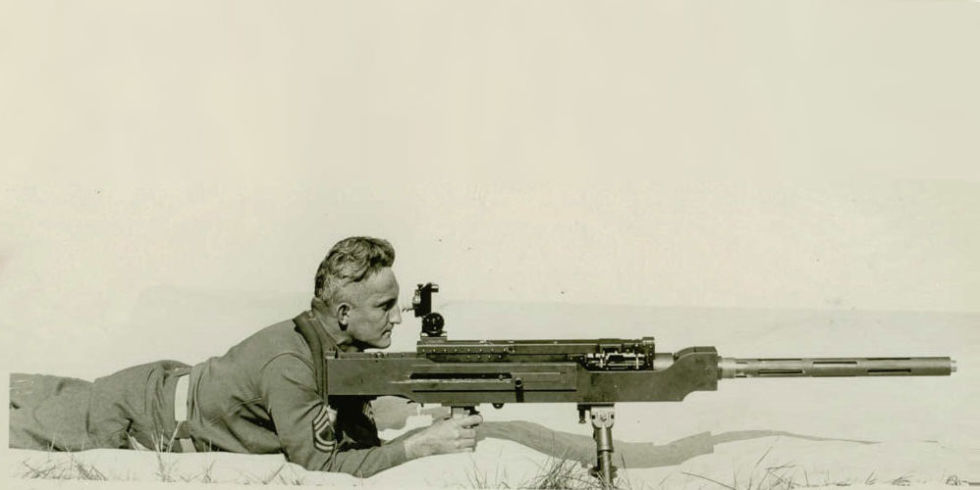
Experiment on making the M2 Browning to become a man portable anti-armour rifle

Photo from Springfield Armory, October 9, 1936. Tech Sgt Lamar with an experimental conversion of the M2.
Modified Browning M2 with semiauto trigger, 36″ barrel, and T3 optical sight (photo: Goldsmith)
Final version of the Anti-Mechanization Weapon, with 45″ barrel in firing position. (photo: Goldsmith)


Thursday, October 31, 2013

Thursday, June 20, 2013

The 105mm Gun T8 was a proposed battlefield towed-artillery system for the United States Army

Developed during World War 2 - the peak of towed artillery usage - the T8 was intended to provide years of service as a battlefield stalwart in assistance to United States Army forces. Unfortunately for the system, the war all but over by 1946 - just as the T8 was entering trials in February of that year. With the world decompressing from a wartime atmosphere, the T8 fell along the wayside with a complete project cancellation after only seeing two pilot units produced.

The 105mm Gun T8 was intended to provide a much needed anti-tank punch to American ground forces, an element capitalized on by German and Soviet army units in World war 2.


The T8 featured two synthetic rubber road wheels on a split carriage, a sloped front facing armor for general crew protection and a 65 caliber barrel length with identifying muzzle deflector. The breech was of a vertical block type. Projectiles for the T8 would have been 39lb armor piercing types that the system could lob at targets a distance of some 1,000 yards away. Weighing in at approximately 8 tons, the 105mm gun could be towed into position by other land systems.


Wednesday, May 22, 2013

The M56 Scorpion: a mobile anti-tank weapon for airborne troops

The M56 (sometimes called the "Scorpion") was a fully tracked 90mm gun developed in the 1950s to provide airborne troops with a mobile anti-tank weapon. As such the system was used by airborne battalions and airborne infantry tank companies in the 1960s. The M56 Scorpion was also known as the SPAT for Self-Propelled Anti-Tank. Hull construction of the M56 consisted of an all-welded and riveted aluminum. The standard 90mm main gun was closely associated with the main gun as found on the M47 Patton Tank.

The M56 Scorpion was developed in to provide airborne elements with a mobile anti-tank weapon.

One major drawback of the M56 was that the crew of the M56 was exposed to the elements, with the exception of the blast shield and a windscreen for the driver. The loader utilized a folding stage from which to stand on to reload the weapon system. Despite this complete lack of crew protection, the system was a formidable piece of mobile artillery, particularly given the fact that it would be made available to frontline airborne units. Couple that with the maximum range of the main gun set out to 1,500 meters and the benefits appear to outweigh the drawbacks. Another major drawback was in the force of the recoil of the main gun which would literally tilt the entire system up and backwards when the weapon was fired along with produce an absorbent amount of dust and smoke in the process.

The M56 had a lifespan with the United States 82nd Airborne and 101st Airborne up until the 1960's to which the system gave way to the M551 Sheridan. Despite this replacement, the M56 was in fact fielded in the Vietnam War in limited numbers, yet relegated to the fire support role. The chassis would also be featured in several less noteworthy roles including that of an APC, mortar carrier and a recoilless rifle tank.

Designation: M56 Scorpion
Classification Type: Airborne Self-Propelled Anti-Tank Gun
Contractor: Cadillac Motor Car Division of General Motors Corp - USA
Country of Origin: United States
Initial Year of Service: 1953


Tuesday, April 9, 2013

The 37mm M3 Gun

In the development stage, the US War Department, like most national militaries, first looked at foreign guns that met the weapon standards and purchased them or co-opted the desired elements into the existing system to make for a pseudo-indigenous end-product.


The 37mm Gun M3 became America's first anti-tank gun system to enter service.
Even before World War 2, the United States Army had already begun development of an anti-tank gun. The system was required to weigh less than 1,000 lbs, able to be towed by the standard jeep and field a projectile that could pierce tank armor of the then-current tank systems of the 1930's.
Two of the field guns being evaluated were the French Hotchkiss 25mm and the German Rheinmetall 37mm gun. In the 1930's, the German gun had the capability of destroying any tank in service anywhere in the world.

In January of 1937, the US Army Ordnance Department assigned the infantry branch to oversee design work. They sought a lightweight gun which could be moved about the battlefield by a crew of 4 to 6 personnel. This desire for mobility restricted use of larger-caliber guns greater than the 37mm.

The Army felt confident with the caliber, as did other armies around the globe during the 1930s (to include such types as the Swedish Bofors, Japanese type 94 and Type 1 and both Czechoslovakian vz. 34, vz. 37 guns). As such, the US military opted to go with the German 37mm design as their template, resulting in the American "M3" - a design, despite her origins in the German product, was significantly revised for American use and even used different ammunition.

The gun was manufactured by Watervliet Arsenal, New York that was founded in 1813 (and still in service today, though referred to as 'America's Cannon Factory'). The barrel was small enough to be forged as a single unit. The decision of the all important rifling became 12 right-hand twisted grooves and a single turn in 25 calibers.

The breech mechanism selected was of the vertical sliding block type. The square breech ring maintained the breech end of the barrel screwed into it. The breech ring was a solid piece with the center removed to allow the block to slide vertically up and down inside it. The vertical type was liked by the crews because the top face of the block could act as a loading tray for the shell, and the block could not jam the trail if the breech was opened at a high elevation. The breech ring and block were designed to withstand the violent rearward caused by the propellant gas pressure when the gun fired. The mechanism was made up of seven main parts: the breech ring, breech block, gearing (to open and close the breech), breech block buffer, extractors (to remove the empty cartridge), devices to limit movement and safety devices to prevent firing until the block and/or gearing was fully closed.


The carriage was built by the Rock Island Arsenal in Illinois. The arsenal started producing ordnance and other military items in the 1880's and is now the largest government-owned weapons manufacturing arsenal in the United States. The carriage was of a split-trail type with pneumatic air-filled tires allowing for better towing by a jeep.

When the gun was detached from the towing vehicle, the crew would move the gun into position for firing by hand. For stability, the wheel segment supports mounted on the axle next to the wheels could be lowered to provide a more stable firing position. They could then be raised before the gun was moved to the next firing position.

The telescopic sight and both elevation and traverse controls of 60 degrees were located along the left side of the system so the gunner could aim the weapon. The maximum elevation was +15 degrees and the maximum depression could be -15 degrees. The traverse gear had a release mechanism which allowed free movement of the barrel in case a quick traverse was needed with the normal 5-man crew.

Other than practice and dummy rounds, the primary ammunition used with the M3 were made up of three types - the M51 APC, M63 HE and M2 canister projectiles. The M51 anti-tank armor piercing capped shot shell (APC) which weighted 3.48 lbs (1.579 kg) and had steel shot with a 3-second tracer and could penetrate 2.4 inches of armor at 500 yards with a maximum range of 7,500 yards. The M63 was a "general purpose" high explosive (HE) shell weighing 3.13 lbs (1.420 kg) and having a maximum range of 12,800 yards. The explosive round was encased within a steel covering and fitted 0.85 of a pound of TNT with a BD fuse. The M2 canister anti-personnel round weighed 3.49 lbs (1.583 kg) and contained 122 lead balls.

The US Army organized the M3 within infantry anti-tank battalions. Four 37mm guns were assigned to be towed by 10-ton trucks or jeeps and twelve such guns had 10-ton trucks as their prime movers. A division fielded twenty-four guns with many of these towed by M2 halftracks. By 1942, the Army had formed its first airborne divisions and forty-four M3's were assigned to field parachute artillery. The new 10th Mountain Division had twenty-five of the 37mm guns assigned to its infantry regiments. During 1942, all Army armored divisions had a total of sixty-eight M3's in service. At the beginning of the war, the Marine Corps was committed to using the 20mm gun for the anti tank role but were furnished the newer, more effective 37mm gun within time. By 1943, the 37mm gun had become the AT weapon of choice of the Marines. 

In the Battle of Kasserine Pass of 1943 in North Africa, advanced medium and heavy tanks systems fielded by the Germans had already made the 37mm gun a marginal anti-tank weapon. The M3 did prove useful against lighter Italian armored components, however, and was effective against the smaller Renault R35 tanks throughout the Italian Campaign. Similarly, in the Pacific Theater, the Japanese Army was keen on using light tanks and the M3 proved adequate in stopping them. On Guadalcanal, US Marines and, later, the Army, used the M3 with good results against the Type 95, Type 96, and Type 97 tanks with their 12mm armor. The Japanese "bonsai" attacks - essentially suicidal front offenses - were perfect for the canister shot of the M3 and, with the system being very mobile, the gun could relatively easily be directed to fire all over the island and against mountain terrain - no Japanese Army cave or pill box was safe. At the Battle of Tarawa, Marines are known to have picked up a M3 over a five foot seawall to fire directly at Japanese bunkers.

If the M3 proved to have a limitation, it was in her rather smallish shield meant to protect the crew against incoming enemy fire. As a result, American Marines would take it upon themselves to weld additional shielding onto the M3 structure. Though this increased her operational weight, it provided priceless protection for her all-important crew. 

The M3's wartime use was exceptional and her reach made sure she would be remembered in World War 2 history. Her combat forays made for great marketing and she was introduced within the inventories of foreign nations within time including many American-allied nations in South America. Despite being phased out of service with the American Army soon after the end of World War 2, the M3 survived in a frontline role with other armies into 1970. Notable operators included the Soviet Union (via Lend-Lease), the United Kingdom, Canada and France. South American operators settling on the M3 included Bolivia, Chile, Columbia and El Salvador. Cuba also armed with the M3, as did China.

T3 was used as the prototype designation. T7 was another prototype but this fitted with a semi-automatic sliding breech. The T8 was yet another prototype but differed in fitting a Nordenfelt sliding breach. The T9 prototype was a 37mm automatic cannon that became the M4 production model. The M10 prototype became the M3 production model and sported the manual vertical block breach. The M3 designation signified the base production series family line. The M3A1 was noted for the introduction of a threaded barrel to accept an optional muzzle brake - this being introduced in 1942. The M5 was a tank-mounted version of the M3 gun with a shorter barrel and introduced in 1939. The M6 was another tank-mounted version with the original barrel length, a semi-automatic breech and introduction beginning in 1940.


Dimensions:
Overall Length: 12.86ft (3.92m)
Width: 5.28ft (1.61m)
Height: 3.15ft (0.96m)
Weight: 0.5 US Short Tons (413kg; 911lbs)


Tuesday, December 4, 2012

Carl Gustav Recoiless Rifle

The global reach of the Carl Gustav recoilless rifle emphasizes the popularity of the weapon, appearing in three major variants and in use by standard military and special forces alike for some sixty years. The system has been noted from the start for its accuracy, impressive range and firepower since appearing with the Swedish Army in 1948. The system earned its distinct name from the production facility from whence the initial rifles were produced - Carl Gustafs Stads Gevarsfaktori in Sweden - a facility now owned by Bofors.

The Carl Gustav recoiless rifle design is a popular and widely used multi-purpose weapons platform appearing with various military groups across the globe.


When introduced, the Carl Gustav was similar in most respects to weapons such as the American Bazooka, British PIAT or German Panzerschreck anti-tank weapons. The Carl Gustav was a recoilless rifle design featuring a rifled barrel which instantly differentiated itself from its contemporaries. The rifled barrel allowed for stabilization of the ammunition to occur through the barrel, negating the need for spring-loaded fins to be used once the projectile reached flight (a popular feature in other systems). This operation allowed the Carl Gustav's projectile greater range and firepower and quickly made it a favorite amongst its users.

Since its inception, the Carl Gustav went on to become a pivotal offensive arm of military forces around the globe (even seeing license-production in Japan with Sumitomo).


The M1 appeared in 1948 and was followed by the improved Carl Gustav M2 in 1964. The M3 followed decades later in 1991 and featured a host of improvements, chief among these being a reduction in overall weight in part to the replacement of internal steel components. The Carl Gustav remains in operational service in its varied forms and is a particular favorite with special forces groups including the United States Special Operations COMmand (USSOCOM) units.

The rifle can fire all types of ammunition beyond its primary anti-armor projectiles and include illumination, anti-structure, smoke, practice and anti-personnel (flechette) projectiles.


A crew of two is required for optimal service though the simplicity of the system allows for a single operator/firer at the cost of rate of fire. Optical, laser rangefinder and image intensification sights (along with the standard iron sights) can be mounted and greatly improve the weapon for a variety of specialty roles as needed. Ammunition is reloaded through a hinged breech on the side of the tube. The basic main tube features a pistol grip, a forward grip, shoulder strap and optional bipod along with standard iron sights.


Variants
M1 - Production beginning 1946; entered Swedish Army service in 1948.
M2 - Appeared in 1964; "improved" M1 model.
M3 - Appeared in 1991; reduced overall weight; alloy/plastic construction replacing steel components; reinforced outer sleeve.
M3 MAAWS - US Special Forces Designation of Carl Gustav M3 model.
Panzerfaust Carl Gustaf / Leuchtbuchse 84mm - German designation.
Sumitomo FT-84 - Japanese license-production Carl Gustav designation.


Specifications for the Carl Gustav

Action: Hinged Breech; Percussion Firing Mechanism
Cartridge: 84mm / 8.4cm
Feed System: 1
Cyclic Rate-of-Fire: 6rds/min
Overall Length: 1130mm (44.49in)


Monday, March 5, 2012

Mauser 1918 T-Gewehr


The Mauser 13 mm anti-tank rifle (German: Tankgewehr M1918, usually abbreviated T-Gewehr) was the world's first anti-tank rifle,i.e. the first rifle designed for the sole purpose of destroying armored targets and the only anti-tank rifle to see service in World War 1. Approximately 15,800 were produced


It was a German weapon of World War I, appearing in February 1918. The Mauser Company began mass production at Oberndorf am Neckar in May 1918. The first of these off the production lines were issued to specially raised anti-tank detachments. The idea of using heavy calibre and high velocity rifles as anti-tank weapons originated in Germany. In June 1917, the German Army faced the menace of the Mark IV tank, and found that the armour-piercing 7.92 mm K bullet was no longer effective.


The rifle was a single shot bolt action rifle using the Mauser action, with rounds manually loaded into the chamber. The weapon had a pistol grip, bipod but no method of reducing the recoil such as a soft buttpad or muzzle brake. The iron sights were a front blade and tangent rear, graduated in 100 meter increments from 100 to 500 meters. The rifle was operated by a two-man crew of a gunner and ammunition bearer, who were both trained to fire the weapon. The high recoil of the rifle was very hard on the firer, sometimes breaking the collar bone or dislocating the shoulder.

The armour piercing hardened steel cored 13.2 x 92mm (.525-inch) semi-rimmed cartridge, often simply called "13 mm", was originally planned for a new, heavy Maxim MG.18 water-cooled machine gun, the Tank und Flieger (TuF) meaning for use against "tank and aircraft", which was under development and to be fielded in 1919. The round’s weighed 51.5g (795gn)with an initial velocity of 780m/sec (2,650ft/sec).

Wednesday, February 8, 2012

106mm Self-propelled Rifle M50A1 Ontos


106mm Self-propelled Rifle M50A1 Ontos


The impressive-looking M50 Ontos (in the Greek meaning "The Thing") was built to a United States Marine Corps tank destroyer specification. With five prototypes built, and each fitted with differing calibers of recoilless rifles, the T156 design was born. No fewer than 24 of the type were ordered for further trials, each armed with six of the powerful 106mm recoilless rifle type. From the T156 trials emerged the T156E2 which gave rise to the production M50 - each slightly modified from the predecessor. A switch to a Chrysler-based petrol engine produced 294 models of the M50A1 series, which in itself included evermore modifications to the system.

At it's core, the M56 was fitted with a common turret mounting six of the M40A1C recoilless rifles. Additionally, the top four 106mm mounts were fitted with 4 x 12.7mm (.50 caliber) heavy machine guns to act as spotters when aligning the main guns. The use of the spotting machine guns was directly after optical sighting was completed. The spotter machine guns were then fired to accurize contact. Shortly thereafter, the recoilless rifles could be fired with some degree of accuracy.

Photo of an Ontos at the National Museum of the Marine Corps taken in August 2007.


All weapon systems on the M50 were limited in ammunition-carrying capacities. The 106mm recoilless rifles were limited to just 18 projectiles spread across the six guns. The 12.7mm spotting machine guns were limited to just 80 rounds of ammunition. Not to be left high and dry against advancing enemy infantrymen, an additional 7.62mm machine gun was mounted to the top of the turret for self-defense.

Besides the limited ammunition situation, crew quarters once inside the machine were cramped at best. Additionally the weapon systems could only be reloaded from outside the vehicle, exposing the crew to dangerous enemy fire. The system saw action in South Vietnam and in the hands of the United States Marines. No longer in service with the Marine Corps, no replacement vehicle was selected to succeed the M50 Ontos on the modern battlefield, the assumption being that other weapon systems are more likely up to the task of tank destroyer than a similar self-propelled recoilless rifle design like the Ontos.

Tuesday, January 31, 2012

The Solothurn S-18/1000 20 mm Anti-Tank rifle


The Solothurn S-18/1000 20 mm Anti-Tank rifle was a Swiss and German anti-tank rifle used during the Second World War. It was a variant of the earlier S-18/100 with modifications for a higher muzzle velocity, as well as a larger cartridge size. As a result of its large, powerful ammunition the gun had a tremendous recoil, and its size made portability difficult.

German Soldier on the Russian Front


The Solothurn firearms company was owned by the German firm Rheinmetall, who used the Swiss company to manufacture arms which were prohibited for manufacture by any German firm under arms limitations imposed at the end of the First World War.

German Soldier on the Russian Front observing enemy armour


In 1940–1941 the US Army considered adopting the Solothurn S-18/1000. The weapon was standardized for limited procurement as 20mm automatic gun T3. In spring 1941 the Solothurn was tested against the .90-cal. T4 automatic gun. Although less powerful, the Solothurn was also less bulky and complicated and was found more suitable for Army use. The plans were to acquire an order of 50 pieces and later to produce the weapon in the US. However, long contract negotiations resulted in abandonment of the planned purchase.

Friday, December 16, 2011

Anti-tank rifles by Finnish and British designers in WW2


Lahti L-39 Anti-Tank Rifle

The Lahti L-39 was a large Finnish anti-tank rifle used in the World War 2 engagements against the Soviet Union, earning itself the nickname of Elephant Gun.


The Lahti L-39 was an indigenous Finnish 20mm anti-tank rifle design used during the "Winter War" of World War 2. The system was designed in 1939 and produced in some 1,900 examples by the end of her run, expanding to include the fully-automatic L-39/44 anti-aircraft variant. For a time, the weapon proved effective in combating Soviet armor head-on but as armor protection on new Soviet tanks soon increased, the Lahti L-39 was relegated to other - though still useful - battlefield roles as necessary.


Two schools of anti-tank thought had ultimately developed in Finland. On one side there were those believing in the effectiveness of the smaller 13mm cartridge tied to a fast-firing machine gun-type action, providing better penetration value via higher muzzle-velocity. On the other side there stood those believing in a larger-caliber 20mm rifle. Though slower-firing, the 20mm shell inherently held sufficient benefits in being able to penetrate the then known armor thicknesses of enemy tanks. Finnish patriot Aimo Johannes Lahti (1896-1970), the self-educated weapons designer, attempted to settle the debate - he himself favoring the larger 20mm projectile weapon. Lahti set forth to design both a 13.2mm anti-tank machine gun and a 20mm anti-tank rifle. Evaluation would soon enough reveal the 20mm cartridge to be the way of things.

By the time of the Winter War - the Soviet invasion of Finland - anti-tank weaponry for the Finns was in desperately short supply with only a few 20mm and some 13.2mm weapons in circulation. The 13.2mm breed was quickly found to be useless against even the base Soviet armor. Though these 13.2mm systems offered up their high rate-of-fire, the projectiles did little in the way of penetrating armor. Those 20mm systems that were in use, however, delivered much better results. As such, a priority on 20mm anti-tank weapons was put in motion and Amios Lahti ultimately produced his memorable L-39.

The L-39 maintained a most unique external appearance. The operator was braced by a curved padded shoulder piece. The pistol grip and trigger group were set aft of the receiver. The massive curved box magazine was fitted to the top of the receiver. To the forward portion of the weapon was supported by a decidedly Finnish bipod sporting ski-type implements - suitable for winter weather conflict. The barrel extruded out at length and sported noticeable cooling vents akin to a pepper shaker. The 20mm cartridge of choice became the 20x138mm "Solothum Long" to be fired from a 10-round detachable box magazine. Muzzle velocity was listed at 2,600 feet per second and the firing action was semi-automatic. The weapon weighed in at an astonishing 109lbs with an overall length of 88 inches, 51.2 inches of this made up by the barrel. The L-39 carried the appropriate nickname of "Norsupyssy" (meaning "Elephant Gun").

In practice, the Lahti L-39 proved quite effective at the outset. Perhaps moreso adding to its legacy was the fact that the L-39 was equally adept at engaging just about any type of Soviet target under the Finland sun - be they armored or unarmored. The L-39 was used against bunker emplacements, low-flying enemy aircraft and enemy troops including other enemy sniper teams. A fully-automatic variant - the L-39/44 - was introduced in 1944 in limited quantity to serve as a dedicated anti-aircraft weapon system - seeing service even after World War 2. At any rate, the long-range hitting power and penetration values were a godsend for the defense of the Finnish frontier.

L-39 gun teams also took to targeting certain vulnerable parts of tanks if their cartridge was not able to penetrate the armor directly. This proved the case with the arrival of the heavier T-34 and KV-1 tanks to come. Thick armor proved the Soviet modus operandi until the end of the war and such armor essentially dwindled the L-39's reach to an extent. Additionally, the large weapon system was cumbersome to deploy and relocate with any sense of efficiency and were often left to the enemy when positions were overrun.

Though never receiving much in the way of support from the Allies, the outnumbered Finns (3-to-1) utilized what they had - a special combination of weapons and winter tactics - against the ill-trained Soviet soldier. The result became several notable early victories against the mighty Red Army, sometimes resulting in the decimation of entire army groups and the capturing of Soviet armor, weapons and ammunition. Though Finland eventually capitulated on March 12th, 1940, with the signing of the Moscow Peace Treaty the damage was ultimately done - some 126,875 Soviet personnel were killed or went missing while a further 264,908 were wounded. In contrast, the Finns suffered 25,904 dead or missing and a further 43,557 wounded. Finland lost out on 11% of its pre-war territory and over a quarter of her economic power. Her resistance, however, kept the Soviet Union from claiming complete control over all of Finland - delivering an international black eye to the Communist powerhouse. In the "Continuation War" still to come, Finland would once again take up arms against the Soviet Union - this time with material support from Germany and Italy at a time when Germany and the Soviet Union were now fully at war with one another.

Specifications for the Lahti L-39
Operation:
Action: Semi-Automatic
Cartridge: 20x138B Long Solothum
Feed System: 10-round detachable box
Muzzle Velocity: 2,600ft/sec (792m/sec)
Cyclic Rate-of-Fire: 30rds/min
Sights: Iron Sights

Dimensions:
Overall Length: 2200mm (86.61in)
Barrel Length: 1,300.00 (51.18in)
Empty Weight: 49.50kg (109.13lbs)


Boys Anti-Tank Rifle (Stanchion) Anti-Tank Rifle

The Boys Anti-Tank rifle proved to be of some value, particularly against the early tank designs of the World War 2.

In 1934 the British Army issued a requirement for a light anti tank weapon. The designer of the heavy rifle was Captain Boys, a designer at the Royal Small Arms Factory, Enfield. For security reasons it was initially given a code-name 'Stanchion' but was later renamed after its designer.


Good progress was made and tests were encouraging with penetration of 1" (25mm) in armor plate. The Boys rifle was an oversized scale version of a service rifle that would be able to shoot a large round that an average soldier could be expected to hold and fire. This was made easier with a spring absorber using a muzzle brake and a front support monopod - later a bipod was added. Both models were bolt-action and used a detachable top-loading 5-round magazine. The first model had a double sight for 300 yards and 500 yards while the later models only had a fixed sight.


The weapon was introduced to the British infantry in 1937, however tank design had improved and with the outbreak of war it was clear the Boys was going to be limited in its use. In the early stages of World War 2, the Boys did prove effective against light armored German tanks and combat vehicles. The weapon was especially popular with Finnish Army troops in Finland in 1940 during the Winter War against the Soviet Union, as the rifle proved capable of knocking out the Soviet T-26 tanks encountered.

A shortened version was issued in 1942 for airborne forces and saw action in Tunisia, where it was proven ineffective due to the reduced velocity inherent with the shortened barrel. When used in roles against bunkers, machine gun nests, and light-skinned vehicles the Boys rifle truly found its success. In the Pacific Theater, the Boys was used effectively against light Japanese tanks and remained in the British inventory for use throughout that theater.

Most troops disliked the weapon due to the massive recoil along with the noise and a heavy muzzle blast causing bruised necks and shoulders. The weapon was not one of choice with numerous small screws in soft steel that made maintenance difficult in the field. Nevertheless, the weapon system saw continued use throughout the British Commonwealth along with a few samples falling into the hands of German and Japanese troops to be used against their owners.

Specifications for the Boys Anti-Tank Rifle (Stanchion)
Operation:
Action: Bolt-Action
Cartridge: 0.55 in
Feed System: 5-round detachable box magazine
Cyclic Rate-of-Fire: 10rds/min

Dimensions:
Overall Length: 1613mm (63.50in)
Barrel Length: 0.00 (0.00in)
Empty Weight: 16.00kg (35.27lbs)
NANG THIS POST, NANG THIS POST, NANG THIS POST

LinkWithin

Related Posts with Thumbnails