
Showing posts with label Artillery. Show all posts
Showing posts with label Artillery. Show all posts
Tuesday, February 9, 2016
Monday, July 6, 2015

Wednesday, June 24, 2015

Wednesday, May 20, 2015

Wednesday, May 13, 2015
WWII German 12.8cm Flak 40 Zwilling
 The 12.8 cm Flak 40 was a German anti-aircraft gun used during World War II, most famously in the Flakturms around some of the major cities in Germany including of course Berlin.
Although this gun was intended to replace the 88 mm gun it was unsuccessful in it’s bid for major production numbers but remained one of the most effective anti-aircraft guns of the war. This twin mount cannon 12.8 cm FlaK 40 Zwilling Twin mounted anti-aircraft was capable of firing 20 rounds per minute. Production started in 1942 with 10 twin sets produced, then another eight in 1943 and in February 1945 a total of 34 were available for the German forces.
%5B1%5D.jpg)
AA versions firing a shell 26 kg with an initial velocity of 880 m / s 10 675m, compared to 88; 128 used 4 times more powder to initiate the explosive charge. The AT versions firing a shell of 26.4 kilograms could penetrate 200 mm of armour at close range, 120 mm at 2,000 m.
%5B1%5D.jpg) |
%5B1%5D.jpg)


Tuesday, May 12, 2015

Thursday, May 29, 2014
D-20 152mm Howitzer (Also: M1955)
The M1955 was developed in the 1950s to late to be deployed in the Great Patriotic War 1939-1945. However this howitzer has shown reliability and power in numerous wars deployed by scores of nations. The Soviet Union design bureau awarded the contract to Petrov Artillery and the M1955 was built in Yekaterinburg a city in central Russia used in WW II to relocate many heavy factories and many stayed after the war.

The D 20 was placed on an existing carriage used by the D 74 and was a common practice used by the Soviets. The gun proved to be well designed and rugged enough during field trails. An 8 man crew was needed to man the howitzer an AT-S medium tractor was used for towing along with the URAL-375 6x6 heavy truck. The Russian government still uses the M1955/D20 and still field about 1,000 guns in their arsenal. An initiative development was a semiautomatic vertical sliding wedge breech block.

The major copy was from The Peoples Republic of China that produced the Type 66. This variant has been shipped all around the globe. Type 66 was made with few changes making most Soviet parts interchangeable along with using all types of 152 mm ammunition. The barrel was 5.195 m (17ft 0.5 in) long using a double baffle muzzle to reduce the recoil. A shield was mounted to protect the breach and recoil mechanism. The crew also was protected to some degree. A firing pedestal was lowered to the grown before firing and the split tail carriage was also rested on the pedestal, this allowed a full 360 degrees traverse.
The main projectile used by the howitzer was the HE-FRAG that weighted 95.92 lbs which led to the sustained rate of fire to 1 rpm. Special types included an AP shell 107.54 kg that would penetrate 124 mm (4.88 in) of armor at 1,000 m (1,095 yards). Smoke and illuminating projectiles are available along with a shell contained flechettes for use against infantry and another that spread anti personnel mines in flight.

A rate of 5 to 6 rounds-per-minute can be achieved with 1 round-per-minute in the sustained firing role. Range for an HE-FRAG projectile is reported at 19,040 yards while a rocket-assisted projectile can land within 26,245 yards. Elevation of the barrel is -5 degrees to +65 degrees with a traverse of 58 degrees.

Specifications:
Overall Length: 26.57ft (8.10m)
Width: 7.71ft (2.35m)
Height: 8.27ft (2.52m)
Crew: 8
Weight: 6.3 US Short Tons (5,700kg; 12,566lbs)
Armament: 152mm Main Gun
AMMUNITION: Varies. Typical 152mm ammunition type is Frag-HE, OF32.
Maximum Range: 10,818 miles (17,410 km)

The D 20 was placed on an existing carriage used by the D 74 and was a common practice used by the Soviets. The gun proved to be well designed and rugged enough during field trails. An 8 man crew was needed to man the howitzer an AT-S medium tractor was used for towing along with the URAL-375 6x6 heavy truck. The Russian government still uses the M1955/D20 and still field about 1,000 guns in their arsenal. An initiative development was a semiautomatic vertical sliding wedge breech block.
The major copy was from The Peoples Republic of China that produced the Type 66. This variant has been shipped all around the globe. Type 66 was made with few changes making most Soviet parts interchangeable along with using all types of 152 mm ammunition. The barrel was 5.195 m (17ft 0.5 in) long using a double baffle muzzle to reduce the recoil. A shield was mounted to protect the breach and recoil mechanism. The crew also was protected to some degree. A firing pedestal was lowered to the grown before firing and the split tail carriage was also rested on the pedestal, this allowed a full 360 degrees traverse.
 |
| Serbian Army Nora 152mm howitzer |
A rate of 5 to 6 rounds-per-minute can be achieved with 1 round-per-minute in the sustained firing role. Range for an HE-FRAG projectile is reported at 19,040 yards while a rocket-assisted projectile can land within 26,245 yards. Elevation of the barrel is -5 degrees to +65 degrees with a traverse of 58 degrees.
Specifications:
Overall Length: 26.57ft (8.10m)
Width: 7.71ft (2.35m)
Height: 8.27ft (2.52m)
Crew: 8
Weight: 6.3 US Short Tons (5,700kg; 12,566lbs)
Armament: 152mm Main Gun
AMMUNITION: Varies. Typical 152mm ammunition type is Frag-HE, OF32.
Maximum Range: 10,818 miles (17,410 km)
Friday, November 15, 2013
Thursday, November 14, 2013
Wednesday, August 28, 2013
PzH 2000 155mm Self-Propelled Artillery
The PzH 2000 (Panzerhaubitze 2000) is the 155mm self-propelled howitzer developed by Krauss-Maffei Wegmann (KMW) together with the main subcontractor Rheinmetall Landsysteme for the German Army.

KMW received a contract in 1996 for production of 185 units. The first system was delivered in July 1998 and deliveries for this batch are complete. Rheinmetall (formerly MaK) delivers the complete chassis for all series vehicles.
In May 2001, during test firings for the Hellenic Army, the PzH 2000 fired 20 rounds all to ranges exceeding 40km (41.8km maximum). The ranges were achieved using M2000BB Assegai shells from Naschem / Denel of South Africa, in combination with the Rheinmetall DM 72 modular charge system. In November 2002, in live firings in Sweden, a similar range was achieved with Rheinmetall's new long-range RH 40 BB ammunition, also fired with the modular charge system.

A PzH 2000 howitzer turret has been mounted on the deck of German Navy F124 frigate, Hamburg, as a demonstration of the feasibility of the system for naval applications. The concept is called MONARC and requires a flexible elastic mounting.
PzH 2000 howitzer orders and deliveries
Total German Army requirement has been reduced from around 450 units to 260. PzH 2000 has also been selected by the Italian, Dutch and Greek Armies. The Greek Army has 24 systems, delivered between July 2003 and June 2004.

A German / Italian co-production programme with Consorzio Iveco-Oto Melara is providing the 70 units for the Italian Army. KMW delivered two units in 2002. First deliveries of the remaining 68 from Consorzio Iveco-Oto Melara took place in May 2007. The system entered service with the Italian Army in June 2007 and achieved initial operating capability in October 2008. Final deliveries are scheduled for 2009.

The Dutch army signed a contract for the procurement of for 57 units, later reduced to 39 units and deliveries are underway. The surplus 18 units (not yet built) were offered to the Australian Army but were declined.

In September 2006, the PZH 2000 completed its first live-fire combat mission with the Dutch Army in Afghanistan, as part of Operation Medusa. In operations against the Taliban, three PZH 2000 provided fire support at a range of more than 30km.
PzH 2000 155mm L52 howitzer gun
The electrical gun control system, supplied by ESW Extel Systems Wedel, comprises the automatic elevating and traversing drives with semi-automatic back-up, direct laying with electrical instrument control and manual control.

The 155mm L52 gun of the PzH 2000 was developed by Rheinmetall DeTec. The barrel length is 52 calibre and chamber volume is 23l. The gun has a chromium-plated barrel and semi-automatic lifting breech block with integrated 32-round standard primer magazine.

Gun parameters such as chamber temperature are monitored automatically. The PzH 2000 is equipped with a fully automatic shell loading system with ammunition management system.

The chromium-plated barrel is 8m long and is fitted with a slotted muzzle brake which gives increased muzzle velocity and reduces the level of muzzle flash.
The wedge-type breech block is integrated with an exchangeable primer magazine fitted with an endless conveyer for automatic primer transportation, loading and unloading.
Rheinmetall DeTec has also developed a six-zone modular propelling charge system (MTLS), the DM72, which provides for faster handling, less wear on the gun, lower sensitivity to ignition hazards and improved range. In the PzH 2000, up to six MTLS modules form the propelling charge. The maximum range of the L52 gun using the maximum MTLS charges is 30km with the standard L15A2 round and up to 40km with assisted projectiles.

The gun positioning and laying system is produced by Honeywell Maintal and mounted on the gun cradle. The system automatically determines gun direction, position and elevation above sea level. The integrated global positioning system (GPS) receiver and the vehicle's motor sensors form the hybrid navigation system of the PzH 2000.
Automatic shell-loading system
The PzH 2000 automatic shell-loading system can handle 60 rounds of 155mm ammunition. The shells are picked up from the back of the vehicle and automatically stowed in the 60-round magazine in the centre of the chassis.

The shell-loading system is driven by brushless electric servo motors supplied by MOOG. The automatic shell loading system has pneumatically driven flick rammer and automatic digital control, ammunition supply management and inductive fuze setting.
This provides rates of fire of three rounds in under ten seconds and loading of 60 shells by two operators within 12 minutes, including the collation of ammunition data.
The firing rate of the PzH 2000 was 12 rounds in 59.74 seconds, and 20 rounds in one minute 47 seconds, during firing tests in October 1997 with an improved autoloader. The muzzle velocity is determined automatically by means of a radar sensor and is used in the fire control computation.
Fire control and observation
The PzH 2000 can use an automatic mode of operation including the data radio link with an external command and control system. The autonomous fire control functions are controlled by an on-board MICMOS computer supplied by EADS (formerly DaimlerChrysler Aerospace). Using the automatic mode, target engagements can be carried out by a crew of two. Using the fire control data provided by the ballistics computer, the gun is automatically laid and relayed during the mission.
Various backup modes are available which guarrantee system sustainability in case of a component failure. As the lowest backup mode, an optical mechanical backup sytem is available.
The commander has a Leica PERI-RTNL 80 panoramic periscope, which is used in under-armour operations and for target designation in direct laying engagements. PERI-RTNL 80 has day and night vision channels and a laser rangefinder. The gunner is equipped with a Leica PzF TN 80 day and night direct fire sight for direct laying of the gun.
Propulsion
The 736kW powerpack of the PzH 2000 is mounted at the front of the hull and consists of an eight-cylinder direct-injection, supercharged MTU MT881 Ka-500 diesel engine with a four-speed Renk HSWL 284 C gearbox. Three fuel tanks provide a 420km cruise range.

KMW received a contract in 1996 for production of 185 units. The first system was delivered in July 1998 and deliveries for this batch are complete. Rheinmetall (formerly MaK) delivers the complete chassis for all series vehicles.
In May 2001, during test firings for the Hellenic Army, the PzH 2000 fired 20 rounds all to ranges exceeding 40km (41.8km maximum). The ranges were achieved using M2000BB Assegai shells from Naschem / Denel of South Africa, in combination with the Rheinmetall DM 72 modular charge system. In November 2002, in live firings in Sweden, a similar range was achieved with Rheinmetall's new long-range RH 40 BB ammunition, also fired with the modular charge system.

A PzH 2000 howitzer turret has been mounted on the deck of German Navy F124 frigate, Hamburg, as a demonstration of the feasibility of the system for naval applications. The concept is called MONARC and requires a flexible elastic mounting.
PzH 2000 howitzer orders and deliveries
Total German Army requirement has been reduced from around 450 units to 260. PzH 2000 has also been selected by the Italian, Dutch and Greek Armies. The Greek Army has 24 systems, delivered between July 2003 and June 2004.

A German / Italian co-production programme with Consorzio Iveco-Oto Melara is providing the 70 units for the Italian Army. KMW delivered two units in 2002. First deliveries of the remaining 68 from Consorzio Iveco-Oto Melara took place in May 2007. The system entered service with the Italian Army in June 2007 and achieved initial operating capability in October 2008. Final deliveries are scheduled for 2009.

The Dutch army signed a contract for the procurement of for 57 units, later reduced to 39 units and deliveries are underway. The surplus 18 units (not yet built) were offered to the Australian Army but were declined.

In September 2006, the PZH 2000 completed its first live-fire combat mission with the Dutch Army in Afghanistan, as part of Operation Medusa. In operations against the Taliban, three PZH 2000 provided fire support at a range of more than 30km.
PzH 2000 155mm L52 howitzer gun
The electrical gun control system, supplied by ESW Extel Systems Wedel, comprises the automatic elevating and traversing drives with semi-automatic back-up, direct laying with electrical instrument control and manual control.

The 155mm L52 gun of the PzH 2000 was developed by Rheinmetall DeTec. The barrel length is 52 calibre and chamber volume is 23l. The gun has a chromium-plated barrel and semi-automatic lifting breech block with integrated 32-round standard primer magazine.

Gun parameters such as chamber temperature are monitored automatically. The PzH 2000 is equipped with a fully automatic shell loading system with ammunition management system.

The chromium-plated barrel is 8m long and is fitted with a slotted muzzle brake which gives increased muzzle velocity and reduces the level of muzzle flash.
The wedge-type breech block is integrated with an exchangeable primer magazine fitted with an endless conveyer for automatic primer transportation, loading and unloading.
Rheinmetall DeTec has also developed a six-zone modular propelling charge system (MTLS), the DM72, which provides for faster handling, less wear on the gun, lower sensitivity to ignition hazards and improved range. In the PzH 2000, up to six MTLS modules form the propelling charge. The maximum range of the L52 gun using the maximum MTLS charges is 30km with the standard L15A2 round and up to 40km with assisted projectiles.

The gun positioning and laying system is produced by Honeywell Maintal and mounted on the gun cradle. The system automatically determines gun direction, position and elevation above sea level. The integrated global positioning system (GPS) receiver and the vehicle's motor sensors form the hybrid navigation system of the PzH 2000.
Automatic shell-loading system
The PzH 2000 automatic shell-loading system can handle 60 rounds of 155mm ammunition. The shells are picked up from the back of the vehicle and automatically stowed in the 60-round magazine in the centre of the chassis.

The shell-loading system is driven by brushless electric servo motors supplied by MOOG. The automatic shell loading system has pneumatically driven flick rammer and automatic digital control, ammunition supply management and inductive fuze setting.
This provides rates of fire of three rounds in under ten seconds and loading of 60 shells by two operators within 12 minutes, including the collation of ammunition data.
The firing rate of the PzH 2000 was 12 rounds in 59.74 seconds, and 20 rounds in one minute 47 seconds, during firing tests in October 1997 with an improved autoloader. The muzzle velocity is determined automatically by means of a radar sensor and is used in the fire control computation.
Fire control and observation
The PzH 2000 can use an automatic mode of operation including the data radio link with an external command and control system. The autonomous fire control functions are controlled by an on-board MICMOS computer supplied by EADS (formerly DaimlerChrysler Aerospace). Using the automatic mode, target engagements can be carried out by a crew of two. Using the fire control data provided by the ballistics computer, the gun is automatically laid and relayed during the mission.
Various backup modes are available which guarrantee system sustainability in case of a component failure. As the lowest backup mode, an optical mechanical backup sytem is available.
The commander has a Leica PERI-RTNL 80 panoramic periscope, which is used in under-armour operations and for target designation in direct laying engagements. PERI-RTNL 80 has day and night vision channels and a laser rangefinder. The gunner is equipped with a Leica PzF TN 80 day and night direct fire sight for direct laying of the gun.
Propulsion
The 736kW powerpack of the PzH 2000 is mounted at the front of the hull and consists of an eight-cylinder direct-injection, supercharged MTU MT881 Ka-500 diesel engine with a four-speed Renk HSWL 284 C gearbox. Three fuel tanks provide a 420km cruise range.
Monday, July 8, 2013
S-23 Cannon
The S-23 was a heavy gun to be used in Europe if the Cold War got hot.
It was available to Soviet allies and operations were trained by the
members of the Soviet army. This massive weapon uses a 16 man crew and
is towed by an AT-T heavy-tracked tractor which also carriers the crew
their supplies and some ammunition. This ammo was large and heavy, the
HE round is 84.09kg (185.4 lbs) and the concrete piercing round weighs
97.7 kg (215.4 lbs). The gun was also available to shoot a 0.2kt
nuclear projectile.
A Soviet Army heavy artillery brigade had 12 S-23 weapons; the amount of fire power was staggering along with 155mm and 130 mm artillery howitzers in the division.
The S-23 had an 8.8 m (28 ft 10.46 in) barrel. To reduce the overall length the barrel could be moved and linked to the trailing double wheel carriage. The carriage was a standard split type with two twin rubber tires in front and a dolly in the rear, also with two rubber tires.
Rate of fire was 1 round per minute and 1 round per 2 minutes of sustained fire. The effective range of an HE projectile was a reported 30,400 meters (33,245 yards) while a rocket-assisted projectile could reach within 43,800 meters (47,900 yards).
 |
| When paired with other Soviet artillery weapons, the S-23 would have added a ferocious punch to an already intimidating barrage. |
A Soviet Army heavy artillery brigade had 12 S-23 weapons; the amount of fire power was staggering along with 155mm and 130 mm artillery howitzers in the division.
The S-23 had an 8.8 m (28 ft 10.46 in) barrel. To reduce the overall length the barrel could be moved and linked to the trailing double wheel carriage. The carriage was a standard split type with two twin rubber tires in front and a dolly in the rear, also with two rubber tires.
Rate of fire was 1 round per minute and 1 round per 2 minutes of sustained fire. The effective range of an HE projectile was a reported 30,400 meters (33,245 yards) while a rocket-assisted projectile could reach within 43,800 meters (47,900 yards).
Thursday, June 20, 2013
The 105mm Gun T8 was a proposed battlefield towed-artillery system for the United States Army
Developed during World War 2 - the peak of towed
artillery usage - the T8 was intended to provide years of service as a
battlefield stalwart in assistance to United States Army forces.
Unfortunately for the system, the war all but over by 1946 - just as the
T8 was entering trials in February of that year. With the world
decompressing from a wartime atmosphere, the T8 fell along the wayside
with a complete project cancellation after only seeing two pilot units
produced.
The T8 featured two synthetic rubber road wheels on a split carriage, a sloped front facing armor for general crew protection and a 65 caliber barrel length with identifying muzzle deflector. The breech was of a vertical block type. Projectiles for the T8 would have been 39lb armor piercing types that the system could lob at targets a distance of some 1,000 yards away. Weighing in at approximately 8 tons, the 105mm gun could be towed into position by other land systems.
 |
| The 105mm Gun T8 was intended to provide a much needed anti-tank punch to American ground forces, an element capitalized on by German and Soviet army units in World war 2. |
The T8 featured two synthetic rubber road wheels on a split carriage, a sloped front facing armor for general crew protection and a 65 caliber barrel length with identifying muzzle deflector. The breech was of a vertical block type. Projectiles for the T8 would have been 39lb armor piercing types that the system could lob at targets a distance of some 1,000 yards away. Weighing in at approximately 8 tons, the 105mm gun could be towed into position by other land systems.
Wednesday, February 6, 2013
D 20
The M1955 was developed in the 1950s to late to be deployed in the Great Patriotic War 1939-1945. However this howitzer has shown reliability and power in numerous wars deployed by scores of nations. The Soviet Union design bureau awarded the contract to Petrov Artillery and the M1955 was built in Yekaterinburg a city in central Russia used in WW II to relocate many heavy factories and many stayed after the war.
The D 20 was placed on an existing carriage used by the D 74 and was a common practice used by the Soviets. The gun proved to be well designed and rugged enough during field trails. An 8 man crew was needed to man the howitzer an AT-S medium tractor was used for towing along with the URAL-375 6x6 heavy truck. The Russian government still uses the M1955/D20 and still field about 1,000 guns in their arsenal. An initiative development was a semiautomatic vertical sliding wedge breech block.
The major copy was from The Peoples Republic of China that produced the Type 66. This variant has been shipped all around the globe. Type 66 was made with few changes making most Soviet parts interchangeable along with using all types of 152 mm ammunition. The barrel was 5.195 m (17ft 0.5 in) long using a double baffle muzzle to reduce the recoil. A shield was mounted to protect the breach and recoil mechanism. The crew also was protected to some degree. A firing pedestal was lowered to the grown before firing and the split tail carriage was also rested on the pedestal, this allowed a full 360 degrees traverse.
The main projectile used by the howitzer was the HE-FRAG that weighted 95.92 lbs which led to the sustained rate of fire to 1 rpm. Special types included an AP shell 107.54 kg that would penetrate 124 mm (4.88 in) of armor at 1,000 m (1,095 yards). Smoke and illuminating projectiles are available along with a shell contained flechettes for use against infantry and another that spread anti personnel mines in flight.
A rate of 5 to 6 rounds-per-minute can be achieved with 1 round-per-minute in the sustained firing role. Range for an HE-FRAG projectile is reported at 19,040 yards while a rocket-assisted projectile can land within 26,245 yards. Elevation of the barrel is -5 degrees to +65 degrees with a traverse of 58 degrees.
Specifications for the D-20 (M1955)
Overall Length: 26.57ft (8.10m)
Width: 7.71ft (2.35m)
Height: 8.27ft (2.52m)
Weight: 6.3 US Short Tons (5,700kg; 12,566lbs)
Armament Suite: 1 x 152mm Main Gun
Ammunition: Varies. Typical 152mm ammunition type is Frag-HE, OF32.
 |
| The D-20 can be towed by a variety of tracked and wheeled vehicles. |
The D 20 was placed on an existing carriage used by the D 74 and was a common practice used by the Soviets. The gun proved to be well designed and rugged enough during field trails. An 8 man crew was needed to man the howitzer an AT-S medium tractor was used for towing along with the URAL-375 6x6 heavy truck. The Russian government still uses the M1955/D20 and still field about 1,000 guns in their arsenal. An initiative development was a semiautomatic vertical sliding wedge breech block.
The major copy was from The Peoples Republic of China that produced the Type 66. This variant has been shipped all around the globe. Type 66 was made with few changes making most Soviet parts interchangeable along with using all types of 152 mm ammunition. The barrel was 5.195 m (17ft 0.5 in) long using a double baffle muzzle to reduce the recoil. A shield was mounted to protect the breach and recoil mechanism. The crew also was protected to some degree. A firing pedestal was lowered to the grown before firing and the split tail carriage was also rested on the pedestal, this allowed a full 360 degrees traverse.
The main projectile used by the howitzer was the HE-FRAG that weighted 95.92 lbs which led to the sustained rate of fire to 1 rpm. Special types included an AP shell 107.54 kg that would penetrate 124 mm (4.88 in) of armor at 1,000 m (1,095 yards). Smoke and illuminating projectiles are available along with a shell contained flechettes for use against infantry and another that spread anti personnel mines in flight.
A rate of 5 to 6 rounds-per-minute can be achieved with 1 round-per-minute in the sustained firing role. Range for an HE-FRAG projectile is reported at 19,040 yards while a rocket-assisted projectile can land within 26,245 yards. Elevation of the barrel is -5 degrees to +65 degrees with a traverse of 58 degrees.
Specifications for the D-20 (M1955)
Overall Length: 26.57ft (8.10m)
Width: 7.71ft (2.35m)
Height: 8.27ft (2.52m)
Weight: 6.3 US Short Tons (5,700kg; 12,566lbs)
Armament Suite: 1 x 152mm Main Gun
Ammunition: Varies. Typical 152mm ammunition type is Frag-HE, OF32.
Monday, November 26, 2012
Dutch Bronze 6-pdr Field Gun
Field guns were increasingly used throughout much of the modern world by the time of Napoleon. The Emperor made frequent use of batteries after realizing their effect on the battlefield. Beforehand, the field artillery system was used as more of an auxiliary set piece to supplement advancing cavalry and infantry. Napoleon began fielding large quantities of artillery that would advance before the infantry and cavalry themselves. His tactic was to soften up the enemy that was usually grouped en masse, then lunge forward with his infantry or proceed with a massive cavalry charge to break the troops.
 |
| This particular 6-pdr Field Gun was captured from Napoleon at Waterloo by the Duke of Wellington. |
Field guns can in various calibers - 4-pounder, 6-pounder and 12-pounder - with the "pounder" designation directly reflecting the weight of the projectile that the system used. The weapon was usually fielded on a portable two-wheel carriage that could be draw by horse. When unhinged, the system was manned by at least six personnel in various capacities from gunner, commander and loader. The system was portable enough that the crew could turn the barrel towards a new target or even advance the weapon by pushing / pulling it to a new position.
A weapon's carriage, often referred to as a caison, would normally sit about 30 yards behind with roughly 200 rounds of ammunition along with fuses and gunpowder. The favorite projectile type during this time would have been the "solid shot".
Artillery particularly failed Napoleon at Waterloo, as the rain-soaked ground became too muddy to effectively weild his artillery to his liking. A soft ground also kept the solid shot (or round shot) from successfully ricocheting into the masses of armed infantrymen advancing on his positions. Roundshot could easily decapitate a man, or relieve him of his legs, as the cannonball could effectively bounce 2 to 3 times before coming at rest. This, in itself, was a demoralizing weapon as well as a devastating one. Crews would have to take great care as to firing the round over the heads of their own advancing infantrymen.
This particular Dutch Bronze 6-pdr Field Gun (pictured above) was constructed by L.E. Marits in the Hague when it was still under French control roughly around 1813. The gun bears the name of 'Le Achille' ('the Achilles') and was part of a captured set by the Duke of Wellington from Napoleon's forces in Waterloo in 1815. The cannon sits on a more contemporary carriage design and is available for public viewing at the Tower of London in London, England.
Thursday, September 27, 2012
M3 105mm howitzer
Designed for air transport during WWII, the M3 105mm towed light howitzer was used by the 320th Glider Field Artillery Battalion. It was originally designed in 1941 and started production in 1943.
 |
The M3 was another World War Two era mobile artillery piece. |
Barrel length measures in at 16 caliber (1.68 meters) and the breech operates out of a horizontal sliding system with recoild handled hydropneumatically. The tow carriage system is an M3A1 split-trail type and can be towed by a variety of vehicles. Elevation for the gun system is at +30 degrees and the unit can traverse plus/minus 22 degrees. Muzzle velocity is reported at 310 meters per second. The M3 105mm towed howitzer can fire a variety of munitions with the standard being the HE (High Explosive) type.
Specifications for the M3
Overall Length: 12.93ft (3.94m)
Width: 5.58ft (1.70m)
Crew: 5
Weight: 1.2 US Short Tons (1,130kg; 2,491lbs)
Armament: 1 x 105mm main gun
Tuesday, June 19, 2012
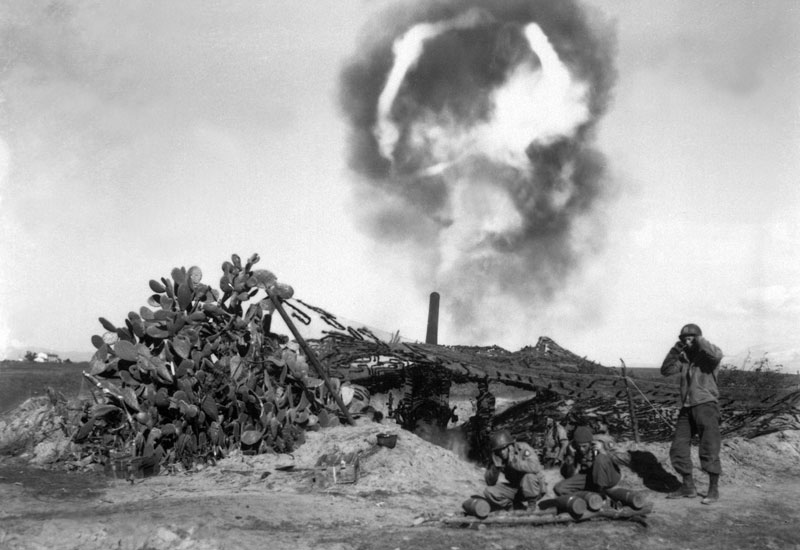
The M1/M59 Long Tom could be found in multiple theaters of war during World War 2 and saw action in Korea and Vietnam
 |
When the American military went to Europe in World War 1 in 1917 they were in short supply of just about any war-making implements including that of heavy artillery. |
One of the best of the day became the French-made Canon de 155mm GPF heavy gun. At the end of the war, General Pershing had a number of the GFP's brought back stateside to be reviewed and improved upon for use in the United States Army. American Army engineers worked on modifying the existing French-based system and, by 1926, a number of prototypes had been revealed. Work continued off and on (Army funding lacked) into the 1930's and ultimately produced a mating of the original French GFP with a new British breach system - the Asbury. The T4 gun prototype was fitted onto the T2 carriage prototype and entered service as the 155mm Gun M1 on Carriage M1. When the new gun was introduced to American troops they bestowed her with the affectionate name of "Long Tom".
 |
| The Army placed an initial quantitative order for 20 Long Toms and several arsenals began production. The main improvements to the original French design were the L/45 modified barrel mounted on the new M1 heavy-split tail carriage using the Asbury breach. |
The carriage had four double-tired road wheels mounted at the front end of the carriage, two sets to either carriage side. This placement acted as the stability point between the weight of the gun and the carriage and made the firing gun more accurate. Additional upgrades to the gun required the model designation to be changed to the "M1A1" (modified breech ring) in 1941 and, by 1944, continuing production changes ultimately birthed the "M2" designation (again, modified breech ring). The M1A1E1 became a prototype with a chromium-plated bore while the M1A1E3 was another prototype featuring liquid cooling.
The M1 Carriage was redesignated to M1A1 after undergoing a process of refurbishment.
 |
The M1/M2 shell used was a 43.1 kg (95lb. ) projectile and, when fired at a 45-degree angle, it would send a High Explosive (HE) round some 25,395 yards out - up to 15 miles away - with a high rate of accuracy. |
A qualified crew of 15 men could fire more than 40 rounds per hour consisting of high-explosive, chemical, smoke, or illuminating shell types. The gun elevation, up to 63-degrees, gave the crew a wide arc of fire.
 |
| The gun proved reliable in practice and became the standard heavy gun in the US Army arsenal. Its success was further driven home by its sales to allied nations around the globe. |
The weapon was used in large numbers during World War II, the Korean War and the Viet Nam conflict. Many nations continued to use the gun well into the 1980's. After World War II, the US Army bestowed upon the M1/M1A1/M2 the new designation of "M59" during a reorganization period.
 |
The standard tractor used for towing the M1in World War II was the M4 High-Speed Tractor which also doubled as an ammunition carrier. |
By 1942, the manufacturer Allis Chalmers produced a tracked tractor that weighted 14.2 tons but offered no armor protection for the driver. The Waukesha 6-cylinder gas engine produced 210 horsepower and 14.7 horsepower per towing ton. This vehicle gave the heavy gun a means to deploy over 290 km of territory with a maximum speed of 53 km/h. Once the M4 arrived at the firing position with the Long Tom, the crew needed about 30 minutes set up time before firing the first round. Long Tom was delivered to UK and French forces via Lend-Lease in numbers totaling 184 and 25 respectively. Her combat debut occurred in North Africa in 1943 as part of the 34th Field Artillery Battalion. She saw further actions in Europe and the Pacific and was most often times transported by way of the Mack NO 6x6 7 1/2 ton utility truck until that mode of transportation gave way to the tracked M4 mentioned above.
 |
| She provided "steel rain" along many fronts and fought on in battles during the North African campaign, against the caves on Peleliu, into the numbers of North Korea and in the jungles of Vietnam. |
The Long Tom was the primary armament of the 155mm Gun Motor Carriage M40 tracked self-propelled gun.

Friday, April 13, 2012
M1918 155mm Field Artillery
 |
| The American M1918 155mm GPF was a copy of the French mle.1917 field gun and utilized by the US Army and US Marines up to 1945. |
The 155mm (6.10 in) field gun was originally designed and built by France during World War I under the direction of one Colonel L.J.F. Filloux as the G.P.F. ("Grande Puissance Filloux"). The gun was to fill a vital French Army requirement for a heavy artillery piece. The design ultimately proved a success and became the standard heavy field gun of the French from 1917 through to the end of World War II.
So successful was the gun that the United States Army paid for, and subsequently copied, the design as the Model 1918 (M1918). The M1918 gun was mounted on a large, four-wheeled carriage weighing in at 11,065 lbs and having a split tail in anchoring to the ground for firing stability. The split tail design allowed recoil clearance for the gun from 1.8m/10 degrees to 1.1m/ 28 degrees at high elevation and also provided for firing over a horizontal field of 60 degrees and an elevation from 0 degrees to 35 degrees. While traveling the split tail was closed together to form a trail and supported by a carriage limber having a gear brake. Transportation was normally by a tractor. The carriage would be travelling on paved roads and open terrain so the limber was supported on semi-elliptical springs to absorb all road shocks.
 |
| The top carriage was a steel casting mounted on top of the bottom carriage so the gun could pivot when traversing; Belleville springs carried the load of the gun. However, when the gun was fired, the springs were compressed and the stress was centralized along the surfaces of the top and bottom carriages. |
The bottom carriage was a steel casting suspended from the axle by a heavy leaf spring. The main purpose of this design element was to support the top carriage; also it housed the axles and the hinges for the trail. The trail was a "split" type made of steel beams with locks pivoting along their front ends for securing them in the open position. When the gun was in the towing retracted position, a lock was provided for on the trail. Spades were fitted mounted on the trail ends for soft or hard ground stabilization and could be removed when the gun was in transport mode. The carriage wheels were made of cast steel with a solid rubber tire and each wheel was afforded its own brakes. Caterpillar wheel shoes are used when on soft ground and these simply fit over the rubber tires. They consisted of twelve shoes that spread the load weight over a given soft surface.
The gun was sighted by a "quadrant sight panoramic" system and a peep sight. The quadrant sight was mounted on top of the left side trunnion of the carriage and was used for elevation. The angle of sight mechanism was mounted on top of the quadrant and an extinction bar was provided for use with the panoramic sight. The peep sight was used only for direct firing or in an emergency - if the latter then it could be mounted on the quadrant sight instead of the panoramic sight. For night-sighting, an aiming lamp, an azimuth lamp along with cables and fixtures were provided. These fit into a provided storage chest that was mounted on the carriage.
 |
| Ammunition shell types made available were HE (High-Explosive) steel, shrapnel, gas, and some special ammunition. The powder was smokeless and packed in two sections - a larger base section and a smaller one. The most common fuse used was a 31-second combination fuse for shrapnel and combination time and percussion. For high explosive steel rounds, the Mark 4 detonating fuse was used. For gas shells, the Mark 2. |
The 155 mm shell was the same size as the 6-inch artillery round and was the heaviest mobile artillery of the day except for railroad guns and some howitzers. The round weighed 95 pounds (43.1 kg) and fielded a muzzle velocity of 735 m/s (2,411 FPS) with a range of 17,700 yards (10+ miles). The weight of the maximum powder charge itself was 25 pounds. The gun crew could fire off two rounds per minute and the life of the gun was rated at about 3,000 firings. The rounds were not carried on a caisson because of their sheer weight but instead transported on support trucks. The barrel length was 19.35 ft (5.915m) with the rifling being one turn 2,989 caliber right-handed and considered uniform.
The breech block was the uninterrupted screw type that had four plain and four threaded sectors. The breach mechanism was of an obturator type having the forward mushroom type head of the breach block fitted with an asbestos ring known as the obturator pad. When the gun was fired, the ring was compressed and acted as a gas check to prevent the explosive gas from escaping from the breach. The cradle was made of forged steel bored with three parallel cylinders to house the recoil brake and recuperator. On the upper sides of the cradle were slots for the gun slides and underneath the cradle was the bolted elevating rack.
The recoil mechanism was of a hydropneumatic variable type. The mechanism was made up of a piston, a piston rod and a control rod. The piston rod was connected to the breach lug and recoils when the gun fired. The control rod featured oil groves that allowed oil to flow along the rod controlling the oil, going to the piston ports during the recoil. The piston rod rotated as the gun was elevated by the arm and gear sectors in such a way that this reduced the recoil of the weapon. A replenisher, or gravity tank, was fitted in connection with the recoil cylinder. The tank held 17 quarts of overheated oil and assured the recoil cylinders were always filled with oil.
The French gun was widely used in Europe by Allied and captured systems were fielded by the Central Powers as well. German units named the captured guns the 15.5-cm K 418(f) where it served with heavy artillery battalions and as coastal defense weapons. On D-Day in 1944, the Germans had over 50 of the 155-mm French guns trained on the northern French beaches with the most famous collection near Pointe du Hoc - these were ultimately destroyed by the US Army 2nd Ranger battalion during the Allied invasion of France.
During World War 2 in the United States, the 155mm guns were taken out of storage and utilized for coastal defense on American shores and across allied territories such as the Philippines and Australia. These defensive guns were sat upon "Panama" mountings that allowed the gun to swivel on a concrete pillar with the split trails spread out on wheel rails that could be rolled around the pillar for maximum flexibility in training the gun against targets.
Ultimately, both the US Army and Marine Corps phased out their M1918 guns for the 155-mm M1A1 "Long Tom" beginning in 1942. The M1918 was also fitted to the M12 Gun Motor Carriage as a self-propelled gun (SPG) and used from 1944 to 1945.
Friday, April 6, 2012
M1A1 75mm Artillery
 |
| The M1A1 Pack Howitzer was the standard howitzer for American forces in World War 2. The Pack design actually traced its roots back to the howitzer development of World War One, standardized in the American Army post-war as the M1. |
The M1A1 of the Second World War featured a short barrel, could reach a sustained rate of fire of 3 to 6 rounds per minute with a capable crew, and had a range of roughly 9,610 yards (8,790 meters). The system was purposely engineered to be light, easily transportable and operated by a small crew (which worked well in the favor of light divisions such as airborne units as evident in the M8 variant of the Pack). The high explosive shell of the M1 Pack Howitzer weighed 6.3 kilograms. The weapon system could be used for suppression, assault, defense and limited anti-tank duty. Further developments enabled better cross-country mobility.
 |
| Pack howitzers garnered their 'Pack' designations by the idea that pack animals could tow the lightweight system (most common in World War One but not uncommon in World War Two for either side). |
The system was designed to be easily taken apart in multiple pieces (the M1 carriage could be taken down to a total of six parts while the gun system could be taken down to nine parts) for this very purpose. The M1A1 first utilized the aforementioned M1 Carriage, which featured wooden spoke wheels. Later versions implemented into the follow-up M8 Carriage utilized rubber threaded tires on metal wheels.
 |
| The M1A1 saw action in Arnhem with the British, being dropped by glider in Operation Market Garden. British troops also trained Yugoslavian partisans in the use of the weapon system (seeing some success in the mountain warfare role). |
The M1A1 saw action in the far east jungles of the Pacific Theater. The ability of the system to be able to be broken down made it most advantageous in mounting amphibious assaults needing artillery support immediately upon landing on the beaches.
M1A1 Pack Howitzers were also trialed on halftrack chassis and utilized to great effect in this role as well. Overall, the M1A1 became a classic piece of American artillery design. Portable, potent and very versatile, the system went on to see a great many years of frontline service as the standard light artillery weapon system.
Specifications for the M1A1 Pack Howitzer
Structure:
Accommodation: 5
Weight: 1.2 US Short Tons (1,062kg; 2,341lbs)
Armament Suite:
1 x 75mm main gun
AMMUNITION:
Dependent on ammunition carrier.
Thursday, March 15, 2012
M-46 (pictures and history)
 |
| The M-46 has been widely distributed around the globe since its introduction in 1954. |
The M-46 (formal designation of "130mm Towed Field Gun M1954) was a Soviet Cold War-era battlefield implementation designed to fulfill a variety of roles in support of infantry and armor actions. The system was first unveiled to Western observers in 1954 (hence its "M1954" designation) and subsequently went on to be fielded by a myriad of countries with relations to the Soviet Union. This included many military forces in the Middle East, across Africa and in South America as well as allied states in Eastern Europe. Despite its early Cold War roots, the M-46 still maintains a battlefield presence in the inventories of countries even today with modernization programs designed to increase the longevity and tactical usefulness of such a system.

Its success has been proven by the plethora of operators using the weapon system and the countless wars that she has participated in. Her notable operators have included (or still do) Afghanistan, Czechoslovakia, China, Croatia, Cuba, Finland (as the "130 K54"), India, Iraq, Iraq, Israel, Laos, North Korea, Pakistan, Russia (Soviet Union), Somalia, Sudan, Syria, Thailand, Vietnam, Yemen and Yugoslavia. Czechoslovakia, Finland and Serbia have all phased their M-46 systems out. Israel only received their M-46s as spoils from their many Middle East conflicts, with approximately 100 examples captured. The Chinese license production copy of the Soviet M-46 is designated as the Type 59-1 and produced under the NORINCO banner.

Her actions have seen the M-46 participate in the Sri Lankan Civil War (1983-2009), the Sino-Indian War (1962), the Indo-Pak War (1965), the Angolan Civil War (1975-2002), the South African Border War (1966-1989), the Six Day War (1967), the Sino-Soviet Border Conflict (1969), the Cambodian Civil War (1967-1975), the Vietnam War (1959-1975), the Yom Kipper War (1973), the Sino-Vietnamese War (1979), the Soviet Invasion of Afghanistan (1979-1989), the Gulf War (1990-1991), the Iran-Iraq War (1980-1988), the Yugoslav Wars (1991-2001) and the Invasion of Iraq (2003).

Design of the M-46 is typical of weapons in this class. Her long, slender barrel sits out and over her base and carriage, sporting two large road wheels for transport (and additional pair of road wheels is sometimes added). The weapon system is supported by legs that fan out aft, semi-recessed into the ground to accept the violent recoil. There is an angular shield to either side of the barrel base for limited protection to the operating crew from small arms fire. Her muzzle brake is vented and noticeably large at the barrel end. Her size is such that she can be transported into action with relative ease when compared to her larger cousins and set up just about anywhere that her size allows.
Operation of the M-46 field gun revolves around a crew of eight personnel. The weapon system is towed by whatever means necessary to her pre-determined target zone and set up to fire. She weighs in at roughly 16,975lbs and features a 130mm caliber barrel. The breech is of a horizontal sliding wedge design and projectiles are manually loaded by the operating crew. The barrel can elevate from -2.5 degrees to 45 degrees and traverse up to 50 degrees. A rate-of-fire by a trained crew can reach six rounds per minute under normal conditions with five being reported for the sustained fire role. In the burst role, eight rounds per minute can be achieved. Muzzle velocity is 3,051 feet per second. Maximum range is out to 17 miles though this can be padded through the use of specialized ammunition and reach out to over 23.5 miles. The M-46 is provided with a night sight for direct fire.
Since most any artillery piece makes its name on the battlefield based on its adaptability and firepower, the M-46 proves no different in the types of projectiles she is designed to fire. This includes the Frag-HE (Fragmentation, High-Explosive), OF-43 and the Frag-HE, OF-44 rounds, ranged out to 27,500 and 22,500 meters respectively. The Frag-HE, ERFB-BB (Extended Range Full Bore - Base Bleed) round offers a range up to 38,000 meters. The APCBC-HE-T, BR-482 (along with its cousin the BR-482B) is ranged out to just 1,140 meters but is still effective for the given role. Other projectile types run the gamut of basic uses including illumination rounds, smoke rounds and chemical rounds. Projectiles feature variable charge.
The M-46 has since been replaced in the Russian inventory by the 2A36 Giatsint-B. This weapon system is further supported by the self-propelled 2S5 Giatsint-S as well.
Subscribe to:
Posts (Atom)
LinkWithin
