
Showing posts with label Grenade launcher. Show all posts
Showing posts with label Grenade launcher. Show all posts
Monday, June 13, 2016
Wednesday, March 2, 2016

Friday, September 11, 2015

Wednesday, September 2, 2015


Friday, August 14, 2015

Friday, July 17, 2015
The USS America (CV-66 though initially designated as CVA-66) was a conventionally-powered aircraft carrier that served the United States Navy. Officially decommissioned in 1996.
She was of the Kitty Hawk-class of aircraft carriers which were eventually replaced by the powerful breed of nuclear-powered types in the USS Nimitz mold. The America fought on for America in her war with Vietnam, served as a deterrent in the Persian Gulf and Lebanon and took part in Operations Desert Shield and Desert Storm. All her years of service sadly culminated in her use as a target in 2005. Her name was officially struck from the Naval Vessel Register on August 9th, 1996.
As aircraft carriers go, their power is truly made known by the fleet she can put into the air and the USS America was no exception. Her deck and lower hangars could hold, maintain and repair up to 79 aircraft of various makes and sizes including F-4 Phantoms, A-6 Intruders, A-7 Corsair II’s and SP-2 Neptunes in addition to anti-submarine and transport helicopters. Supported by her flotilla of fleet defenders and resupply ships, the USS America formed an important and vital cog to United States Navy operations covering the globe.
Defensively, the USS America was served by a variety of sensors and processing systems by way of the AN/SPS-48 and AN/SPS-49 air search radars. Her electronic countermeasures suite consisted of the AN/SLQ-32 built by Raytheon Company. Additionally, these systems were augmented by three Sea Sparrow (initially Terrier missile) surface-to-air missiles. This was further supported by 3 x 20mm Phalanx CIWS (Close-In Weapon Systems) for anti-aircraft and anti-missile defense.
By 1967, on her second deployment out, the USS America was called into the Persian Gulf as tensions rose between Israel and her Arab neighbors that erupted in the inevitable Six Day War. Little in the way of action for the USS America crew was apparent until the USS Liberty was attacked by Israeli torpedo boats - apparently in "error" caused through poor communications - sending America's fighters and bombers scrambling off of her deck. 34 souls were lost with 75 injuries.
Her next major assignment saw her on post at Yankee Station in the Vietnam War. Her aircraft were used in anger to pound targets inland, disrupt infrastructure and provide combat air patrols as needed. She would be deployed to Vietnam a total of three times before the cessation of hostilities in 1973. Following the war, the USS America supported the evacuations related to the crisis in Lebanon before undertaking a variety of exercises and tests including NATO-sponsored gatherings. During the Vietnam War, USS America performed to mythical standards without the loss of any of her pilots. Her aircrews dropped over 11,000 tons of ordnance on Vietcong targets and flew over 10,500 sorties total.
The USS American did not have to wait long to see action once more, this time at US President Ronald Reagan's order for two battle groups to be sent into the Mediterranean off the coast of Libya. America's aircraft were used to their highest potential as Libyan SAM sites and aggressive Libyan Navy ships were targeted and destroyed or damaged. Grumman F-14 Tomcats, Vought A-7 Corsair II's and A-6 Intruders were used in the strikes which included the first ever use of the AGM-84 Harpoon air-to-surface missile against a Libyan vessel. Further strikes followed including support of Operation El Dorado Canyon that featured the F-111 Aardvark swing-wing fighter-bombers of the US Air Force. This attack constituted several A-6 Intruders from American as well, charged with silencing more Libyan SAM systems. With her role in the Libyan strikes completed after the arrival of USS Enterprise into the region, USS America served for a time off of Lebanon (taking part in the 1983 evacuations) once more and ultimately made her way back home.
The 1990's brought about a new challenge and a changed face of warfare. Iraqi leader Saddam Hussein had entrenched his military in positions throughout the US-friendly Gulf nation of Kuwait, effectively giving him control over a large portion of the worlds oil production. The USS America, as part of a larger contingent of world allies, was once again bound for the region and joined the USS John F. Kennedy and the USS Saratoga in the Red Sea. By January 17th, 1991, Operation Desert Storm was in full swing and America's air wing was back in action providing combat air patrols and – later - direct strikes on targets inland. Now officially reassigned to the Persian Gulf alongside the USS Theodore Roosevelt and others, America continued her support with inland strikes, this time conducted from the eastern side of Iraq. In total, USS America would go on to complete some 3,000 sorties from her decks as Iraqi elements were smashed to oblivion and forced to retreat. She later took part in Operation Southern Watch, the enforcement of the no-fly zone over southern Iraq. USS America was later called back to action as she operated in support for NATO forces inland off the Adriatic in Operation Joint Endeavor (over Bosnia).
USS America undertook her final deployment (out of a total of 20) on August 28th, 1995. Her thirty years of trusted service had finally come to an end. Decommissioning took place in middle 1996 and had her name struck from the Naval Vessel Register that same year. Sadly, she was selected for use as a target ship and sunk as such on May 14th, 2005 off of the North Carolina coast. Such was the end for the storied ship as she became the largest ship to ever be purposefully scuttled in this fashion. The event was secretive and unveiled days after the fact with the action serving useful to see how well a carrier to sustain damage from a variety of munitions including cruise missile strikes.
The USS America was ordered in 1960 and laid down in 1961. She was launched in 1964 and officially commissioned in 1965. She made her home port in Norfolk, Virginia, USA, and fights under the motto of "Don't Tread on Me". The America is known affectionately as "the Big A". At the time, USS America was the third ship in the United States Navy history named for the country.
 |
| Her design was of a traditional layout with a starboard island and the characteristic angled deck serving three catapults (one angled off port and two forward). The flight deck was serviced by four hangar elevators in total with one located on the port side and three on the starboard side, with one of these located aft of the island. The island was dominated by a communications and sensor mast with a further mast located just behind the island before the rear starboard-side hangar deck. |
As aircraft carriers go, their power is truly made known by the fleet she can put into the air and the USS America was no exception. Her deck and lower hangars could hold, maintain and repair up to 79 aircraft of various makes and sizes including F-4 Phantoms, A-6 Intruders, A-7 Corsair II’s and SP-2 Neptunes in addition to anti-submarine and transport helicopters. Supported by her flotilla of fleet defenders and resupply ships, the USS America formed an important and vital cog to United States Navy operations covering the globe.
Defensively, the USS America was served by a variety of sensors and processing systems by way of the AN/SPS-48 and AN/SPS-49 air search radars. Her electronic countermeasures suite consisted of the AN/SLQ-32 built by Raytheon Company. Additionally, these systems were augmented by three Sea Sparrow (initially Terrier missile) surface-to-air missiles. This was further supported by 3 x 20mm Phalanx CIWS (Close-In Weapon Systems) for anti-aircraft and anti-missile defense.
By 1967, on her second deployment out, the USS America was called into the Persian Gulf as tensions rose between Israel and her Arab neighbors that erupted in the inevitable Six Day War. Little in the way of action for the USS America crew was apparent until the USS Liberty was attacked by Israeli torpedo boats - apparently in "error" caused through poor communications - sending America's fighters and bombers scrambling off of her deck. 34 souls were lost with 75 injuries.
Her next major assignment saw her on post at Yankee Station in the Vietnam War. Her aircraft were used in anger to pound targets inland, disrupt infrastructure and provide combat air patrols as needed. She would be deployed to Vietnam a total of three times before the cessation of hostilities in 1973. Following the war, the USS America supported the evacuations related to the crisis in Lebanon before undertaking a variety of exercises and tests including NATO-sponsored gatherings. During the Vietnam War, USS America performed to mythical standards without the loss of any of her pilots. Her aircrews dropped over 11,000 tons of ordnance on Vietcong targets and flew over 10,500 sorties total.
The USS American did not have to wait long to see action once more, this time at US President Ronald Reagan's order for two battle groups to be sent into the Mediterranean off the coast of Libya. America's aircraft were used to their highest potential as Libyan SAM sites and aggressive Libyan Navy ships were targeted and destroyed or damaged. Grumman F-14 Tomcats, Vought A-7 Corsair II's and A-6 Intruders were used in the strikes which included the first ever use of the AGM-84 Harpoon air-to-surface missile against a Libyan vessel. Further strikes followed including support of Operation El Dorado Canyon that featured the F-111 Aardvark swing-wing fighter-bombers of the US Air Force. This attack constituted several A-6 Intruders from American as well, charged with silencing more Libyan SAM systems. With her role in the Libyan strikes completed after the arrival of USS Enterprise into the region, USS America served for a time off of Lebanon (taking part in the 1983 evacuations) once more and ultimately made her way back home.
The 1990's brought about a new challenge and a changed face of warfare. Iraqi leader Saddam Hussein had entrenched his military in positions throughout the US-friendly Gulf nation of Kuwait, effectively giving him control over a large portion of the worlds oil production. The USS America, as part of a larger contingent of world allies, was once again bound for the region and joined the USS John F. Kennedy and the USS Saratoga in the Red Sea. By January 17th, 1991, Operation Desert Storm was in full swing and America's air wing was back in action providing combat air patrols and – later - direct strikes on targets inland. Now officially reassigned to the Persian Gulf alongside the USS Theodore Roosevelt and others, America continued her support with inland strikes, this time conducted from the eastern side of Iraq. In total, USS America would go on to complete some 3,000 sorties from her decks as Iraqi elements were smashed to oblivion and forced to retreat. She later took part in Operation Southern Watch, the enforcement of the no-fly zone over southern Iraq. USS America was later called back to action as she operated in support for NATO forces inland off the Adriatic in Operation Joint Endeavor (over Bosnia).
USS America undertook her final deployment (out of a total of 20) on August 28th, 1995. Her thirty years of trusted service had finally come to an end. Decommissioning took place in middle 1996 and had her name struck from the Naval Vessel Register that same year. Sadly, she was selected for use as a target ship and sunk as such on May 14th, 2005 off of the North Carolina coast. Such was the end for the storied ship as she became the largest ship to ever be purposefully scuttled in this fashion. The event was secretive and unveiled days after the fact with the action serving useful to see how well a carrier to sustain damage from a variety of munitions including cruise missile strikes.
The USS America was ordered in 1960 and laid down in 1961. She was launched in 1964 and officially commissioned in 1965. She made her home port in Norfolk, Virginia, USA, and fights under the motto of "Don't Tread on Me". The America is known affectionately as "the Big A". At the time, USS America was the third ship in the United States Navy history named for the country.

Sunday, June 28, 2015

Wednesday, June 17, 2015

Tuesday, May 26, 2015
Panzerfaust & Faustpatrone
The Panzerfaust (lit. "armor fist" or "tank fist", plural: Panzerfäuste) was a cheap, single shot, recoilless German anti-tank weapon of World War II. It consisted of a small, disposable preloaded launch tube firing a high-explosive anti-tank warhead, and was operated by a single soldier. A similar but smaller weapon was named the Faustpatrone. The first generation Panzerfaust was in service from 1943 until the end of the war.


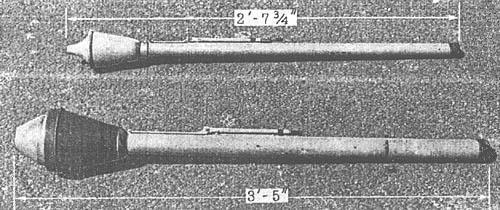 | ||
| Faustpatrone 30 (top) and Panzerfaust 60 (bottom) |
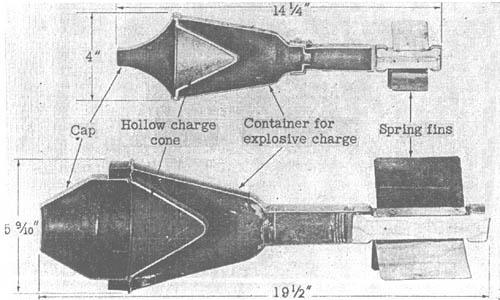 |
| Sectional view of Faustpatrone 30 (top) and Panzerfaust 60 (bottom) warheads, further cross sectional views for the Faustpatrone 30 and Panzerfaust 100, including the tube, are available. |
|
| Panzerfaust 60 (left) with Panzerschreck rocket (right) |
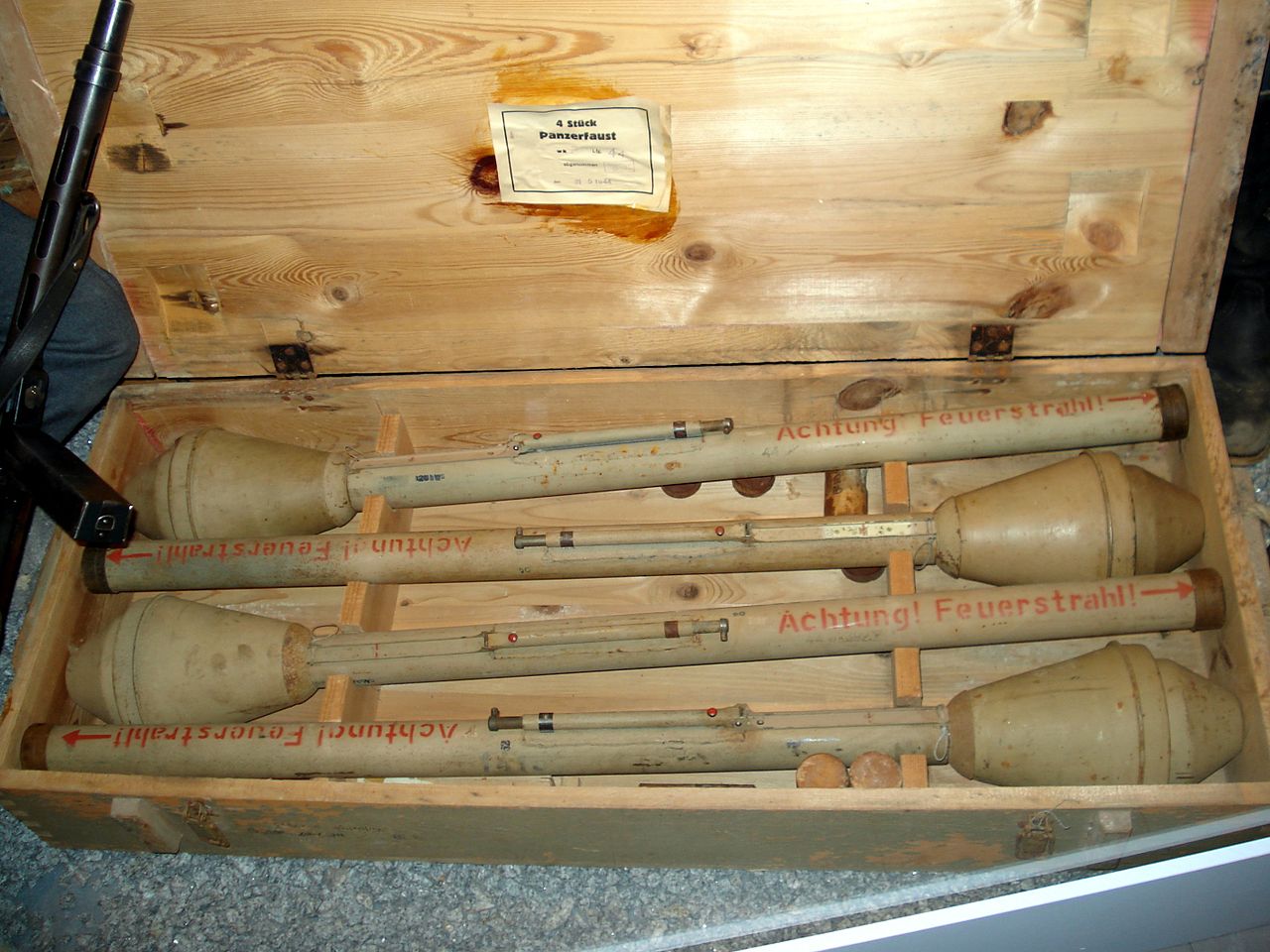 | |
| Four Panzerfaust 30s in original shipping crate, on display at the Helsinki Military Museum. |
 |
| Panzerfaust-armed Finnish soldiers (soldier in foreground is also armed with a Suomi KP/-31) passing the wreckage of a Soviet T-34 tank, destroyed by detonation, in the Battle of Tali-Ihantala. |
Sunday, February 1, 2015

Thursday, January 29, 2015

Wednesday, January 28, 2015
Wednesday, September 17, 2014

Tuesday, June 1, 2010
EX-41 multi-shot grenade launcher (USA)

Caliber: 40x46 low velocity
Type: multi-shot, cartridge-firing, manually operated
Overall length: n/a
Weight: ~8.1 kg unloaded
Effective range: up to 300 m
Magazine capacity: 3 rounds
The idea of a multi-shot 40mm grenade launcher came of a combat experience, gained by US troops in Vietnam. They were using single-shot M79 grenade launchers to great effect, but often found M9 to be too slow in reloading, such as in ambush / counter ambush situations. Therefore, US Navy (which was responsible for armament of various special purpose troops like Navy SEALs) set to develop such weapon. The task has been handled to the China Lake Naval Research Facility, which turned out first prototypes in around 1968. This large weapon represented a typical American-style pump-operated shotgun with tubular magazine below the barrel. Submitted for field trials in Vietnam, this weapon apparently performed quite well with HE-Frag ammunition, but often chocked on close-combat ammunition loaded with buckshot or flechettes (small arrows). This was mostly because of stubby shape of these rounds, while HE rounds had nicely curved noses which assisted reliable feeding. Furthermore, the overall weight of the loaded weapon was quite significant, to say the least. Apparently, no more than couple of dozens of such weapons, designated as EX-41, were made before US Forces were withdrawn from Vietnam. It seems that no further development has occurred on this weapon since then.
EX-41 is a manually operated, magazine fed grenade launcher. It has a tubular magazine below the barrel which holds 3 rounds, plus one round can be carried in the barrel. magazine is loaded through the port at the bottom of the receiver, empty cartridge cases are ejected to the right via ejection window. Reloading mechanism is operated by the sliding handguard, which shall be pulled to the rear and then pushed forward to complete reloading cycle. EX-41 was fitted with wooden buttstock that had a rubber recoil pad. Sights were of open type, same as on M79 grenade launcher.
Wednesday, May 26, 2010
DENEL PAW-20 "Neopup" handheld grenade launcher (South-Africa)


20mm ammunition for PAW-20 grenade launcher (shown are High Explosive Incendiary rounds)
Caliber: 20x42
Type: semiautomatic, magazine fed
Overall length: 845 mm
Weight: 5.9 kg unloaded
Effective range: up to 1000 m (area targets)
Magazine capacity: 7 rounds
PAW-20 (PAW stands for Personal Assault Weapon) is a most recent development of the South-African company Gemaco Elbree Pty Ltd, and is marketed by South African military corporation DENEL. Ammunition of new type, developed for PAW-20, is produced by the PMP - DENEL munitions. While in some advertising texts the PAW-20 was listed as a "new assault rifle", it is obviously not a true assault rifle, but, rather a semi-automatic grenade launcher, which is intended as an infantry support weapon. PAW-20 fires specially developed explosive ammunition of 20mm caliber, using relatively short, straight cartridge cases. Muzzle velocity is about 300 m/s, which is quite low by artillery standards but rather high by standards of hand-held grenade launchers. Intended targets for PAW-20 are infantry in the open and behind light covers, as well as unarmored or lightly armored vehicles and thin-walled buildings. While maximum effective range for PAW-20 is given as 1000 meters, it is obviously stated for "area" targets such as groups of soldiers; against point targets like cars or machine gun nests, effective range will be much less probably no more than 300-400 meters - unless gun will be used in conjunction with laser rangefinder and computerized sight with built-in ballistic calculator.
Standard ammunition at this time is available in HE, HE-I and TP (practice) variety, with other types being in development. Weight of the round warhead is listed as 105 gram, and it seems that new round consists of a standard 20mm projectile (as used in aircraft cannons) loaded into short, straight-walled case of 42mm length. All ammunition is point-detonating only, unlike the American XM-25, to which PAW-20 is a direct competitor.
PAW-20 is semiautomatic, gas operated weapon with rotary bolt locking. The entire barrel / bolt group is allowed to recoil within the polymer gun housing for about 75mm (3"), in attempt to decrease peak recoil down to manageable level. General layout of the gun is somewhat unusual as the pistol grip with the trigger is located at the right side of the receiver. Gun is fed from detachable box magazines which hold 7 rounds of ammunition. Empty cartridge cases are ejected through the window on the left side of the weapon, right in the front of the firer's face. Sighting equipment is installed on two Picatinny-type rails located in parallel at the top of the gun housing. Preferred sighting arrangement seems to be a red-dot type collimating sight, but other sight options also available.
Caliber: 20x42
Type: semiautomatic, magazine fed
Overall length: 845 mm
Weight: 5.9 kg unloaded
Effective range: up to 1000 m (area targets)
Magazine capacity: 7 rounds
PAW-20 (PAW stands for Personal Assault Weapon) is a most recent development of the South-African company Gemaco Elbree Pty Ltd, and is marketed by South African military corporation DENEL. Ammunition of new type, developed for PAW-20, is produced by the PMP - DENEL munitions. While in some advertising texts the PAW-20 was listed as a "new assault rifle", it is obviously not a true assault rifle, but, rather a semi-automatic grenade launcher, which is intended as an infantry support weapon. PAW-20 fires specially developed explosive ammunition of 20mm caliber, using relatively short, straight cartridge cases. Muzzle velocity is about 300 m/s, which is quite low by artillery standards but rather high by standards of hand-held grenade launchers. Intended targets for PAW-20 are infantry in the open and behind light covers, as well as unarmored or lightly armored vehicles and thin-walled buildings. While maximum effective range for PAW-20 is given as 1000 meters, it is obviously stated for "area" targets such as groups of soldiers; against point targets like cars or machine gun nests, effective range will be much less probably no more than 300-400 meters - unless gun will be used in conjunction with laser rangefinder and computerized sight with built-in ballistic calculator.
Standard ammunition at this time is available in HE, HE-I and TP (practice) variety, with other types being in development. Weight of the round warhead is listed as 105 gram, and it seems that new round consists of a standard 20mm projectile (as used in aircraft cannons) loaded into short, straight-walled case of 42mm length. All ammunition is point-detonating only, unlike the American XM-25, to which PAW-20 is a direct competitor.
PAW-20 is semiautomatic, gas operated weapon with rotary bolt locking. The entire barrel / bolt group is allowed to recoil within the polymer gun housing for about 75mm (3"), in attempt to decrease peak recoil down to manageable level. General layout of the gun is somewhat unusual as the pistol grip with the trigger is located at the right side of the receiver. Gun is fed from detachable box magazines which hold 7 rounds of ammunition. Empty cartridge cases are ejected through the window on the left side of the weapon, right in the front of the firer's face. Sighting equipment is installed on two Picatinny-type rails located in parallel at the top of the gun housing. Preferred sighting arrangement seems to be a red-dot type collimating sight, but other sight options also available.
Monday, May 24, 2010
GL-06 40mm grenade launcher (Switzerland)
GL-06 grenade launcher is a dedicated stand-alone shoulder-firing weapon, intended for military and police applications. Designed by well-respected Swiss arms-making company Brügger & Thomet AG, GL-06 is already in use with certain European military Special Forces groups. A special dedicated "less lethal" version of GL-06 is produced as LL-06. It must be noted that the only difference between GL-06 and LL-06 is the color of the frame - both weapons are fully capable of firing a complete range of 40mm x 46 munitions.

GL-06 grenade launcher with optional accessories such as Red Dot sight, forward grip and a tactical light


LL-06 - a dedicated less-lethal version of the GL-06, intended for police application, with array of available less-lethal and practice munitions
Caliber: 40x46mm low velocity
Type: single-shot
Overall length: 590 / 385 mm (stock opened / folded)
Weight: 2,05 kg unloaded
Effective range: up to 300 m
It must be noted that GL-06 was born from recent request from police force of one of leading European nations, which sought to obtain a less-lethal weapon for anti-riot application, with particular need for pin-point accuracy at standoff ranges (beyond 40 meters for such scenarios) when firing impact rounds. B+T provided its client with both weapon and a special round, with added benefit of compatibility with wide array of lethal and less-lethal ammunition produced in 40mm low-velocity class. GL-06 is lighter and more compact than other stand-alone weapons of the same class (such as US M79 or German HK 69), yet it is capable of great accuracy, tactical flexibility and has good ergonomics.
GL-06 grenade launcher is a single shot weapon, with rifled tip-up barrel. For loading and unloading, rear part of the barrel is tipped up; therefore, rounds of any conceivable length can be easily loaded and extracted without problems. Barrel opening is assisted by special spring, thus speeding-up the reloading process. The barrel lock levers are fully ambidextrous and located in front of trigger guard, within the reach of the index finger. Trigger is of Double Action Only type, with concealed hammer. Additional manual safety is provided in form of the cross-bolt button located on the receiver above the pistol grip. GL-06 is provided with integral open sights (with adjustable diopter-type rear sight), and an integral Picatinny type rail on the barrel, which permits installation of many types of sighting equipment. Three additional accessory rails are installed on the short forend, below the barrel. GL-06 is fitted with side-folding butt, made of durable polymer, and is equipped with sling attachment points.
Caliber: 40x46mm low velocity
Type: single-shot
Overall length: 590 / 385 mm (stock opened / folded)
Weight: 2,05 kg unloaded
Effective range: up to 300 m
It must be noted that GL-06 was born from recent request from police force of one of leading European nations, which sought to obtain a less-lethal weapon for anti-riot application, with particular need for pin-point accuracy at standoff ranges (beyond 40 meters for such scenarios) when firing impact rounds. B+T provided its client with both weapon and a special round, with added benefit of compatibility with wide array of lethal and less-lethal ammunition produced in 40mm low-velocity class. GL-06 is lighter and more compact than other stand-alone weapons of the same class (such as US M79 or German HK 69), yet it is capable of great accuracy, tactical flexibility and has good ergonomics.
GL-06 grenade launcher is a single shot weapon, with rifled tip-up barrel. For loading and unloading, rear part of the barrel is tipped up; therefore, rounds of any conceivable length can be easily loaded and extracted without problems. Barrel opening is assisted by special spring, thus speeding-up the reloading process. The barrel lock levers are fully ambidextrous and located in front of trigger guard, within the reach of the index finger. Trigger is of Double Action Only type, with concealed hammer. Additional manual safety is provided in form of the cross-bolt button located on the receiver above the pistol grip. GL-06 is provided with integral open sights (with adjustable diopter-type rear sight), and an integral Picatinny type rail on the barrel, which permits installation of many types of sighting equipment. Three additional accessory rails are installed on the short forend, below the barrel. GL-06 is fitted with side-folding butt, made of durable polymer, and is equipped with sling attachment points.
Wednesday, May 12, 2010
Heckler & Koch HK XM25 IAWS


The Heckler & Koch XM25 is currently being field-tested with full deployment expected in 2012 if all goes as planned.
The futuristic Heckler & Koch HK XM25 IAWS (Individual Airburst Weapon System) is a semi-automatic, multiple-shot, shoulder-fired 25mm grenade launcher categorized as an "airburst weapon" system designed to neutralize out-of-view targets. The term airburst is derived from the launcher's use of fuze delayed detonated munitions which allow for a higher kill probability. Initial prototypes were handed over to the United States Army for field-testing in April of 2005. By the middle of 2009, field tests in combat zones from Iraq to Afghanistan were taking place. The project - barring any setbacks - should see fielding in production form sometime in 2012.
The general basis of the XM25 is in its rangefinding and delayed munition detonation capabilities. The operator activates the laser rangefinder and determines the distance to a target or target area. Once determined by the rangefinder, the operator then has the freedom to "fine-tune" the detonation delay of the projectile before firing by adding to - or subtracting - distance. The chambered grenade is "imprinted" with the calculated distance via a microchip fitted into every 25mm projectile. The operator pulls the trigger and propels the grenade onto its flight path. The grenade then automatically follows through by calculating how many rotations have occurred since it was launched from the rifled barrel. Once the pre-set range is reached, the grenade detonates itself at or in the area of the target. In essence, it is a "smart" weapon - though still requiring user input, it handles a great deal of the actual work post-fire. A first-kill probability is noted to be very high at least against target mannequins.
The XM25 is designed in a "bullpup" configuration, meaning that the magazine and applicable feed system is mounted to the rear of the pistol grip, trigger group and receiver. This provides for a stable hold when up against the operators shoulder as it necessitates a larger and heavier stock. The specialized optical system -the Target Acquisition Fire Control System - is fitted above the receiver. The forward portion of the weapon body is contoured to fit nicely in the free hand of the operator to further assist in bracing the weapon. The pistol grip features an integrated guard running forward of the trigger to the base of the pistol grip. Overall weight (6.3 kilograms) is said to be comparable to an M16 assault rifle with the 40mm grenade launcher attachment. Range is listed at 500 meters for point targets and up to 1,000 meters for ranged area targets. In some ways, the XM25 is similar in appearance to another -albeit ill-fated- Heckler & Koch / Alliant Techsystems joint development, the XM29 OICW.
The XM25 makes use of a low-velocity 25x40mm grenade munition. The launcher can fire this caliber of grenade in varying forms including a two-warhead high-explosive round (HEAB - High-Explosive Air Bursting), a flechette-laden (arrow) round and a thermobaric round (useful in confined spaces such as caves). Additionally, there will be standard training rounds as well as non-lethal rounds. The weapon fires from a 4-round oversized magazine fitted to the rear of the weapon.
The heart and soul of the XM25 is its Target Acquisition Fire Control System (TAFCS). This complex piece of equipment (developed by L-3 Communications Brashear) allows the XM25 operator to engage and fire on targets in day or night (the latter via thermal imaging), in adverse weather conditions and against targets in defilade - that is, hidden from view in a ditch or ravine. Similarly, the weapon will give the US soldier the capability to engage targets inside of buildings, firing from windows. The soldier need only his weapon to calculate the distance past the window frame, fire the XM25 and have the grenade detonate once it is inside the room, hopefully defeating the enemies within - all this with little damage to the building's major internal substructure. The laser rangefinder is activated through a button found along the front side of the XM25's trigger guard. The trigger guard also has the controls to fine-tune the range, adding or subtracting meters to the chambered grenade "on-the-fly". Aiming is via an adjusted crosshair aim point in the optical lens where the recorded target distance is also displayed. The fire control system evaluates the current air temperature and pressure and takes into account the inherent ballistics of the 25mm round for the presented range.
The US Army is intending to purchase some 12,500 M25 systems beginning in 2012 in an effort to field at least one unit with each of its infantry squads as well as for its Special Forces detachments. Primary development of the weapon has been handled by Heckler & Koch GmbH of Germany and Alliant Techsystems of Minnesota, USA.
The first successful test fire of the XM25 by a US soldier occurred at Aberdeen Test Center in Maryland on August 11th, 2009. Testing has shown results on practice targets to be up to 300% greater than that of current squad level weapons tasked to do the same job. Training on the XM25 has also been noted as swift with new XM25 operators being made ready to fire the weapon within five minutes time.
In theory, the XM25 is one of those "mouth watering" warfare devices (such as the Lockheed F-22 Raptor) that could very well change the face of the modern battlefield if it is put into actual practice. The "gun-and-hide" tactics of Al Qaeda's strategy guide will need to be rewritten.
Tuesday, May 11, 2010
M202 M202A1 M202A2 FLASH multishot rocket launcher / flamethrower (USA)
The M202 multishot rocket launcher evolved from XM191 multishot rocket launcher, that was extensively combat tested by US Army in Vietnam during late 1970s. The M202 is very similar to XM191 although it appears that its rockets were loaded with different incendiary agent - TPA rather than Napalm. It is also believed that XM191 was developed as a multipurpose weapon, capable of firing not only incendiary, but also 66mm HEAT rockets, compatible with that of M72 LAW lightweight antitank weapon. The M202, however, was issued only with one type of ammunition - the M74 incendiary rockets.
 Clip of four M74 incendiary rockets for M202 FLASH grenade launcher / flamethrower (drawing)
 Drawing of the M74 incendiary rocket in flight configuration (with tail fins extended)
 US soldier aims the M202A1 FLASH grenade launcher / flamethrower, possibly during the Vietnam war
 M202A1 FLASH grenade launcher less clip, with covers opened

Caliber: 66 mm
Type:rocket
Overall length: 686 mm empty launcher, 883 mm loaded with clip
Weight: 5.22 kg unloaded, 12 kg loaded with clip of 4 rockets
Effective range: up to 200 m (750 m maximum)
In theory, the M202 was an impressive weapon with significant combat capabilities - it had long range (compared to earlier flamethrowers), it allowed for relatively rapid fire and high maneuverability, its physical and psychological effect on unprotected infantry and military vehicles was significant to say the least. However, it appears that M202 ammunition had some flaws (most probably due to poor quality control or design flaws), which resulted in self-ignition of warheads during loading of the weapon. Not surprisingly, such disastrous events made the M202 less than popular among the troops, and most M202 launchers were put into storage during late 1980s, although some launchers were observed during training of US and allied troops through early 1990s.
It must be noted that M202 made its biggest impact not on the battlefields but rather on cinema screens, when it was featured in the "Commando" movie (1985), starring Arnold Schwarzenegger. In this movie the M202 was used to blow up the police truck and free the Schwarzenegger's character, although in real life this would be the last scene of the action, with main character quickly burned to death inside scorched truck (the M74 rocket generated fire as hot as 1800-2200C for several minutes).
The M202 multishot rocket launcher is a four-barreled re-usable smoothbore weapon which is loaded with a clip with factory-loaded M74 rockets, pre-loaded into separate aluminum tubes that are assembled together to form a single 4-shot clip. The clip is attached to the rear of the launcher and each loaded tube forms an extension to the barrel. Once clip is loaded and fixed to the weapon, launcher can be fired up to 4 times, with practical rate of fire as high as 1 round per second. Once all rockets are fired, the empty clip is detached and discarded. During storage and transportation the M202 launcher is closed at front and back with two hinged covers, which shall be unlocked and opened before loading and firing. The front cover has a dual-purpose handle, which is used for carrying the launcher in vertical position, and is used as a forward grip in firing position. Firing controls include folding pistol grip under the barrel cluster, and folding collimating sight on the left side of the weapon. 66mm rockets use solid fuel engines, switch-blade type folding stabilizator fins, and a warhead loaded with some 0.6kg of self-igniting triethylaluminum (TEA), a gel-like substance. Since the M202 is a rocket launcher, upon firing it produces a dangerous backblast zone about 15 meters long.


US soldier aims the M202A2 FLASH grenade launcher / flamethrower, circa 1991
Caliber: 66 mm
Type:rocket
Overall length: 686 mm empty launcher, 883 mm loaded with clip
Weight: 5.22 kg unloaded, 12 kg loaded with clip of 4 rockets
Effective range: up to 200 m (750 m maximum)
In theory, the M202 was an impressive weapon with significant combat capabilities - it had long range (compared to earlier flamethrowers), it allowed for relatively rapid fire and high maneuverability, its physical and psychological effect on unprotected infantry and military vehicles was significant to say the least. However, it appears that M202 ammunition had some flaws (most probably due to poor quality control or design flaws), which resulted in self-ignition of warheads during loading of the weapon. Not surprisingly, such disastrous events made the M202 less than popular among the troops, and most M202 launchers were put into storage during late 1980s, although some launchers were observed during training of US and allied troops through early 1990s.
It must be noted that M202 made its biggest impact not on the battlefields but rather on cinema screens, when it was featured in the "Commando" movie (1985), starring Arnold Schwarzenegger. In this movie the M202 was used to blow up the police truck and free the Schwarzenegger's character, although in real life this would be the last scene of the action, with main character quickly burned to death inside scorched truck (the M74 rocket generated fire as hot as 1800-2200C for several minutes).
The M202 multishot rocket launcher is a four-barreled re-usable smoothbore weapon which is loaded with a clip with factory-loaded M74 rockets, pre-loaded into separate aluminum tubes that are assembled together to form a single 4-shot clip. The clip is attached to the rear of the launcher and each loaded tube forms an extension to the barrel. Once clip is loaded and fixed to the weapon, launcher can be fired up to 4 times, with practical rate of fire as high as 1 round per second. Once all rockets are fired, the empty clip is detached and discarded. During storage and transportation the M202 launcher is closed at front and back with two hinged covers, which shall be unlocked and opened before loading and firing. The front cover has a dual-purpose handle, which is used for carrying the launcher in vertical position, and is used as a forward grip in firing position. Firing controls include folding pistol grip under the barrel cluster, and folding collimating sight on the left side of the weapon. 66mm rockets use solid fuel engines, switch-blade type folding stabilizator fins, and a warhead loaded with some 0.6kg of self-igniting triethylaluminum (TEA), a gel-like substance. Since the M202 is a rocket launcher, upon firing it produces a dangerous backblast zone about 15 meters long.
Wednesday, May 5, 2010
Mk.47 (Mark 47) Striker 40 automatic grenade launcher / machine gun (USA)


Picture 1: Mk.47 mod.0 Advanced Lightweight Grenade Launcher (ALGL) on standard tripod
Picture 2: Mk.47 mod.0 automatic grenade launcher, close-up view
Picture 3: Mk.47 mod.0 automatic grenade launcher, close-up view from the rear; note screen of electronic sighting / fire control unit
Picture 4: Mk.47 mod.0 automatic grenade launcher on field trials
Caliber: 40x53mm High Velocity
Type: short recoil operated, belt fed automatic grenade launcher
Overall length: 940 mm
Weight: 18 kg gun body; 41 kg complete with Mk.108 tripod and AN/PWG-1 video sight
Effective range: up to 1700 meters against point targets, up to 2200 m maximum
Rate of fire: 225-300 rounds per minute
The development of the more lightweight and effective weapon which could replace venerable Mk.19 Mod.3 automatic grenade launcher in US and foreign service, has been initiated by Saco Defense Company (now General Dynamics Armament and Technical Products - GDATP) during late 1980s.First prototypes of the new weapon appeared by mid-1990s, and in 1995 US DoD approved the industry team which then consisted of Saco Defense (now GDATP) as a weapon producer and system integrator, and Raytheon as a provider of advanced electronic sighting and fire control equipment. Later on, team was joined by Norwegian NAMMO Oy company, which develops the advanced, air- bursting 40mm ammunition for new weapon. In the year of 2003, US Special Operation Command (USSOCOM) adopted the GDATP Striker 40 40mm automatic grenade launcher as Mark 47 model 0, complete with its new tripod mount and AN/PVG-1 Lightweight Video Sight developed by Raytheon. These weapons now (February 2006) are in limited service with US Special Operation forces in Afghanistan and Iraq, and also are being considered for adoption by US Marine Corps. Mk.47 grenade launchers are compatible with full spectrum on NATO-standard 40mm high velocity ammunition; advanced air-bursting ammunition with programmable fuses is being developed for this weapon. Once this ammunition will be available, the Mk.47 / Striker 40 weapon system will provide serious and more cost-effective alternative to the much-discussed 25mm XM307 ACSW weapons now in development.
Mark 47 Model 0 (mk.47 mod.0) automatic grenade launcher is short recoil operated, locked breech weapon that fires from closed bolt for improved first-shot hit probability. Weapon is air-cooled and belt fed, using standard disintegrating belts, same as Mk.19 Mod.3 launcher. Standard belts are supplied in 32 or 48 round boxes. Weapon is equipped with newly developed Mk.108 mod.0 tripod with T&E mechanisms and brake that allows to lock weapon on pre-selected target spot. The key member of the Striker 40 system is the AN/PVG-1 Lightweight Video Sight (LVS), which offers 3X magnification TV view on target, combined with laser range finder and ballistic computer; sight also has interface connectors that allow to link it to optional thermal night sighting equipment which can be installed on the weapon; once the night sight is connected, operator can select TV or thermal picture via the single button. The LVS allows to accurately measure the range to the target then aim the gun accurately for high first shot hit accuracy. LVS is installed on the right side of the weapon, and is controlled by the buttons and four-position "joystick" located at the rear of the receiver, between and above spade grips.
Thursday, April 29, 2010
Mk.19 (Mark 19) automatic grenade launcher / grenade machine gun (USA)


Picture 1: The very early (probably prototype) Mark 19 model 0 grenade launcher; note that it lacks sights and any grips.
Picture 2: The Mk.19 mod.1 was the first upgrade of the basic design; about 1000 of such guns were converted from Mod.0 or built as new
Picture 3: Experimental Mk.19 mod.2 grenade launcher in remotely-controlled from, with electric trigger. Note that it had much slimmer profile - too bad it never worked well
Picture 4: Mk.19 mod.3 automatic grenade launcher on tripod, with ammunition box attached. Today it is one of most widespread designs of this class in the world
Picture 5: Firing Mk.19 mod.3 automatic grenade launcher in infantry configuration
Picture 6: Mk.19 mod.3 on US riverine craft
Caliber: 40x53mm High Velocity
Type: blowback operated, belt fed automatic grenade launcher
Overall length: 1095 mm
Weight: 35.3 kg gun body plus 20 kg M3 tripod mount or 9.1 kg lightweight tripod mount
Effective range: up to 1500 m (point target); 2200 m maximum range
Rate of fire: 300 - 400 rounds per minute
Development of the Mark 19 (Mk.19 in short) grenade machine gun was initiated by US Navy in 1966, after the initial experience gained during Vietnam war. Since about 1962, US forces in Vietnam used several multi-shot 40mm grenade launchers that fired low velocity 40x46mm M406 grenades originally developed for M79 single-shot weapon. Among these, most notable was the Mark 18 belt-fed grenade launcher, developed by Hughes corporation; this was a hand-cranked weapon that provided significant short-range firepower to riverine crafts and marine infantry. However, all such weapons lacked effective range, and US Navy decided to develop a new, automatic, self-powered weapon around the high-velocity 40x53mm M384 grenade (which was originally developed for US Army's M75 automatic grenade launcher, used on UH-1 and AH-1 combat helicopters). Development of Mark 19 automatic grenade launcher began in July 1966, and by October 1967 firs three working prototypes of the new weapon were ready for official field trials. The production Mark 19 Model 0 grenade launchers entered service in Vietnam in early 1968, on board of riverine crafts and UH-1 Huey gunship helicopters belonging to US Navy. In around 1971, the basic design was slightly improved, and type classified as Mark 19 Model 1; these weapons were manufactured by US Naval Ordnance Station Louisville. In around 1974, US Navy attempted to produce more streamlined version of the basic design, known as Mk.19 Mod.2, but this development never went past prototype stage, and in 1976 work began on simplified and more robust improved version of the Mk.19, which was type classified as Mark 19 Model 3 (Mk.19 mod.3) in 1981. The manufacturing contract for Mk.19 Mod.3 weapons was granted to Saco Defense (now General Dynamics Armament and Technical Products - GDATP). By the year 2000, at least 25 thousands of Mk.19 mod.3 grenade launchers were in service worldwide, mostly with all branches of US armed forces.
The Mark 19 Model 3 (Mk.19 mod.3) automatic grenade launcher is air cooled, belt fed, blowback operated machine gun. It fires from open bolt and uses advanced primer ignition principle to decrease peak recoil. To provide minimum of parts and maximum reliability of feeding, Mk.19 uses two-stage feed, when each round is first withdrawn rearwards from the belt on the opening stroke of the belt and then placed into T-slot cut in the bolt face; on the closing stroke, the round is already properly positioned on the bolt and is feed straight to the chamber; empty cartridge cases are ejected to the bottom as they are pushed down from the T-slot by the next cartridge (the same principle has been employed on some WW1 era machine guns). Ammunition is fed using special disintegrating belt; when rounds are fed into the chamber, links stay on the case and are ejected from the gun along with spent cartridge cases. Ammunition is usually supplied in belt boxes with capacity of 32 or 48 rounds. Loaded 32-round box weights about 19 kg (42 lbs). Mk.19 grenade launcher is fitted with dual spade grips, and can be fired in semi-automatic of full automatic modes. Alternatively, electric trigger pack can be installed for remote controlled mounts. It can be installed on standard M3 tripods (using Mark 64 cradle / adapter) for infantry use, or on various vehicle mounts on jeeps, armored vehicles, naval vessels etc. By default, Mk.19 mod.3 grenade launchers are equipped with machinegun type iron sights, but other types of sighting equipment (including night sights and range-finding electronic sights) are available. Today the primary ammunition type for Mk.19 mod.3 in US service is the 40mm M430 High Explosive, Dual Purpose (HEDP) round, which can penetrate up to 50mm (2") of rolled homogenous armor and provide effective anti-personnel fragmentation effect with damage radius of about 15 meters (lethal damage / kill zone radius 5 meters).
Subscribe to:
Comments (Atom)
LinkWithin
