
Showing posts with label Special Weapons. Show all posts
Showing posts with label Special Weapons. Show all posts
Tuesday, April 14, 2015
Monday, November 3, 2014

Thursday, July 31, 2014
Wednesday, September 25, 2013
US flamethrower during WW2 - The M1 series
There are many ways in which to decimate one's enemy - arguably one of the most terrible being fire. Fire has remained a feared battlefield element since ancient times when it was used to both severely maim an individual or group, frighten those under its reach and bring about destruction to flammable structures. By medieval times, "liquid fire" was in the fold, perhaps most notably utilized by the Byzantine Navy, and continued fire's dominance for centuries thereafter.
Modern day "flamethrowers" were first unveiled by the German Army in World War 1. These cumbersome machines could require up to three soldiers to move the system about the battlefield and, while the psychological effect was there, it was hardly practical in the heat of an offensive. Nevertheless, the these weapons saw first use in the Argonne forest against the French Army as early as 1914 and saw much publicized use against the same enemy in the 1916 campaign at Verdun. Despite the global disgust towards these new weapons of war - perhaps no worse than the chemical agents being lobbed against trench adversaries throughout the conflict - the flamethrower was here to stay, generally accepted by all sides and soon developed (or outright copied) by other nations. World War 1 ultimately ended in November of 1918 and the flamethrower had more or less seen its day in the sun.
The "flamethrower", as we know it today, had officially arrived. After their use in the opening salvos of World War 2 (seeing ever-improved forms), the British Army brought back into the fold their old World War 1-era flame-throwing developments. Likewise, the Australians put financing into a similar indigenous product all their own. The Japanese Army was also keen on the prospects of the flamethrower as a weapon through use of their Type 93 and Type 100 series. The Soviets had already been developing flamethrowers themselves by 1941. Before America had officially committed to the war effort, plans were already underway to design and develop an indigenous flamethrower system.
In 1940, the United States Army came down with a requirement for a new man-portable flame-throwing system. The department in charge for the design and development of the new weapon was the "Chemical Warfare Service". However, the department had little-to-no knowledge of how to proceed with the program and nothing of which to go by in beginning their endeavor. As such, they focused their efforts upon the flamethrowers utilized by the Wehrmacht (German Army). A prototype model - the "Flame-Thrower E1" was quickly developed and eventually evolved into the "E1R1" developmental model. Progress was deemed far enough along to send the E1R1 into trials. The E1R1 featured two large vertically-set tanks, each containing the needed fuel and a third, slimmer tank mounted atop and between the two fuel tanks contained the required propellant. The tanks were worn on the back of the operator as a backpack and fed to the "flame gun" dispenser (essentially a pipe) through a flexible tube line. The flame gun was held with two hands, one on the handle-grip type appendage and the other along the forend of the dispenser. A thin hydrogen tank was fitted laterally across the length of the flame gun and supplied the needed ignition. A battery pack was used to ignite the hydrogen by way of a spark, the hydrogen in turn igniting the outgoing fuel supply. A valve located at the aft end of the flame gun - the portion seeing the hose line connecting to the gun - was controlled by the operator.
Operation was such as that found on a rifle, though most often times fired from the hip as opposed to the shoulder. The firing action brought about a stream of "liquid fire" from the muzzle of the flame gun, the liquid fuel ignited at the nozzle end as it exited the gun. The pressurized tank allowed for a steady stream and the operator could "spray" an area in much the same way a person could spray a garden bed with a hose. Most trial images of the M1-in-training showcased the operator down on one knee, the M1 flame gun aimed upwards for arcing fire. In reality, this stance was not always possible.
The M1
The need for a flamethrower for the US Army was such that even some of these evaluation models were featured in operational assaults in Papau before the type was officially approved for active service. The operational evaluation did the project some good, though, for several key shortcomings were soon revealed in the American design. The E1R1 system was prone to breakdowns in the field and proved relatively unreliable in the harsh battlefield conditions. The controls were noted for their ill-placement and the machine was generally not a trusted weapon in the heat of battle. As such, the board took to refining the base design - attempting to produce a more robust and reliable system - and the new weapon was therefore accepted into service as the "Portable Flame-Thrower M1". American was fully committed to World War 2 after December 7th, 1941 following the surprise Japanese attack on Pearl Harbor, Hawaii and the M1 would soon be put to dastardly use.
The M1 differed only subtly from the E1R1 developmental model, retaining the same basic shape and configuration of the tanks. Production of the M1 began in March of 1942 and the weapon was soon to see action the following January in the Guadalcanal action. In theory, the M1 was a solid design effort with several key ingredients ironed out during its refinement process. However, once in practice, the M1 continued to fail its operators, sometimes at the worst possible times. One of the major drawbacks of the M1 became its ignition system which relied on electrical power supplied to the flame gun via batteries. In testing, this ignition method proved adequate but when pressed into the grimy, violent and unpredictable world of war, this solution was far from perfect. The construction material of each tank was also liable to develop small, unseen holes from general metal corrosion which ultimately allowed both pressure and liquids to unknowingly escape. As such, a special service was opened by the United States Army to specifically manage, repair and inspect all outgoing M1 throwers before their use in combat.
The M1A1
In June of 1943, American was engulfed in World War across two separate fronts - one to the East throughout North Africa/Europe against the forces of Italy/Germany and the other to the West in the Pacific against the Empire of Japan. Development for an improved M1 model was ongoing and deliveries of the new M1A1 soon began. Napalm was now being used as an additive in the tanks to produce a "thicker" fuel store thus increasing the flamethrower's operational range and damage effect. This thicker fuel differentiated the M1A1 from the M1 in that the M1 was categorized by it using "light" fuel. While range of the original M1 was roughly out to 30 yards, the M1A1 could now yield a flame burst out to 50 yards. The operational weight of the M1A1 was also reduced to a more "manageable" 65lbs. Despite the inadequacies of the ignition system inherent in the M1, it remained unchanged in the improved M1A1. By this time, however, American troops had learned to overcome its deficiencies and resorted to lighting their throwers by whatever means they had available - burning paper, matchsticks and even personal cigarette lighters were just some of the published methods. Some 14,000 M1A1s were ultimately produced and delivered to awaiting infantry platoons. Their operations took them across Italy and Germany though their use was severely limited throughout Europe following the end of the Normandy Campaign in 1944. Use of the M1/M1A1 continued throughout the Pacific however.
The M1/M1A1 in the Pacific
The M1/M1A1 were found to be highly relied upon in weeding out the fanatic Japanese defenders on through the required island campaigns of the Pacific Theater. The flamethrower served American Marines well in engaging dug-in foes in foxholes, tunnels and bunkers. Additionally, the flamethrower worked extremely well for clearing out dry cover brush as found throughout the islands. In some instances, the mere appearance of the flamethrower led some enemy soldiers to surrender - such was the psychological power of "liquid flame", even centuries after the Byzantines.
M1/M1A1 Limitations
If there were limits to the reach of the flame-throwing unit, it was in range, inherent danger and portability to the operator himself. The 30- to 50-yard range was an impressive range on the testing and training courses of America. But in the field of combat, this often involved the operator to expose most of his body when engaging suspected enemy positions. This led to the use needlessly putting himself in harm's way. The size of the tanks and general stance of the infantryman called to bear the M1/M1A1 system also made for a juicy target to the enemy in which one solid shot could force the compression tanks to explode, engulfing the operator and those near him in a ball of flame. To add insult to injury, the M1/M1A1 system could weigh in as much as 70lbs - the infantryman called to carry the weapon would have to do so under combat conditions, trudging himself, his gear and the weapon through mud, rocky terrain, woods and humid jungle settings.
Values Despite the Drawbacks
Despite the drawbacks, the flamethrower proved to still have some value. The sheer psychological effect was second to none for there were few enemy soldiers willing to die in a blast of hot liquid flame. There was little escaping fire too, for its crevice-finding ways were similar to that of water - if there was a will, there was a way. And if the flame itself did not reach the intended target, perhaps the heat would - and intense heat has a way of moving a man out from hiding.
The M2
By the middle of 1943, the Chemical Warfare Service had developed more of sense of what the infantryman needed out of his flamethrower, based on after-action reports and feedback. This ultimately led to the development of the much-improved M2 flamethrower series with its new rotary cartridge ignition system. The M1 series was soon-after replaced by the M2 and production surpassed that of both M1 and M1A1 models combined.
End of the Road
Ultimately, all portable flamethrowers were more or less given up in favor of tank-mounted flame guns. This offered better range and protection for the crew and made for a more imposing target to the enemy.
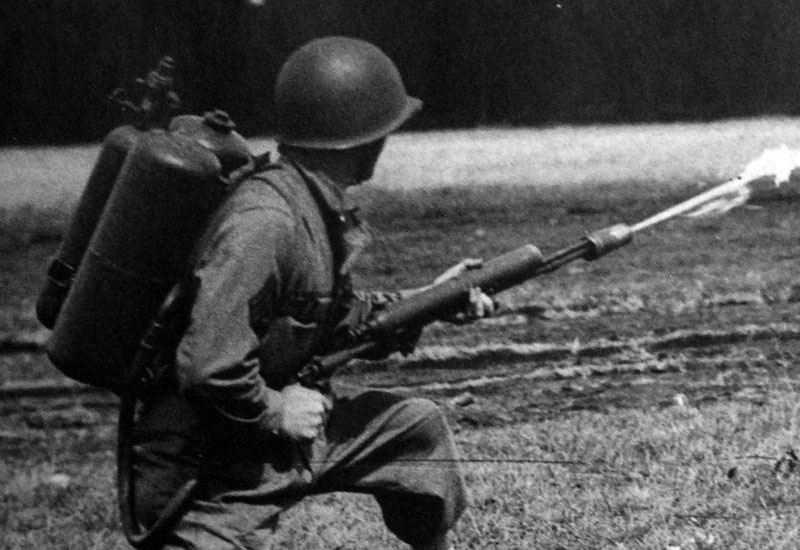 |
| The M1 / M1A1 series of flamethrowers saw widespread us by American forces in the Pacific Theater. |
Modern day "flamethrowers" were first unveiled by the German Army in World War 1. These cumbersome machines could require up to three soldiers to move the system about the battlefield and, while the psychological effect was there, it was hardly practical in the heat of an offensive. Nevertheless, the these weapons saw first use in the Argonne forest against the French Army as early as 1914 and saw much publicized use against the same enemy in the 1916 campaign at Verdun. Despite the global disgust towards these new weapons of war - perhaps no worse than the chemical agents being lobbed against trench adversaries throughout the conflict - the flamethrower was here to stay, generally accepted by all sides and soon developed (or outright copied) by other nations. World War 1 ultimately ended in November of 1918 and the flamethrower had more or less seen its day in the sun.
 |
| Within time, the rebuilding German Army under Adolph Hitler had begun replacing the large World War 1-era systems with man-portable components known under the family name of "Flammenwerfer" throughout the 1930s. |
The "flamethrower", as we know it today, had officially arrived. After their use in the opening salvos of World War 2 (seeing ever-improved forms), the British Army brought back into the fold their old World War 1-era flame-throwing developments. Likewise, the Australians put financing into a similar indigenous product all their own. The Japanese Army was also keen on the prospects of the flamethrower as a weapon through use of their Type 93 and Type 100 series. The Soviets had already been developing flamethrowers themselves by 1941. Before America had officially committed to the war effort, plans were already underway to design and develop an indigenous flamethrower system.
In 1940, the United States Army came down with a requirement for a new man-portable flame-throwing system. The department in charge for the design and development of the new weapon was the "Chemical Warfare Service". However, the department had little-to-no knowledge of how to proceed with the program and nothing of which to go by in beginning their endeavor. As such, they focused their efforts upon the flamethrowers utilized by the Wehrmacht (German Army). A prototype model - the "Flame-Thrower E1" was quickly developed and eventually evolved into the "E1R1" developmental model. Progress was deemed far enough along to send the E1R1 into trials. The E1R1 featured two large vertically-set tanks, each containing the needed fuel and a third, slimmer tank mounted atop and between the two fuel tanks contained the required propellant. The tanks were worn on the back of the operator as a backpack and fed to the "flame gun" dispenser (essentially a pipe) through a flexible tube line. The flame gun was held with two hands, one on the handle-grip type appendage and the other along the forend of the dispenser. A thin hydrogen tank was fitted laterally across the length of the flame gun and supplied the needed ignition. A battery pack was used to ignite the hydrogen by way of a spark, the hydrogen in turn igniting the outgoing fuel supply. A valve located at the aft end of the flame gun - the portion seeing the hose line connecting to the gun - was controlled by the operator.
Operation was such as that found on a rifle, though most often times fired from the hip as opposed to the shoulder. The firing action brought about a stream of "liquid fire" from the muzzle of the flame gun, the liquid fuel ignited at the nozzle end as it exited the gun. The pressurized tank allowed for a steady stream and the operator could "spray" an area in much the same way a person could spray a garden bed with a hose. Most trial images of the M1-in-training showcased the operator down on one knee, the M1 flame gun aimed upwards for arcing fire. In reality, this stance was not always possible.
The M1
The need for a flamethrower for the US Army was such that even some of these evaluation models were featured in operational assaults in Papau before the type was officially approved for active service. The operational evaluation did the project some good, though, for several key shortcomings were soon revealed in the American design. The E1R1 system was prone to breakdowns in the field and proved relatively unreliable in the harsh battlefield conditions. The controls were noted for their ill-placement and the machine was generally not a trusted weapon in the heat of battle. As such, the board took to refining the base design - attempting to produce a more robust and reliable system - and the new weapon was therefore accepted into service as the "Portable Flame-Thrower M1". American was fully committed to World War 2 after December 7th, 1941 following the surprise Japanese attack on Pearl Harbor, Hawaii and the M1 would soon be put to dastardly use.
The M1 differed only subtly from the E1R1 developmental model, retaining the same basic shape and configuration of the tanks. Production of the M1 began in March of 1942 and the weapon was soon to see action the following January in the Guadalcanal action. In theory, the M1 was a solid design effort with several key ingredients ironed out during its refinement process. However, once in practice, the M1 continued to fail its operators, sometimes at the worst possible times. One of the major drawbacks of the M1 became its ignition system which relied on electrical power supplied to the flame gun via batteries. In testing, this ignition method proved adequate but when pressed into the grimy, violent and unpredictable world of war, this solution was far from perfect. The construction material of each tank was also liable to develop small, unseen holes from general metal corrosion which ultimately allowed both pressure and liquids to unknowingly escape. As such, a special service was opened by the United States Army to specifically manage, repair and inspect all outgoing M1 throwers before their use in combat.
The M1A1
In June of 1943, American was engulfed in World War across two separate fronts - one to the East throughout North Africa/Europe against the forces of Italy/Germany and the other to the West in the Pacific against the Empire of Japan. Development for an improved M1 model was ongoing and deliveries of the new M1A1 soon began. Napalm was now being used as an additive in the tanks to produce a "thicker" fuel store thus increasing the flamethrower's operational range and damage effect. This thicker fuel differentiated the M1A1 from the M1 in that the M1 was categorized by it using "light" fuel. While range of the original M1 was roughly out to 30 yards, the M1A1 could now yield a flame burst out to 50 yards. The operational weight of the M1A1 was also reduced to a more "manageable" 65lbs. Despite the inadequacies of the ignition system inherent in the M1, it remained unchanged in the improved M1A1. By this time, however, American troops had learned to overcome its deficiencies and resorted to lighting their throwers by whatever means they had available - burning paper, matchsticks and even personal cigarette lighters were just some of the published methods. Some 14,000 M1A1s were ultimately produced and delivered to awaiting infantry platoons. Their operations took them across Italy and Germany though their use was severely limited throughout Europe following the end of the Normandy Campaign in 1944. Use of the M1/M1A1 continued throughout the Pacific however.
The M1/M1A1 in the Pacific
The M1/M1A1 were found to be highly relied upon in weeding out the fanatic Japanese defenders on through the required island campaigns of the Pacific Theater. The flamethrower served American Marines well in engaging dug-in foes in foxholes, tunnels and bunkers. Additionally, the flamethrower worked extremely well for clearing out dry cover brush as found throughout the islands. In some instances, the mere appearance of the flamethrower led some enemy soldiers to surrender - such was the psychological power of "liquid flame", even centuries after the Byzantines.
M1/M1A1 Limitations
If there were limits to the reach of the flame-throwing unit, it was in range, inherent danger and portability to the operator himself. The 30- to 50-yard range was an impressive range on the testing and training courses of America. But in the field of combat, this often involved the operator to expose most of his body when engaging suspected enemy positions. This led to the use needlessly putting himself in harm's way. The size of the tanks and general stance of the infantryman called to bear the M1/M1A1 system also made for a juicy target to the enemy in which one solid shot could force the compression tanks to explode, engulfing the operator and those near him in a ball of flame. To add insult to injury, the M1/M1A1 system could weigh in as much as 70lbs - the infantryman called to carry the weapon would have to do so under combat conditions, trudging himself, his gear and the weapon through mud, rocky terrain, woods and humid jungle settings.
Values Despite the Drawbacks
Despite the drawbacks, the flamethrower proved to still have some value. The sheer psychological effect was second to none for there were few enemy soldiers willing to die in a blast of hot liquid flame. There was little escaping fire too, for its crevice-finding ways were similar to that of water - if there was a will, there was a way. And if the flame itself did not reach the intended target, perhaps the heat would - and intense heat has a way of moving a man out from hiding.
The M2
By the middle of 1943, the Chemical Warfare Service had developed more of sense of what the infantryman needed out of his flamethrower, based on after-action reports and feedback. This ultimately led to the development of the much-improved M2 flamethrower series with its new rotary cartridge ignition system. The M1 series was soon-after replaced by the M2 and production surpassed that of both M1 and M1A1 models combined.
End of the Road
Ultimately, all portable flamethrowers were more or less given up in favor of tank-mounted flame guns. This offered better range and protection for the crew and made for a more imposing target to the enemy.

Monday, August 19, 2013
ASM-DT
In mid-1970s, Soviet Navy adopted an underwater APS assault rifle for its combat divers, to provide underwater security against enemy frogmen and specially trained sea animals (i.e. dolphins). The APS, while successful in its narrow niche, had its set of inherent flaws, so, during the late 1990s,a severely modified version of it appeared in Tula, in the form of the experimental ASM-DT “dual medium” amphibious assault rifle.

The key improvement of the ASM-DT is that it uses a 5.45 mm rifled barrel with relatively shallow rifling, which allows to fire both standard 5.45 x 39 spin-stabilized ammunition, and modified underwater hydrodynamically stabilized ammunition, which is also based on 5.45 x39 case, with long projectile of about 5.4 mm in diameter.
To achieve this, the magazine housing of the ASM-DT is fitted with a sliding magazine catch, which can be positioned at the rear of the long magazine port to hold the deep underwater magazines, or in the middle of the magazine port to hold the relatively shallow (front to back)AK-74 magazines. In the latter mode, the rear, unused part of the magazine housing is closed by a spring-loaded dust cover. To avoid problems with the remaining water in the barrel when firing the 5.45 x39 in air, the chamber has special grooves that lead from the chamber forcing cone forward, into the rifling grooves. When the standard 5.45mm cartridge is fired, a small amount of powder gases run through the grooves ahead of the bullet, effectively blowing the remaining water out of the barrel. The rest of the action is similar to the APS, but the muzzle is fitted with AKS-74U-style muzzle device / flash hider. The overall performance of ASM-DT with underwater ammunition is similar to the APS, while in air and with standard 5.45 x 39 ammunition, it is roughly on par with the AKS-74U and greatly out performs the APS.
Caliber: 5.45 mm (5.45x39 for above water firing and 5.45mm special underwater ammunition for submerged firing)
Action: Gas operated, rotating bolt
Overall length: n
Barrel length: n
Weight: kg
Rate of fire: ~600 rounds per minute
Magazine capacity: 30 rounds (for above water configuration) or 26 rounds (for underwater configuration)
The key improvement of the ASM-DT is that it uses a 5.45 mm rifled barrel with relatively shallow rifling, which allows to fire both standard 5.45 x 39 spin-stabilized ammunition, and modified underwater hydrodynamically stabilized ammunition, which is also based on 5.45 x39 case, with long projectile of about 5.4 mm in diameter.
To achieve this, the magazine housing of the ASM-DT is fitted with a sliding magazine catch, which can be positioned at the rear of the long magazine port to hold the deep underwater magazines, or in the middle of the magazine port to hold the relatively shallow (front to back)AK-74 magazines. In the latter mode, the rear, unused part of the magazine housing is closed by a spring-loaded dust cover. To avoid problems with the remaining water in the barrel when firing the 5.45 x39 in air, the chamber has special grooves that lead from the chamber forcing cone forward, into the rifling grooves. When the standard 5.45mm cartridge is fired, a small amount of powder gases run through the grooves ahead of the bullet, effectively blowing the remaining water out of the barrel. The rest of the action is similar to the APS, but the muzzle is fitted with AKS-74U-style muzzle device / flash hider. The overall performance of ASM-DT with underwater ammunition is similar to the APS, while in air and with standard 5.45 x 39 ammunition, it is roughly on par with the AKS-74U and greatly out performs the APS.
Caliber: 5.45 mm (5.45x39 for above water firing and 5.45mm special underwater ammunition for submerged firing)
Action: Gas operated, rotating bolt
Overall length: n
Barrel length: n
Weight: kg
Rate of fire: ~600 rounds per minute
Magazine capacity: 30 rounds (for above water configuration) or 26 rounds (for underwater configuration)
Tuesday, July 30, 2013
APS assault rifle
The APS (Avtomat Podvodnyj Spetsialnyj = Special Underwater Assault rifle) was developed during the early 1970s at TSNIITOCHMASH(Central Institute for Precision Machine building) by the team lead by V. Simonov. APS has been in active service with combat divers of the Soviet and Russian Navy since circa 1975.
The APS is designed for special underwater cartridges, which fire 5.66 mm needle-like projectiles 120 mm long. The projectiles are stabilized using a hydrodynamic cavity, generated by the flat point of the projectile. The cartridges use standard 5.45 x 39 cases, sealed from water. The APS itself is a relatively crude, smooth bore arm, with a gas operated, rotating bolt action, fired from an open bolt. Single safety / selector switch is located at the left side of the receiver and allows for single shots and full automatic fire. The gas system features a patented self-adjusting gas valve, which allows the gun to be fired both underwater and in atmosphere. The simple trigger unit allows for single shots and full automatic fire. The rate of fire under water, as well as the effective range, depends on the actual depth. Sights are crude: a non-adjustable open notch rear and post front. The retractable buttstock is made from steel wire. The most complicated thing in the whole design is the feed system, which includes several parts to avoid double and even triple feed with the extremely long projectiles. Unusually deep (front to back) magazines are made from polymer and hold 26 rounds.
It must be noted that while APS could be fired "above the water", it should be done only in the case of emergency. According to the available sources, the expected service life of the APS when fired "in the air" degrades severely, and the effective range is limited only to several tens of meters. So, the APS is useful only under the water, where it is quite effective.
Caliber: 5.6x39 mm MPS
Action: Gas operated, rotating bolt
Overall length: 823 mm (butt retracted), 615 mm (butt collapsed)
Barrel length: n/a
Weight: 2.4 kg less magazine; 3.4 loaded
Rate of fire: 600 rounds per minute (in air)
Magazine capacity: 26 rounds
 |
| APS rifle, with butt collapsed; note crude non-adjustable iron sights and unusual magazine |
The APS is designed for special underwater cartridges, which fire 5.66 mm needle-like projectiles 120 mm long. The projectiles are stabilized using a hydrodynamic cavity, generated by the flat point of the projectile. The cartridges use standard 5.45 x 39 cases, sealed from water. The APS itself is a relatively crude, smooth bore arm, with a gas operated, rotating bolt action, fired from an open bolt. Single safety / selector switch is located at the left side of the receiver and allows for single shots and full automatic fire. The gas system features a patented self-adjusting gas valve, which allows the gun to be fired both underwater and in atmosphere. The simple trigger unit allows for single shots and full automatic fire. The rate of fire under water, as well as the effective range, depends on the actual depth. Sights are crude: a non-adjustable open notch rear and post front. The retractable buttstock is made from steel wire. The most complicated thing in the whole design is the feed system, which includes several parts to avoid double and even triple feed with the extremely long projectiles. Unusually deep (front to back) magazines are made from polymer and hold 26 rounds.
It must be noted that while APS could be fired "above the water", it should be done only in the case of emergency. According to the available sources, the expected service life of the APS when fired "in the air" degrades severely, and the effective range is limited only to several tens of meters. So, the APS is useful only under the water, where it is quite effective.
Caliber: 5.6x39 mm MPS
Action: Gas operated, rotating bolt
Overall length: 823 mm (butt retracted), 615 mm (butt collapsed)
Barrel length: n/a
Weight: 2.4 kg less magazine; 3.4 loaded
Rate of fire: 600 rounds per minute (in air)
Magazine capacity: 26 rounds
Wednesday, July 3, 2013
ADS dual-medium
For several decades, Soviet and then Russian combat divers and Naval commando units were armed with special weapons for underwater combat, including the SPP-1 pistol and APS underwater assault rifle. The main drawback of these weapons is that their effectiveness (and life expectancy) for use above the water is severely degraded compared to standard 'above water' weapons. Therefore, combat divers and other Spetsnaz units, when engaged in amphibious operations (below the water and above), had to carry on the mission two types of weapons - one for underwater use and another for use when on shore or on board of enemy surface vessels. The first known attempt to produce a single weapon which could be effectively used either below or above the water was the ASM-DT experimental 'dual-medium' or amphibious assault rifle, developed in Tula in around 2000. The main problem with ASM-DT was that it still had to use extremely long, specially designed underwater ammunition when submerged, which necessitated overly long receiver, complicated magazine well of adjustable size and two types of magazines. This was found unsuitable for combat use, and further development commenced at the famous arms development facility KBP (Instrument Design Bureau) in Tula. By 2005, design team at KBP has successfully developed effective underwater ammunition which retains the compact size of the standard issue 5.45x39 7N6 ball (as well as 7N10 and 7N22 AP) rounds, and thus can be loaded and fired from standard AK-74-type box magazines, and, more importantly, fired from the same chambers and barrels that would accept the 'above-water' 7N6 ammunition.
This new cartridge is known as 5.45x39 PSP, and is externally similar to standard 5.45x39 ammunition except that it has a different bullet shape. Internally it differs in having a long bullets, which has specially calculated shape and protrudes back into the cartridge case all the way to the bottom, with overall bullet length being about 53mm (2.1 inch), compared to overall cartridge length of 57mm. There are two types of PSP ammunition, the 5.45 PSP (combat ammunition) with hardened steel projectile weighting 16 gram (muzzle velocity on air about 330 m/s) and 5.45 PSP-U (practice / training ammunition) with bronze projectile weighting 8 gram (muzzle velocity on air about 430 m/s). Effective range with PSP ammunition varies from 25 meters at 5 meters depth to 18 meters at 20 meters depth; effective range of the PSP-U training ammunition when below teh water is about 2 times shorter.
Having settled on new ammunition, designer at KBP commenced work on the new weapon, well suitable for both surface and underwater combat. This new rifle was designated as ADS (АДС - Автомат Двухсредный Специальный - Avtomat Dual-medium, Special). They used the A-91M bullpup assault rifle as a starting point, retaining its bullpup layout, gas operated action with rotary bolt locking and forward ejection through the short tube running above and to the right of the barrel. Some parts of the weapon were necessarily redesigned and materials revised to work reliably when submerged in water, gas system was modified with addition of the environment selector ("air / water"). Integral 40mm grenade launcher (which fires VOG-25 type 'caseless' grenades using additional front trigger inside the trigger guard) is fitted with removable barrel which can be removed when it is not needed by the mission profile. Muzzle of the barrel is threaded to accept muzzle brake / compensator, tactical silencer or blank-firing adapter. Rifle is fitted with adjustable iron sights, and an integral carrying handle is provided with Picatinny type rail on the top to accept various day and night optical sights. The ADS can fire any standard issue 5.45x39 ammunition (ball, tracer, AP) when above the water, with accuracy and effectiveness similar, if not better than of AK-74 / AK-74M general issue assault rifle. When submerged and loaded with 5.45 PSP ammunition, ADS outperforms APS underwater assault rifle in terms of accuracy and ease of handling.
Caliber: 5.45x39mm 7N6 / 7N10 / 7N22 for above-water fire and 5.45x39 PSP or PSP-U for under-water fire
Action: Gas operated, rotating bolt
Overall length: 660 mm
Barrel length: 415 mm
Weight: 4.6 kg (with integral 40mm grenade launcher)
Rate of fire: 600-800 rounds per minute
Magazine capacity: 30 rounds
 |
| ADS dual-medium / amphibious / underwater assault rifle, current model, which can be used in same configuration either above or below the water, with only change being ammunition type (in similar magazines) |
This new cartridge is known as 5.45x39 PSP, and is externally similar to standard 5.45x39 ammunition except that it has a different bullet shape. Internally it differs in having a long bullets, which has specially calculated shape and protrudes back into the cartridge case all the way to the bottom, with overall bullet length being about 53mm (2.1 inch), compared to overall cartridge length of 57mm. There are two types of PSP ammunition, the 5.45 PSP (combat ammunition) with hardened steel projectile weighting 16 gram (muzzle velocity on air about 330 m/s) and 5.45 PSP-U (practice / training ammunition) with bronze projectile weighting 8 gram (muzzle velocity on air about 430 m/s). Effective range with PSP ammunition varies from 25 meters at 5 meters depth to 18 meters at 20 meters depth; effective range of the PSP-U training ammunition when below teh water is about 2 times shorter.
 |
| ADS dual-medium / amphibious / underwater assault rifle configured for above-water "Spetsnaz" use; grenade launcher barrel is removed, and a silencer and night sight are installed for special operations |
Having settled on new ammunition, designer at KBP commenced work on the new weapon, well suitable for both surface and underwater combat. This new rifle was designated as ADS (АДС - Автомат Двухсредный Специальный - Avtomat Dual-medium, Special). They used the A-91M bullpup assault rifle as a starting point, retaining its bullpup layout, gas operated action with rotary bolt locking and forward ejection through the short tube running above and to the right of the barrel. Some parts of the weapon were necessarily redesigned and materials revised to work reliably when submerged in water, gas system was modified with addition of the environment selector ("air / water"). Integral 40mm grenade launcher (which fires VOG-25 type 'caseless' grenades using additional front trigger inside the trigger guard) is fitted with removable barrel which can be removed when it is not needed by the mission profile. Muzzle of the barrel is threaded to accept muzzle brake / compensator, tactical silencer or blank-firing adapter. Rifle is fitted with adjustable iron sights, and an integral carrying handle is provided with Picatinny type rail on the top to accept various day and night optical sights. The ADS can fire any standard issue 5.45x39 ammunition (ball, tracer, AP) when above the water, with accuracy and effectiveness similar, if not better than of AK-74 / AK-74M general issue assault rifle. When submerged and loaded with 5.45 PSP ammunition, ADS outperforms APS underwater assault rifle in terms of accuracy and ease of handling.
 |
| Diagram from original Russian patent, issued in 2006, for the design of the 5.45x39 PSP underwater cartridge and bullet, which protrudes down the cartridge case all the way to its base. |
 |
| Early prototype of the ADS dual-medium / amphibious assault rifle configured for above-water fire, with standard AK-74 magazine loaded with 5.45x39 ammunition |

Caliber: 5.45x39mm 7N6 / 7N10 / 7N22 for above-water fire and 5.45x39 PSP or PSP-U for under-water fire
Action: Gas operated, rotating bolt
Overall length: 660 mm
Barrel length: 415 mm
Weight: 4.6 kg (with integral 40mm grenade launcher)
Rate of fire: 600-800 rounds per minute
Magazine capacity: 30 rounds
Monday, June 3, 2013
The M2 Flamethrower improved upon the lessons learned
The M2 flamethrower became the standard flamethrower of the US military during and after World War 2, replacing the M1 and M1A1 series. The M2 would go on to see service in the upcoming Korean and Vietnam wars and still play a role in today's modern military (used in field testing). Production of the M2 series was more than that of the M1 family and totaled nearly 25,000 examples.
"Liquid fire" was nothing new by the time of World War 1 and the Germans used such a flame-spewing weapons to good effect in the trenches against their French enemies. While these systems were large and cumbersome components, they instilled much fear against their intended targets in the fire zone and served as a tremendous psychological presence nonetheless - fire, it seemed, had a way of motivating any living thing to move from its held ground. By the time of the 1930s, the Germans had more or less perfected a man-portable backpack flamethrower (the "Flammenwerfer") that saw good use from it, leading to an ever-growing list of improved forms. It was only a matter of time that the Allies followed suit and developed their own serviceable models. For the Americans, the M1 became such a development - itself being loosely based on the original German design.
The M1A1 was unveiled as an improved, more robust form in 1943 but the system still had a ways to go. Additives were now being added to the fuel stores to produce a "thicker" stream compound, increasing the weapon's range and damage cone. The weight was further "lightened" from 70lbs to make for a more portable system at 65lbs. However, the ignition system originating in the M1 remained unchanged in the M1A1, leading to some of the same problems during combat use.
Design of the M2 began in 1940 and continued on into 1941. With extensive use of the M1 and M1A1 systems, the Chemical Warfare Service - the group responsible for design and delivery of the original flamethrowers - used this experience to develop a more refined weapon system. The prototype came under the designation of "E3" and formed the basis of a new line of more robust and reliable flamethrowing systems. The experimental E3 was eventually accepted into service as the "Portable Flame-Thrower M2-2". The weapon system eventually entered service in 1943 and succeeded both the M1 and M1A1 when numbers made it possible. However, where it was not so, Army and Marine personnel continued use of the M1 family.
The M2 retained the same thickened fuel format as the M1 family but the biggest addition was the new cartridge-based ignition system. The old battery-actuated spark system was dropped from the design, instead replaced by a new six-shot revolver-type magazine fitted to the end of the flame tube. Each revolver well held an ignition cartridge (for a total of six possible ignitions before reloading). The new system proved much more reliable under combat conditions than the original method, requiring reloading only after all six cartridges had been spent.
The M2 maintained an empty weight of 43lbs while she filled in at 68lbs when full of fuel and propellant. The weapon system could fire for up to a second for every half-gallon in the fuel store (or up to 7 seconds straight). Effective range was out to 65.5 feet while maximum spray range was 132 feet. Like the M1 and M1A1 before it, the M2 was worn like a backpack consisting of three tanks - 2 x gasoline tanks fixed vertically and 1 x Nitrogen propellant tank set between the twin fuel tanks. The mixture was fed to the flame gun by way of a tubing line. The flame gun was held with two hands as would a conventional combat rifle. The flame gun was essentially a pipe with a rear vertical handgrip having a controllable valve. The forend featured a pistol-grip style appendage with a ring-enclosed trigger controlling the ignition. The M2 was discernable from the M1 in that the M2's flame gun differed visually at the forward end and lacked the hydrogen canister fitted lengthwise on the gun. No sights were afforded the weapon and firing was generally "from the hip". Most photography showcases the operator down on one knee, angling the flame gun upwards for a firing arc.
The M2 was soon to see action in 1944 on the island of Guam against the fanatical Japanese defenders. Deliveries were slow along some fronts to the extent that American forces in operating in Italy did not see arrival of the new flamethrower until March of 1945. The war in Europe would be over by June of that year with the Pacific Theater seeing closure in August. The M2 would see additional combat actions in the Korean War of 1950-1953.
The inherent dangers of operating a fuel-laden backpack flamethrower in open space were readily apparent with the M2. The operator still needed to expose at least his upper torso to enemy fire before he could squeeze a burst of flame fuel towards the enemy position. The enemy was quick to learn and began targeting flamethrower infantry as soon as they could be spotted. A single well-placed shot could engulf the system and its unfortunate operator (and those around him) within seconds. Conversely, American infantry soon learned to apply covering fire for their flamethrower brethren. Flamethrowers proved ever-popular in the Pacific Theater where their use was high when compared to that of European Fronts. They were adept at clearing out dry cover brush or flushing tunnels, bunkers and foxholes of hidden/dug-in enemies. Some Japanese infantry stood their ground and paid the terrible price of being burned alive while others surrendered at the sheer sight of an incoming M2 unit.
The M2A1-7 variant was a modernized version of the World War 2-era M2 system and used in the Vietnam War. The M2A1-7 was ultimately replaced during the Vietnam War by the M9 family in the M9A1-7 version. The M9A1-7 was, itself, later replaced by the M202A1 "FLASH" ("Flame Assault Shoulder Weapon") model.
Operators of the M2 system included the United States, Australia, the Philippines, Brazil and Japan. The Australians had begun work on an indigenous flamethrower design known as the "Ferret". After some of the American M2s were passed down to Australian ranks, design and development of the Ferret ceased in favor of the M2. Japan became a post-war user of the M2 family and featured it in their rebuilding army known as the Japanese Self-Defense Force (JSDF). The M2 was later replaced in Japanese service by an indigenous Japanese flamethrower system - though this system was itself based on the American M2 design.
The M2, as effective as it was, was never the final solution to the US Army need. As such, development of other experimental models continued throughout the war years. However, the end of the war pulled most military funding away and many projects under development died in the ensuing months of peace. Any improved man-portable flamethrower program would either be terminated, shelved for a time or forgotten altogether. Additionally, portable flamethrowers were generally dropped from some actions by the end of the war with the advent of flamethrowing tanks. These tanks were nothing more than existing tank chassis with specially-modified turrets housing a flame gun and applicable fuel stores. This arrangement allowed for even greater spray ranges while also affording the crew inside the protection of thick tank armor.
 |
| It goes without saying that fire had always maintained a prominent place on the battlefield even dating as far back to ancient times. It was readily available and the only issue revolved around its adequate delivery onto the heads of enemy formations. |
"Liquid fire" was nothing new by the time of World War 1 and the Germans used such a flame-spewing weapons to good effect in the trenches against their French enemies. While these systems were large and cumbersome components, they instilled much fear against their intended targets in the fire zone and served as a tremendous psychological presence nonetheless - fire, it seemed, had a way of motivating any living thing to move from its held ground. By the time of the 1930s, the Germans had more or less perfected a man-portable backpack flamethrower (the "Flammenwerfer") that saw good use from it, leading to an ever-growing list of improved forms. It was only a matter of time that the Allies followed suit and developed their own serviceable models. For the Americans, the M1 became such a development - itself being loosely based on the original German design.
 |
| When the M1 was pressed into evaluation service by 1941, it was quickly shown to have some reliability issues in both design and operation. The system was hardly robust enough for the rigors of the battlefield and the ignition system - relying on hydrogen being ignited by the spark of a battery - often failed its users to the point that soldiers would use whatever means necessary to ignite the flame gun - burning bits of paper, cigarette lighters etc... |
The M1A1 was unveiled as an improved, more robust form in 1943 but the system still had a ways to go. Additives were now being added to the fuel stores to produce a "thicker" stream compound, increasing the weapon's range and damage cone. The weight was further "lightened" from 70lbs to make for a more portable system at 65lbs. However, the ignition system originating in the M1 remained unchanged in the M1A1, leading to some of the same problems during combat use.
Design of the M2 began in 1940 and continued on into 1941. With extensive use of the M1 and M1A1 systems, the Chemical Warfare Service - the group responsible for design and delivery of the original flamethrowers - used this experience to develop a more refined weapon system. The prototype came under the designation of "E3" and formed the basis of a new line of more robust and reliable flamethrowing systems. The experimental E3 was eventually accepted into service as the "Portable Flame-Thrower M2-2". The weapon system eventually entered service in 1943 and succeeded both the M1 and M1A1 when numbers made it possible. However, where it was not so, Army and Marine personnel continued use of the M1 family.
The M2 retained the same thickened fuel format as the M1 family but the biggest addition was the new cartridge-based ignition system. The old battery-actuated spark system was dropped from the design, instead replaced by a new six-shot revolver-type magazine fitted to the end of the flame tube. Each revolver well held an ignition cartridge (for a total of six possible ignitions before reloading). The new system proved much more reliable under combat conditions than the original method, requiring reloading only after all six cartridges had been spent.
The M2 maintained an empty weight of 43lbs while she filled in at 68lbs when full of fuel and propellant. The weapon system could fire for up to a second for every half-gallon in the fuel store (or up to 7 seconds straight). Effective range was out to 65.5 feet while maximum spray range was 132 feet. Like the M1 and M1A1 before it, the M2 was worn like a backpack consisting of three tanks - 2 x gasoline tanks fixed vertically and 1 x Nitrogen propellant tank set between the twin fuel tanks. The mixture was fed to the flame gun by way of a tubing line. The flame gun was held with two hands as would a conventional combat rifle. The flame gun was essentially a pipe with a rear vertical handgrip having a controllable valve. The forend featured a pistol-grip style appendage with a ring-enclosed trigger controlling the ignition. The M2 was discernable from the M1 in that the M2's flame gun differed visually at the forward end and lacked the hydrogen canister fitted lengthwise on the gun. No sights were afforded the weapon and firing was generally "from the hip". Most photography showcases the operator down on one knee, angling the flame gun upwards for a firing arc.
The M2 was soon to see action in 1944 on the island of Guam against the fanatical Japanese defenders. Deliveries were slow along some fronts to the extent that American forces in operating in Italy did not see arrival of the new flamethrower until March of 1945. The war in Europe would be over by June of that year with the Pacific Theater seeing closure in August. The M2 would see additional combat actions in the Korean War of 1950-1953.
The inherent dangers of operating a fuel-laden backpack flamethrower in open space were readily apparent with the M2. The operator still needed to expose at least his upper torso to enemy fire before he could squeeze a burst of flame fuel towards the enemy position. The enemy was quick to learn and began targeting flamethrower infantry as soon as they could be spotted. A single well-placed shot could engulf the system and its unfortunate operator (and those around him) within seconds. Conversely, American infantry soon learned to apply covering fire for their flamethrower brethren. Flamethrowers proved ever-popular in the Pacific Theater where their use was high when compared to that of European Fronts. They were adept at clearing out dry cover brush or flushing tunnels, bunkers and foxholes of hidden/dug-in enemies. Some Japanese infantry stood their ground and paid the terrible price of being burned alive while others surrendered at the sheer sight of an incoming M2 unit.
The M2A1-7 variant was a modernized version of the World War 2-era M2 system and used in the Vietnam War. The M2A1-7 was ultimately replaced during the Vietnam War by the M9 family in the M9A1-7 version. The M9A1-7 was, itself, later replaced by the M202A1 "FLASH" ("Flame Assault Shoulder Weapon") model.
Operators of the M2 system included the United States, Australia, the Philippines, Brazil and Japan. The Australians had begun work on an indigenous flamethrower design known as the "Ferret". After some of the American M2s were passed down to Australian ranks, design and development of the Ferret ceased in favor of the M2. Japan became a post-war user of the M2 family and featured it in their rebuilding army known as the Japanese Self-Defense Force (JSDF). The M2 was later replaced in Japanese service by an indigenous Japanese flamethrower system - though this system was itself based on the American M2 design.
The M2, as effective as it was, was never the final solution to the US Army need. As such, development of other experimental models continued throughout the war years. However, the end of the war pulled most military funding away and many projects under development died in the ensuing months of peace. Any improved man-portable flamethrower program would either be terminated, shelved for a time or forgotten altogether. Additionally, portable flamethrowers were generally dropped from some actions by the end of the war with the advent of flamethrowing tanks. These tanks were nothing more than existing tank chassis with specially-modified turrets housing a flame gun and applicable fuel stores. This arrangement allowed for even greater spray ranges while also affording the crew inside the protection of thick tank armor.
Wednesday, March 28, 2012
SDV Mk VIII
This is the vehicle used in the Call of Duty: Modern Warfare 2.
 |
| Operation of the SDV requires specialized training by elements of the US Navy SEALs. |
 |
| The SEAL Delivery Vehicle (SDV) MK VIII was developed in 1975 by United States UDT (Underwater Demolition Team) / SEAL (SEa, Air and Land) teams as a reusable, submersible underwater vehicle. |
US Navy SEALs are essentially the grandsons of the World War 2 underwater demolition teams charged with blowing up underwater beach obstructions and performing vital shore terrain scouting before assaults by the regular land forces. UDT teams of those days had problems of limited compressed air time and swimming stamina when launched from their PT boats or submarines, having to make their way to the beach and find their way back out to sea. This method of operation reduced mission times and limited the operations of this critical component to American battlefield supremacy. As such, the SDV was ultimately developed.
 |
| As a submersible underwater vehicle, the SDV can carry SEALs and their equipment, increasing mission time while the swimmers personal energy level is maintained for the operation ahead. |
The SEAL Team pilot, co-pilot and passengers are situated in fully-flooded compartments and use their own individual Self-Contained Underwater Breathing Apparatus (SCUBA) during the mission. Operational scenarios for these SEALs can include underwater reconnaissance and surveillance, beach and surf observation and combat swimmer attacks.
 |
| Any Attack Submarine can be adapted to carry the ubiquitous SDV. |
The Dry Dock Shelter (DDS) is attached to the deck of the submarine (behind the sail) and is fitted so the submarine's weapon or sensor operations are not limited or affected in any way. The DDS is portable and can be air-lifted to its preset location and installed in 12 hours.
 |
| The SDV itself is propelled by an electric propulsion system powered by rechargeable silver-zinc batteries. |
Trouble with the batteries was experienced on long missions so the battery size was increased to compensate. The round nose shaped SDV maintains buoyancy and pitch attitude by the pilot using ballast and trim controls in the cockpit. For controlling the vertical and horizontal angles of the vehicle, the pilot has a joystick control that operates the forward bow planes and the aft rudder and elevator. The mini instrument panel supports Doppler navigation sonar that indicates speed, heading, depth and distance traveled. The electronic instruments are sealed within watertight compartments and have been designed for easy removal/replacement.
 |
| Seal graduates who are assigned to SDV School in Coronado, California, spend some three months in training and, upon completion, are then assigned to SEAL Team One in Hawaii or SEAL Team Two in Little Creek, Virginia. |
The course concentrates on diving and navigating the MK-VIII SDV in a variety of conditions and scenarios. As operation of this craft can be quite dangerous and technical - with the lives of the crew and SEAL Team at stake - it takes a good amount of time to effectively pilot the SDV to fullest potential. Though many are expelled from the course, heroic reputations can be made if a SEAL SDV trainee can graduate as a skilled pilot. Despite its Cold War legacy, details of the SDV training program itself naturally remain a guarded secret.
 |
| Specifications for the SEAL Delivery Vehicle (SDV) Mk VIII Length: 15.4ft (4.69m) Beam: 6.2ft (1.89m) Draught: 0.2ft (0.06m) Surface Speed: 18kts (21mph) Complement: 4 Engine: 1 x Rechargeable Silver-Zinc Battery-powered Motor; 1 x shaft. |
Tuesday, December 13, 2011
Drones: A deeply unsettling future
SEE ALJAZEERA: http://www.aljazeera.com/indepth/opinion/2011/12/201112774824829807.html
San Francisco, California - On Sunday, Iran claimed to have taken down a US drone in Iranian airspace - not by shooting it out the sky, but with its cyber warfare team.

Two years ago the Wall Street Journal reported Iran-funded militants in Iraq were able to hack into drones' live-video feeds with "$26 off-the-shelf software". In another unnerving incident, Wired reported in October that a fleet of the Air Force's drones was infected with a computer virus that captured all of drones' key strokes. Technicians continually deleted the virus to no avail. How did the drones get infected? The military is "not quite sure". Worse, the Air Force's cyber security team didn't even know about the virus until they read about it in Wired.
Wired reported in a separate story that an upcoming Congressional report will detail how hackers broke into the US satellite system. With one satellite, hackers "achieved all steps required to command" it, "but never actually exercised control".
Last summer, a drone caused a scene in the nation's capital, when, as New York Times wrote, "fighter jets were almost scrambled after a rogue Fire Scout drone, the size of a small helicopter, wandered into Washington's restricted airspace". A similar incident took place in Afghanistan where military planes had to shoot down a "runaway drone" when pilots lost control.
The US, of course, leads the world in drone use for both surveillance and combat missions. Attacks are carried out in Pakistan every four days on average. Many times, the US isn't even sure exactly who they are killing. Despite the fact that the location of vast majority of drone bases are classified, journalist Nick Turse pieced together a startling picture of the massive US fleet. He determined that the US has at least 60 drone bases operated by either the US military or the CIA around the world, and "most of these facilities have remained unnoted, uncounted, and remarkably anonymous - until now".
But drone use is not just relegated to US military. Drone manufacturers already command a $94bn market, according to some estimates, and the drone arms race is in full swing. As the Washington Post reported, the constant buzz of drones and threats of attack now dominates the lives of civilians in Gaza. And Turkey plans to have Predator drones in operation by June 2012.
Meanwhile, Chinese contractors unveiled 25 types of unmanned aircraft last year. In all, at least 50 countries now have some sort of unmanned aerial vehicles, and the New York Times reports that "the number is rising every month". That number also includes Iran, which is seeking to upgrade its fleet. Even the Libyan rebels had their own surveillance drone - provided to them by Canadian defence contractors - before they were in full control of their own country.
The technology itself is also developing at an alarmingly rapid pace. The New York Times reports that researchers in the US are working on "shrinking unmanned drones, the kind that fire missiles into Pakistan and spy on insurgents in Afghanistan, to the size of insects", along with oversized drones that can capture video of an entire city. There are birdlike drones, underwater drones, drones within drones, facial recognition drones, and perhaps most terrifying, completely autonomous drones - currently being tested in Georgia - which will require no human control at all.
As Micah Zenko, Senior Fellow at the Council on Foreign Relations, told me last month, "It's a very impressive and responsive tool that should be used sparingly. Even if we’re responsible now, we might not be forever."
But in the US, drones will become yet another way authorities can compromise the privacy of ordinary citizens, as the FAA plans to propose new rules for their domestic flight. As Newsweek reported, police forces and border patrols in the US are buying the technology from defence contractors, and one has already been spotted flying over Houston. Police departments are already using GPS and cell phone tracking without warrants, this will another powerful surveillance weapon in their arsenal. As privacy advocates warn, "drones can easily be equipped with facial recognition cameras, infrared cameras, or open Wi-Fi sniffers". And while these drones will be used for many surveillance purposes (a scary thought in and of itself), contractors admit they are equipped to carry weapons, such as Tasers.
Whether they are being used for surveillance or all-out combat, drones will soon pose serious risks for all of the world's citizens. They can offer governments, police departments, or private citizens unprecedented capabilities for spying, and given their security vulnerabilities, the potential consequences could be endless.
Thursday, November 24, 2011
Are 'non-lethal' weapons really dangerous?
From an article from AlJazeera. See: http://www.aljazeera.com/indepth/features/2011/11/2011112213479768939.html?utm_content=features&utm_campaign=features&utm_source=twitter&utm_term=rss&utm_medium=tweet
------------------------------------
Fears that tear gas and rubber bullets, widely used in crackdown against protesters, could be cause of deaths in Egypt. From Egypt, to Athens, to Oakland, police have employed "non-lethal weapons" to break down recent protests and disperse protesters.  As crowds have swelled to express discontent, variations of tear gas, rubber bullets, water cannons, and stun grenades have been fired back at them. The US defence department describes non-lethal weapons as "primarily employed to immediately incapacitate targeted personnel or materiel, while minimising fatalities, permanent injury to personnel ... in the target area or environment. |
Despite this, activists have reported grave injuries as a result of tear gas canisters fired at protesters from close range.
Moreover, the non-lethality of the gas is also in doubt, as serious questions are being raised about the causes of recent deaths during this week's protests in Cairo's Tahrir square.

Al Jazeera’s Mike Hanna, reporting from the Egyptian capital, said: "There have been repeated rounds of tear gas fired here. It is a particularly virulent form, stinging the face to an immense extent.
"Many of those who have been killed are said to have died of asphyxiation.
"Medical workers say the conditions of those brought in is serious, many with symptoms they have not seen before from tear gas inhalation."
Speaking to Al Jazeera, Khalid Hamdi, staffing a make-shift clinic in Tahrir square, said: “We've seen many faintings and we'd never seen that before.
"About 70 per cent of the injuries are fainting. People are coming in with asthma, convulsions sometimes - this wasn't often before."
Amnesty international has also expressed concern about the use of tear gas in the square.
"We have received reports from medical sources saying that some of those who died did so as as a result of suffocation after inhaling tear gas," Said Haddadi, a spokesman for the rights group, told Al Jazeera.
'Pain and discomfort'
US government agencies, the departments of state and commmerce in particular, regulate the export of tear gas and other non-lethal weapons by granting export licenses allowing US manufacturers to sell tear gas to foreign buyers.
Two US companies have been identified as major exporters of the devices: Combined Systems Inc and NonLethal Technologies Inc, both based in Pennsylvania.
Peter Felstead, editor of Jane’s Defence Weekly, said countries buying weapons from the UK, at least, are closely vetted and their contracts constantly reviewed.
“If something happens in Saudi Arabia, or Bahrain for example, withdrawing contracts in response to those kind of events would present something of a dilemma. The US and UK strategic alliances with Saudi Arabia in particular are very strong. If there is unrest in Saudi, the question is will the support be withdrawn?"
He said buyers are expected to obtain training packages along with their purchase to make sure the weapons are employed properly. A lack of proper training could be the cause of any fatalities that might result.
"There are times when employing crowd control is absolutely necessary. But if the non-lethal weapons are not employed properly, they could make things worse.
"For example, if you end up forcing a crowd away from security forces to stampede through a narrow gap, you could kill people in the process."
What exactly is being fired at protesters in Tahrir is unclear.
Two forms of tear gas are most commonly used: Chlorobenzylidene malononitrile (also referred to as CS) and Chloroacetophenone (often known as CN).
Both gases are irritants that affect the eyes, nose, mouth and lungs, and cause tearing, sneezing and coughing.
"The primary effect is shortness of breath, pain, and discomfort," reads the catalogue of Combined Systems Inc.
Dr Ziad Kazzi, from Grady Health System and assistant director of Georgia Poison Center, said large doses of the gas could be fatal to healthy individuals as well.
“Those with already existing conditions, such as asthma or lung disease, are at higher risk. However, if large doses are inhaled, particularly in enclosed space, it could damage lungs and lead to death, even for healthy people. But it depends on the dosage.”
“Dose determines the poison,” he said, adding that several factors such as concentration, potency of the gas, the amount that is being delivered, the environment that it is being released in, and the personal characteristics of the people receiving it all play a part.
He said small doses have not been proven to have lasting effects.
'A cloud of irritant agent'
Tear gas canisters come in various shapes and forms, for indoor and outdoor purposes.
Smoke grenades - both launched by hand as well as munitions launchers - "deliver a cloud of irritant agent with a discharge time of approximately 25 seconds," NonLethal Technologies Inc's catalogue says.
Smoke projectiles, the second method that tear gas can be used at protesters, are "designed to provide effective outdoor crowd dispersal while maintaining a safe stand-off distance of up to 80 yards," according to the catalogue.
The canisters weigh between 175 and 500 grammes, and are made of aluminum or stern steel. Much of the injuries are caused by the fact that these canisters are fired onto crowded areas.
"Danger: Do not fire directly at person[s]. Severe injury or death may result," is reportedly written on the canisters.
Rubber bullets have also been fired at protesters, causing severe injuries.
The bullets come in aluminum cartridges, with a total weight of about 185 grammes. In one of the models in the NonLethal Technologies catalogue, each cartridge contains "three rubber batons that are skip fired towards the subjects".
"Eyewitnesses and lawyers have told us that some were injured as a result of rubber bullets," Amnesty's Haddadi said about the use of rubber bullets in the protests in Cairo.
“People can be killed by rubber bullets, there is no doubt about that. It has happened in northern Ireland. If you fire from close range, or someone is hit in the head," Felstead said.
"It would be quite difficult to specifically target people lethally. But it could easily happen when firing into a crowd."
With over 36 killed in Egypt since November 19, and medical sources citing "suffocation after inhaling tear gas" as the cause of many of the deaths, the non-lethality of the weapons employed - as well as how they were imported - has come under serious question.
Khalid Abdala, an Egyptian actor and activist, told Al Jazeera from Tahrir that he held international governments "complicit in everything that is happening here".
"International governments have replenished the stocks of bullets that have been shot at people right now, and the tear gas that is clinging to my lungs," he said.
Wednesday, April 20, 2011
Karl-Gerät (040/041): self-propelled siege mortar
"Karl-Gerät" (040/041) (German literally "Karl-device"), also known as, Thor and Mörser Karl, was a World War II German self-propelled siege mortar (Mörser) designed and built by Rheinmetall. It was the largest self-propelled weapon to see service. Its heaviest munition was a 60 cm diameter, 2,170 Kg shell, and its range for its lightest shell (1,250 Kg) was just over 10 km. Each gun had to be accompanied by a crane, a heavy transport trailer, and several modified tanks to carry shells.

60 cm Karl-Gerät "Ziu" firing in Warsaw, August 1944.
Seven guns were built, but only six saw combat between 1941 and 1945. It was used in attacking the Soviet fortresses of Brest-Litovsk and Sevastopol, bombarded Polish resistance fighters in Warsaw and participated in the Battle of the Bulge and the attacks against the Remagen Bridgehead. Only two exist today, the others were scrapped after the war.

A dud shell fired during the Warsaw Uprising.
In March 1936 Rheinmetall made a proposal for a super-heavy howitzer to attack the Maginot Line. Their initial concept was for a weapon that would be transported by several tracked vehicles and assembled on site, but the lengthy preparation time drove them to change it to a self-propelled weapon in January 1937. Extensive driving trials took place in 1938 and 1939 using the first Neubaufahrzeug tank prototype and a scale model to investigate the extremely high ground pressure and steering of such an enormous vehicle. Firing trials took place in June 1939. The full-scale driving trials were held at Unterlüss in May 1940. General Karl Becker of the Artillery was involved in the development, from whom the huge weapon gained its nickname.

A section of three 54 cm Karl-Geräte in the field. The Munitionsschlepper is shown on the right.
In total, seven Karl-Geräte howitzers were manufactured. The first six had the nicknames "Adam", "Eva", "Thor", "Odin", "Loki", and "Ziu"; the seventh, the research and test weapon (Versuchs-Gerät), had no name. Delivery of the six production vehicles took place from November 1940 to August 1941.

Karl-Gerät at the Kubinka Tank Museum, Russia.
In February 1941, discussions commenced concerning increasing the range of the weapon, and in May 1942, 54 cm barrels (Gerät 041) were ordered for the six vehicles. At a conference with Hitler in March 1943 it was stated that the first 54 cm Gerät 041 would be delivered by June 1943, and the third, by mid-August. Only three of the 54 cm barrels were actually completed and they could be mounted on Nr. I, IV, and V, although any vehicle could be converted to use the smaller weapon.
Twenty-two Panzer IV Ausf. D, E and F chassis were modified with a superstructure capable of carrying four shells that replaced the turret and outfitted with a crane as Munitionsschlepper ammunition transporters/loaders. Two or three of these Munitionsschlepper were assigned to each weapon.
Variants
* Gerät 040: original model, armed with a short 60 centimetres (24 in) caliber barrel;
* Gerät 041: later model, armed with a long (L/11.55) 54 centimetres (21 in) caliber barrel.
The 124 ton vehicle was propelled by a Daimler-Benz MB 503 A 12-cylinder liquid-cooled gasoline engine or a MB 507 C 12 cylinder liquid-cooled diesel engine, but this was mainly used for aiming (the mount had only 4 degrees of traverse on each side) as the engines provided a top speed of only 6.2 miles per hour (10 km/h). For longer distances the Karl-Gerät was disassembled using a special 35 t (34 LT; 39 ST) mobile crane into seven loads. The chassis was loaded onto a six-axle Culemeyer-Strassenroller lowboy trailer. The other parts of the gun were lighter and used four-axle trailers. If the trailer with the chassis on board had to cross a bridge that couldn't carry their combined weight the chassis had to be off-loaded and driven across under its own power. The weapon was moved long distances via rail on a variant of a Schnabel car; the whole chassis was hung between two huge pedestal-mounted swiveling arms fixed to five-axle bogies. When it reached its destination, the weapon was detached from its supporting arms, driven to its intended firing location, then the chassis was lowered to the ground to distribute the recoil forces more evenly in preparation for firing. The Karl-Gerät proved to have no problems moving over normal soil, but under no circumstances was it allowed to make turns on soft soil lest it throw a track. The chassis had to be backed into position to fire, which expedited movement to a new position, but the firing position had to be precisely leveled and the approach route prepared ahead of time to fill in soft spots and any ditches, etc. It could only be loaded at zero elevation, so it had to be re-aimed between every shot.

A Karl-Gerät ready for road transport aboard its Culemeyer trailer.
On 3 January 1941 Heavy Battery (schwere Batterie) 833 was created at the Bergen training ground and ordered to be combat ready by 15 February 1941. On 2 April 1941 it was expanded into Heavy Artillery Battalion (schwere Artillerie Bataillon) 833. The original Batterie 833 was redesignated as the first battery of the new battalion and a new second battery was formed, each battery having two howitzers, with orders to be combat ready by 1 May 1941 in preparation for Operation Barbarossa. Initially a single battery was to be deployed against the Soviet fortress at Brest-Litovsk, but that was changed by 14 May 1941 when the other battery was to ordered to attack the Soviet border fortifications near Lviv. The first battery was assigned to IV Army Corps of 17th Army of Army Group South near Lviv while the second battery was ordered to support the attack by the 4th Army of Army Group Center against the Brest Fortress. The batteries were issued 60 and 36 rounds respectively.

Little is known of First Battery's operations except that IV Army Corps reported on 23 June that the battery was no longer needed and was no longer operational due to technical deficiencies. Second Battery's weapons had some assembly problems, issues with the electrical firing mechanism and non-standard ammunition, not surprising for the Karl-Gerät's combat debut, but managed to fire 31 of their 36 rounds by 24 June. It was ordered home that day by Army Group Center where the battalion was ordered to reform with eight 21 cm Mörser 18 howitzers on 6 August 1941.
In preparation for the attack on Sevastopol scheduled for the early summer Heavy Artillery Battalion 833 was ordered to form a Karl-Batterie with three weapons on 18 February 1942, two of which were "Thor" and "Odin". Camouflaged firing positions 15 metres (49 ft) long, 10 metres (33 ft) wide and 3 metres (9.8 ft) deep had to be dug for each howitzer to minimize Soviet counter-fire before they could move into position. On 20 May 1942 11th Army reported all three Karl-Geräte were at the front with a total of 72 heavy and 50 light concrete-piercing shells. LIV Army Corps reported that 19 heavy shells were fired between 2 and 6 June, 54 on 7 June and all 50 light shells between 8 and 13 June. More shells (29 heavy and 50 light) shipped to the battery before the end of the month. All 50 light shells were fired on 30 June and 25 heavy shells the following day. Many of these shells were fired at the two 305 millimetres (12.0 in) twin-gun armored turrets of the Maxim Gorkii coast defense battery, although shells fired at the turrets had little effect other than to jam one of the turrets and possibly knock out electrical power to the turrets, both of which were repaired without too much trouble. They did rather more damage to the concrete structure supporting the turrets as well as the command center located some 600 meters away (called the Bastion by the Germans). On 19 July 1942 the battery was ordered to ship their weapons to Hillersleben for refurbishment. One dud was recovered by the Soviets and flown to Moscow for evaluation.

28 August, building hit by 2-ton mortar shell from a Karl-Gerät.
On 7 July 1942 Heavy Artillery Battalion 833 was ordered to form another battery with one or two Karl-Geräte. This was done by 15 August as schwere Batterie 628 (Karl) with two weapons, although sufficient personnel to man three guns was to be furnished by Heavy Artillery Battalion 833. On 22 July the Army High Command (Oberkommando des Heeres (OKH)) issued an order to send the battery to Army Group North to support its planned offensive, Operation George (Unternehmen Georg), against Leningrad. The order for Georg, dated 22 August, specified Battery 628 with three guns, presumably with two operational guns and one in reserve was to participate. Army Group North reported the battery's arrival on 1 and 2 September 1942, but the Soviets preempted Georg with heavy attacks against the German forces besieging Leningrad so the Karl-Geräte didn't get into action.
On 18 October OKH ordered the 11th Army to transfer the battery as soon as possible to Leipzig, but the 11th Army asked to retain it to use in a new version of Georg to begin later that month. Georg was again postponed in late October, and later canceled. A new attack, code-named Feuerzauber (Fire Magic), was planned in which the battery was to participate, but it too was canceled after the Soviet encirclement of the German forces attacking Stalingrad. OKH finally recalled the battery on 4 December 1942 when it was clear that it had no mission.
OKH issued orders to create a Heavy Artillery Battalion (Karl) on 4 May 1943 using the vehicles and equipment of Heavy Artillery Battery 628. This became the first battery of the new battalion while the other battery was raised from scratch on 15 May as was the battalion headquarters. Each battery had two Karl-Geräte plus a fifth in reserve. 18th Army of Army Group North had plans to use one Karl-Gerät against the Oranienbaum Bridgehead west of Leningrad during the summer of 1943, but the battalion was ordered to return the Karl-Geräte to Leipzig on 8 August. Just like the 833rd the battalion was ordered to reform with eight 21 cm Mörser 18 howitzers on 29 August 1943 with effect by 10 September. A Unit for Karl-Geräte (Kommando für Karl-Geräte) was formed on that same date as caretakers for the weapons. This was redesignated Unit for Special-Equipment of Heavy Artillery Battalion (motorized) (Kommando für Sonder-Gerät des schwere Artillerie-Abteilung (mot.)) 628 on 2 June 1944.
On 13 August 1944 a battery was ordered to be created immediately with one 54 cm Karl-Gerät and sent to the 9th Army to help it suppress the Warsaw Uprising. The next day the Kommando für Sonder-Geräte formed the Army Artillery Battery (Static) 638 Heeres-Artillerie Batterie (bodenständige) with 60 cm Karl-Gerät Nr. VI "Ziu" since no 54 cm weapon was available and a firing table hadn't yet been computed. It arrived at the Warsaw West train station at 0700 on 17 August 1944, although the ammunition train didn't arrive until the following morning.
On 24 August OKH noted that it had been very successful in combat and ordered another Karl-Gerät sent to Warsaw. A second battery, numbered 428, was formed 2 days later by the Kommando für Sonder-Geräte, but it didn't arrive at the Warsaw West train station until 1257 on 7 September 1944. A third Karl-Gerät 040 was shipped to Warsaw on 10 September and incorporated into Battery 428. "Ziu" needed repairs and was shipped on 22 September back to Jüterbog. At some point a fourth Karl-Gerät was shipped to Warsaw as it was reported as operational on 25 September.
A meeting was held on 29 September by the OKH General der Artillerie to discuss the overall status of the Karl-Gerät, its supporting equipment and ammunition:
1. Karl-Geräte
Gerät Nr. I: Set up for both 040 and 041. Currently equipped with 040 with Battery 428.
Gerät Nr. II: Only set up as 040. Currently being overhauled in Jüterbog. Motor installation will be completed in about 14 days.
Gerät Nr. III: About 14 days ago the gun tube blew apart while test firing. Only about 50% is reusable. Hitler has decided that this Gerät is to be restored to full operating condition. However, the schedule for restoring it isn't known.
Gerät Nr. IV: Set up for both 040 and 041. Currently equipped as 040 with Battery 428.
Gerät Nr. V: Set up for both 040 and 041. Equipped as a 040, it will be sent to Battery 638 in Budapest.
Gerät Nr. VI: Only set up as 040. Came back from employment in Warsaw. Repairs will be completed in about 20 days.
Gerät Nr. VII: Versuchs-Gerät 041 Currently with the Waffenamt for test firing and obtaining firing table data. It is not currently operational because important components (engine) are being overhauled and won't be operational before April 1945.
2. Guns
Six 54 centimetres (21 in) 041 guns have been ordered. Three have been completed and are stored in Jüterbog. A decision on the other three is requested because delivery will take at least 14 months.
3. 35 ton Crane Karl-Geräte can only be employed when each battery has a 35 ton crane. Two are in service, one is in Jüterbog without its trailer, which was destroyed by fire.
4. Culemeyer-Strassenroller Each battery needs one complete set of these heavy transport trailers. The two sets in service are set up for 040. Three 16-wheel trailers set up for 040 are available. Another 24-wheel trailer must be acquired to employ any additional Mörser Karl.
5. Munitionsschlepper 13 total, of which 6 are with Batteries 428 and 638, 2 with the Weapon Department (Waffenamt) for 040, 2 converted to 041 and 2 available.
6. Ammunition a. Munition 040: 264 shells are immediately available, of which 150 are planned to be allotted to Battery 638. Another 96 will be completed in the next few days. 241 round are in Unterluss to change their high explosive filler. About 10 completed daily. Part of the cartridges must be reworked. Powder testing will occur on 5 October so that the rest of the ammunition can be refilled.
b. Munition 041: 50 concrete-piercing shells have been delivered to Hillersleben to be shot for firing table data in early October. 25 shells will still be delivered by the end of September, another 25 by the end of October, from then on 50 per month are planned. 50 high-explosive shells (Sprenggranaten) are to be completed for firing table data in November. In early 1945 a total of 60 HE and concrete-piercing shells are to be produced monthly.
Three days later Battery 638 was ordered to transfer to Budapest and was loaded without any Karl-Gerät. Nr. V was rerouted to Budapest to equip the battery. Battery 428 followed on 10–11 October 1944. Both batteries were ordered back to Warsaw on 19 October, although they didn't arrive until 28 October. On 6 November Battery 638 transferred one Karl-Gerät 040 to 428 and returned to Jüterbog on 10 November to rearm with a Geräte 041. Battery 428 didn't remain near Warsaw much longer and departed for Jüterbog itself on 15 November.
Battery 428 exchanged its guns for Nr. II and VI (both with Geräte 040) and departed for the West on 14 December 1944 to participate in Operation Watch on the Rhine (Unternehmen Wacht am Rhein), which would be known by Americans as the Battle of the Bulge, but didn't reach the front until 29 December. Battery 628 followed on 20 December after equipping with Nr. IV, the first 54 cm Gerät 041 to be committed to battle.
Little is known of their activities during the battle, but Gerät Nr. II was damaged enroute by a bomb and was back in Jüterbog on 6 January 1945. It was repaired using parts from Karl Nr. I by 3 February. Gerät Nr. IV was damaged by a number of penetrating hits and arrived in Jüterbog on 31 January. Gerät Nr. VI was still at the front on 19 January. In the meantime Nr. V was modified to use the 54 cm howitzer and had its engine rebuilt.
Battery 628 was initially ordered to the Vistula Front on 7 March, but this was countermanded on 11 March and the battery was sent west to the Remagen area. The German High Command (Oberkommando der Wehrmacht) war diary reported that 14 rounds were fired at the Remagen Bridgehead on 20 March 1945. Battery 428 was also ordered west on 11 March, but served in the 1st Army sector.
A status report dated 22 March showed Geräte Nr. I and IV were still at Jüterbog, with Nr. I configured as a 040 and Nr. IV to be completed as a 041. Geräte Nr. II and V had left for the front on 11 and 10 March respectively. Gerät Nr. VI was returning to Jüterbog with engine damage. Gerät Nr. III had been virtually destroyed and only the gun breech was salvageable. Gerät Nr. VII needed parts and wasn't going to be made operational anytime soon.
Battery 628 was ordered disbanded on 11 April and its personnel incorporated into Battery 428, although it's unlikely that either unit actually saw action except in local defense.
In 1945, Nr. II ("Eva") as well as Nr. V ("Loki") were captured by US forces in the period 21 March to 11 April 1945. Nr. VII, the test weapon, was captured by the US Army in Hillersleben and shipped to Aberdeen Proving Grounds but later scrapped. Nr. VI ("Ziu") was captured by the Red Army, probably when they overran Jüterbog on 20 April 1945. This is on display at Kubinka, although marked as Nr. I ("Adam"). Nr. IV ("Odin") was also captured by the Red Army. The fates of guns Nr. I ("Adam") and Nr. III ("Thor") are not known. It is probable both were captured by the Red Army as their last known location was in Jüterbog, less than a month earlier.
Monday, April 18, 2011
The Krupp K5 heavy railway gun
The Krupp K5 was a heavy railway gun used by Germany throughout World War II.

K5 railway gun in France circa. 1945.
The Krupp K5 series were consistent in mounting a 21.5 m long gun barrel in a fixed mounting with only vertical elevation of the weapon. This gondola was then mounted on a pair of 12-wheel bogies designed to be operated on commercial and military rails built to German standards. This mounting did not permit any degree of horizontal traverse, but instead the carriage had to be aligned on the rails first, with only minimal fine levelling capable once halted. Hence the gun could only fire at targets tangential to an existing railway track.
To track targets needing greater traverse either a curved length of railway was used with the gun shunted backwards or forwards to aim; a cross-track was laid with the front bogie turned perpendicular to the rest of the gun and moved up and down the cross-track to train the weapon; or for 360 degree traverse, the so-called "Vögele Turntable" could be constructed, consisting of a raised rail section (the "firing bed") carrying the gun, running on a circular track with a central jack to raise the gun during traverse and to take some of the enormous weight.

United States Army Ordnance Museum.
The main barrel of the K5 is 283 mm in calibre (caliber), and is rifled with twelve 7 mm grooves. These were originally 10 mm deep, but were shallowed to rectify cracking problems.
The K5 was the result of a crash program launched in the 1930s to develop a force of railway guns to support the Wehrmacht by 1939. K5 development began in 1934 with first testing following in 1936 at the Firing Test Range Rügenwalde-Bad (German: Schießplatz Rügenwalde-Bad) in Farther Pomerania at the South coast of the Baltic Sea. Initial tests were done with a 150 mm barrel under the designation K5M.

Battery Todt Museum, Audinghen, France.
Production led to eight guns being in service for the Invasion of France, although problems were encountered with barrel splitting and rectified with changes to the rifling. The guns were then reliable until the end of the war, under the designation K5 Tiefzug 7 mm. Three of them were installed on the English Channel coast to target British shipping in the Channel, and proved successful at this task.
Towards the end of the war, development was done to allow the K5 to fire rocket-assisted projectiles to increase range. Successful implementation was done for firing these from the K5Vz.
A final experiment was to bore out two of the weapons to 310 mm (12.2") smoothbore to allow firing of the Peenemünder Pfeilgeschosse arrow shells. The two modified weapons were designated K5 Glatt.
Several other proposals were made to modify or create new models of the K5 which never saw production. In particular, there were a number of plans for a model which could leave the railway by use of specially modified Tiger II tank chassis which would support the mounting box in much the same manner as the railway weapon's two bogies. This project was ended by the defeat of Germany.
A K5(E) is preserved at the United States Army Ordnance Museum in Maryland. It is composed of parts from two guns that shelled Anzio beachhead during World War II. They were named Robert and Leopold by the Germans, but are better known by their Allied nicknames - Anzio Annie and Anzio Express.
The guns were discovered on a railroad siding in the town of Civitavecchia, on 7 June 1944, shortly after the allies occupied Rome. Robert had been partially destroyed by the gun crew before they surrendered and Leopold was also damaged but not as badly. Both guns were shipped to the U.S. Aberdeen Proving Ground, (Aberdeen, Maryland) where they underwent tests. One complete K5 was made from the two damaged ones, and Leopold remains on display to this day.
A second surviving gun can be seen at the Battery Todt museum, near Audinghen in northern France.
| ||||||||||||||||||||||||||||||||||||||||
|---|---|---|---|---|---|---|---|---|---|---|---|---|---|---|---|---|---|---|---|---|---|---|---|---|---|---|---|---|---|---|---|---|---|---|---|---|---|---|---|---|
Saturday, February 12, 2011
Corvus - a Roman military boarding device used in naval warfare
The corvus ("crow" in Latin) or harpago (probably the correct ancient name) was a Roman military boarding device used in naval warfare during the First Punic War against Carthage.

In the book History, by Polybius, he describes this device as a bridge 1.2 m (4 ft) wide and 10.9 m (36 ft) long, with a small parapet on both sides. The engine was probably used in the prow of the ship, where a system of pulleys and a pole allowed the bridge to be raised and lowered. There was a heavy spike shaped as a bird's beak on the underside of the device. The spike was designed to pierce the enemy ship's deck when the boarding-bridge was lowered. This allowed a firm grip between the vessels and a route for the legionaries to cross to the other ship.
In the 3rd century BC, Rome was not a naval power and had little or no experience in war at sea. Before the first Punic war, the Roman Republic had not campaigned outside the Italian Peninsula. The Republic's military strength was on land, and her greatest assets were the discipline and courage of her soldiers. The boarding-bridge allowed her to use her marines against the superior Carthaginian naval skills. The Romans' application of boarding tactics worked; they won several battles, most notably those of Mylae, Sulci, Tyndaris, and Ecnomus.
Despite its advantages, the boarding bridge had serious drawbacks: it could not be used in rough seas since the stable connection of two working ships endangered each other's structure. Operating in rough seas, the device became useless and was abandoned. According to Bonebaker, Professor of Naval Architecture at Delft, with the estimated weight of one ton for the boarding bridge, it is "most improbable that the stability of a quinquereme with a displacement of about 250m³ would be seriously upset".
Some other historians believe that its weight on the prow compromised the ship's navigability and the Romans lost almost two entire fleets to storms in 255 and in 249 BC, largely due to the instability caused by the device. These losses were probably the main reason for the abandonment of the boarding-bridge in ship design by the end of the war. As Roman naval tactics improved and the Roman crews became more experienced, the boarding-bridge was no longer used in battle. It is not mentioned in period sources after the battle of Ecnomus and apparently the Battle of the Aegates Islands that decided the first Punic war was won without it.
A variant of the boarding bridge, called arpax or harpax, was used in the Battle of Naulochus.

Boarding-bridge diagram.
In the book History, by Polybius, he describes this device as a bridge 1.2 m (4 ft) wide and 10.9 m (36 ft) long, with a small parapet on both sides. The engine was probably used in the prow of the ship, where a system of pulleys and a pole allowed the bridge to be raised and lowered. There was a heavy spike shaped as a bird's beak on the underside of the device. The spike was designed to pierce the enemy ship's deck when the boarding-bridge was lowered. This allowed a firm grip between the vessels and a route for the legionaries to cross to the other ship.
In the 3rd century BC, Rome was not a naval power and had little or no experience in war at sea. Before the first Punic war, the Roman Republic had not campaigned outside the Italian Peninsula. The Republic's military strength was on land, and her greatest assets were the discipline and courage of her soldiers. The boarding-bridge allowed her to use her marines against the superior Carthaginian naval skills. The Romans' application of boarding tactics worked; they won several battles, most notably those of Mylae, Sulci, Tyndaris, and Ecnomus.
Despite its advantages, the boarding bridge had serious drawbacks: it could not be used in rough seas since the stable connection of two working ships endangered each other's structure. Operating in rough seas, the device became useless and was abandoned. According to Bonebaker, Professor of Naval Architecture at Delft, with the estimated weight of one ton for the boarding bridge, it is "most improbable that the stability of a quinquereme with a displacement of about 250m³ would be seriously upset".
Some other historians believe that its weight on the prow compromised the ship's navigability and the Romans lost almost two entire fleets to storms in 255 and in 249 BC, largely due to the instability caused by the device. These losses were probably the main reason for the abandonment of the boarding-bridge in ship design by the end of the war. As Roman naval tactics improved and the Roman crews became more experienced, the boarding-bridge was no longer used in battle. It is not mentioned in period sources after the battle of Ecnomus and apparently the Battle of the Aegates Islands that decided the first Punic war was won without it.
A variant of the boarding bridge, called arpax or harpax, was used in the Battle of Naulochus.
Subscribe to:
Posts (Atom)
LinkWithin
