Predator
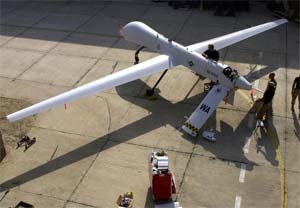
At a cost of about $40 million dollars per system, the RQ-1/MQ-1 Predator is a pricey yet integral part of US Air Force operations in Iraq and Afghanistan. Operating by remote control, the Predator can cover a section of territory with excellent loitering endurance and not expose friendly aircrew to enemy fire or capture. As it stands, the US Air Force currently maintains some 97 General Atomics-produced Predators in its inventory and utilizes the system in both the reconnaissance and armed reconnaissance roles.
 |
| Perhaps the future of powered flight, the MQ-1 Predator has seen some success in the armed reconnaissance role as well as basic spying duties. |
The Predator began service as the RQ-1, indicating her strictly unarmed reconnaissance role. The designation of MQ-1 was appended in 2002 to indicate her new modified form for the armed reconnaissance role.
 |
| The Predator operates remotely under the supervision of three Air Force personnel - one pilot and two sensor operators - though a full team complement consists of 55 personnel. |
The system is fed input via ground equipment and a satellite-ready component known as the Predator Primary Satellite Link. Four Predator aircraft units make up one full Predator group while transportation of Predators is by C-130 Hercules. If operating from a runway in the traditional aircraft sense, the Predator requires very little surface area to land on and take-off from and landing itself is accomplished with a retractable tricycle landing gear system.
 |
Flying the Predator is accomplished through a forward-mounted color camera which feeds real time information to the pilot controlling the unit via joystick while situated in the Ground Control Station. |
Additional infra-red and TV cameras are also fitted into the fuselage and can provide real-time and still image reconnaissance service. In the armed reconnaissance role, the Predator is seen fitted with two AGM-114 Hellfire anti-tank missiles – a munition more commonly associated with the AH-64 Apache combat helicopter - mounted under each wing and can be called on to engage ground-based vehicles through laser-guidance acquisition and targeting. In this mode, the Predator utilizes a powerful built-in laser illuminator / laser designator system with infra-red capability. Powered flight is attained from a single turbocharged Rotax 115 horsepower engine driving a rear-mounted propeller.
 |
| In terms of performance, the MQ-1 can reach ceilings of up to 25,000 feet with a range of 454 miles at speeds of 135 miles per hour (though normal cruise speed is reported to be about 84 miles per hour). |
Wingspan for the unmanned craft measures in at nearly 49 feet and entire system unloaded weighs about 1,100 pounds - two facets that are hardly discernable through aerial images alone. As such, the Predator aircraft is not a smallish aircraft by any sense.
 |
| Incidentally, the Predator initially received the designation of RQ-1 with "R" indicating its reconnaissance role and "1" indicating the initial system series of purposely-built unmanned aircraft. |
"Q" is a designation meaning that this aircraft is unmanned. Since 2002, the system took on the more familiar MQ-1 designation to indicate the addition of an armed reconnaissance duty. The Predator currently appears with three Air Force reconnaissance squadrons.
Avenger
 |
| The General Atomics Avenger is a first in American UAV design, fitting a powerful jet engine instead of a propeller engine. |
The General Atomics Avenger (formerly marked as the "Predator C") is one of the newer UAV systems to come online with the United States military, showcasing some of the very latest in UAV technology. The system was developed from the MQ-9 Reaper series (formerly "Predator B") which itself was designed from the lessons learned in the MQ-1 Predator ("Predator A") and is billed as a true unmanned "combat" air vehicle, defining her role moreso than previous UAV models. The Avenger is a more potent and lethal version of all previous Predator UAVs and should maintain a long and healthy tenure in service to the American Military should her technology live up to her billing. First flight was completed on April 4th, 2009 and the prime contractor is General Atomics Aeronautical Systems of San Diego, California.
 |
| The original Predator A (MQ-1) began life as a reconnaissance platform and was only later modified to carry Hellfire anti-tank missiles. The Predator B (MQ-9 "Reaper") was a second generation predator developed from the beginning to carry weaponry but sported improved performance capabilities. |
The third generation of Predator (Predator C, "Avenger"), is more in line with the current and upcoming crop of 5th Generation fighters being deployed by the USAF. Working in conjunction, this will put the USAF leaps ahead of any air force in existence. One positive selling point of the new Avenger UAV is its use of existing Predator A and Predator B ground-based infrastructure meaning that the US military would need only to procure the Avenger itself and any new available software to run her as they did with the previous Predator offerings.
 |
| What most differentiates the Avenger from previous Predator UAV offerings is its use of a jet-powered engine and her "stealth" qualities. The original and subsequent Predator models both used a "pusher" propeller engine system tied to a combustion engine to achieve adequate performance capabilities and loiter times. |
The Avenger's use of a single Pratt & Whitney PW545B series engine of 4,800lbs thrust now evolves the Predator family line substantially. Her appearance is also more stout and intimidating, a far cry from the fragile stature taken by the earlier MQ-1 and MQ-9 series. Performance specifications include a top speed in excess of 460 miles per hour with an operational ceiling comparable to a military fighter at 60,000 feet. Endurance is listed at 20 hours but this is extendable by way of an optional internal fuel tank taking up space in the bomb bay if need be. The internal fuel tank increases endurance by an additional two hours of flight time.
Externally, the Avenger is of a sleek and ultra-modern design, more akin to perhaps Lockheed's style of designing their new range of stealth aircraft such as the F-22 and F-35. She features the perfect blend of curves coupled with sharp angles to best deflate incoming radar signals meant to track her. The forward portion of the fuselage is devoid of features and appears as a cockpit-less snout. Wings are slightly swept back and fitted along amidships, measuring some 66 feet across. There are no horizontal planes as the Avenger was designed with a "Y" type vertical fin assembly covering the form and function of both vertical and horizontal planes as found on conventional aircraft. There is an identifiable air inlet above the fuselage just behind the center portion of the wings to aspirate the jet engine held within. The engine exhausts at the rear through a diminutive "S" shaped exhaust duct to help reduce its heat signature. The venting is shielded from the ground by a short-running panel extending passed the actual exhaust port..
The Avenger is fitted with the General Atomics-developed "Lynx" Synthetic Aperture Radar (SAR) system as well as the AESA Wide-Area Surveillance Sensor. The former is based on the system that will be incorporated into the Lockheed F-35 Lightning II as part of its Electro-Optical Targeting System (EOTS). She is launched and recovered from conventional runways and makes use of a tricycle undercarriage made up of two main landing gear legs and a nose landing gear leg.
The Avenger makes use of an internal bomb bay to help keep its radar signature to a minimum. She has been cleared to carry the AGM-114 Hellfire anti-tank missile system (common to the Hughes AH-64 Apache attack helicopter), the GBU-24 Paveway III laser-guided bomb, the GBU-31 JDAM (Joint Direct Attack Munition) turning conventional drop bombs into guided threats, and GBU-38 Small Diameter Bombs, bombs designed to improve ordnance carrying capabilities of a given aircraft. Payload is limited to 3,000lbs of internal ordnance. Weapons in the internal bay can be substituted with sensor, electronic and radar equipment as needed.
With the listed performance specifications and capabilities, the Avenger could very well prove to be a potent weapon system for the near future - that is until the enemy developed UAV hunters to cancel out any gains of such combat UAVs as the Avenger. Until then, more human-piloted robots will continue to grace the skies of modern battlefields.
To date, pictures of the Avenger have showcased her with a two-tone grey camouflage paint scheme. Of note during testing was the Avenger's use of a tailhook, perhaps meaning that the Avenger will be evaluated for onboard ship launching/recovery or simply indicating that the UAV will rely on the tailhook to shorten her runway landings.
The Avenger is fully-capable of tackling both combat and reconnaissance-oriented missions, limited only by mission role and payload carried.
Hummingbird
 |
| The Boeing Hummingbird UAV helicopter is actively being reviewed by multiple US military branches. |
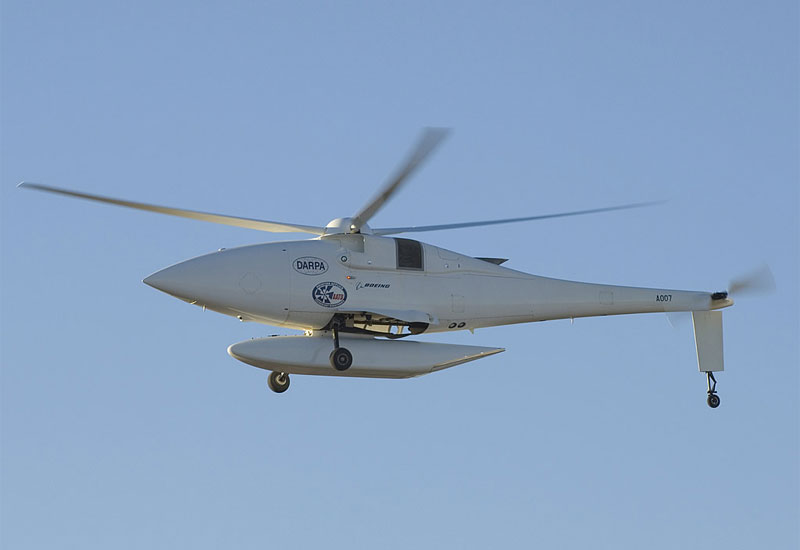 |
| Contractor: Frontier Aircraft / Boeing Phantom Works / Boeing Integrated Defense Systems - Boeing Advanced Systems - USA |
 |
| Designation: Boeing A160 Hummingbird |

IAI Hunter
The Hunter is a large Unmanned Aerial Vehicle (UAV) and was first introduced in 1996 in limited numbers with the United States Army. The system performed admirably well in support of Operation Allied Force over Kosovo where its real-time imagery and communications proved vital. The system was designed in Israel and was fielded by the government militaries of the United States of America, Belgium and France.
 |
| The IAI Hunter Unmanned Aerial Vehicle is operated by two personnel in a ground control station, offering full control over the aircraft component. |
The Hunter design features a distinct twin-boom arrangement and straight edges making it appear very much like the Vietnam-era Rockwell OV-10 Bronco observation two-man aircraft unveiled some decades before (interesting correlation as both conduct the same type of operations to an extent). Another distinct design element is the use of twin engines, one mounted forward and one aft of the fuselage operating in a “push-pull” environment reminiscent of some failed World War 2 aircraft designs. Wings are of a straight monoplane design and mounted to the middle-rear of the fuselage portion. The twin booms connect at rear with a horizontal plane and feature twin vertical tail fins. The undercarriage is static.
The Hunter was born out of a US army need in the late 1980's joint unmanned aerial vehicle program that included the United Navy and Marine branches as well. TRW and Israeli Air Industries were tapped for their design and production of limited-quantity units for operational development beginning with an initial delivery of some seven systems. Like all early UAV systems, the Hunter was initially introduced as an observation / reconnaissance platform providing real-time imagery, target acquisition, artillery adjustment and general surveillance on the modern battlefield. Only later developments of UAVs would yield offensive ordnance and increase the potentiality of UAV systems in general.
The relatively small-sized and ruggedly constructed Hunter can operate from complete or semi-paved surfaces. Rocket assistance (RATO) can further its short take-off and landing capabilities if need be. Standard power is derived from twin Moto-Guzzi 60 horsepower engines. Landing can be equally assisted through the use of arrestor cables. Features of the Hunter UAV include an integrated global positioning system (GPS), forward-looking infrared FLIR, laser designator, VHF/UHF communications and electronic countermeasures. Operation is conducted through a land-based GCS-3000 Ground Control Station (GCS), a vehicle manned by two operators - one controlling flight and the other controlling the payload functions. A Remote Video Terminal (RVT) can operate independently of the GCS or in conjunction with it through a direct link up.
The "Extended" Hunter UAV is nothing more than a high-altitude, longer endurance version of the original Hunter UAV concept. Extended Hunter can traverse the atmosphere at up to 20,000 feet, features a wingspan double the original Hunter and improved range. B-Hunter features an automatic landing system. And is operated by Belgium which purchased six aircraft and two stations in 1998. The Hunter system has seen operational action in Macedonia/Kosovo, where one was reportedly lost to enemy fire within days of deployment. Though in limited use on today’s advancing battlefield, the Hunter UAV was recently used to patrol America's southern border with Mexico in 2004.
RQ-2 Pioneer
The RQ-2 Pioneer series of unmanned aerial vehicles (UAV) was one of the first operational entries into the United States Military family of UAVs. In its early form, the system served battleship vessels with artillery spotting, eventually being devoted wholly to aerial observation of the battlefield (the battleship has since been removed from active service, forcing such an evolution in the Pioneer system). Though not as flashy or powerful as the new generation of unmanned aerial vehicles, the Pioneer was truly just that, a pioneering vehicle that laid down the foundation for an entire UAV family of vehicles in present service with the United States military.
 |
| The RQ-2 Pioneer truly lived up to her namesake in the realm of UAV technology, seeing action beginning with the Persian Gulf War of 1991. |
Design of the RQ-2 produced an aircraft-like aerodynamic fuselage with equipment mounted at front and the single Sachs 2-stroke, 2-cylinder 26 horsepower gasoline piston engine at rear. Wings were mounted high and to the rear of the fuselage and were of a straight edge variety and supported underneath by struts. Twin booms extended aft and were joined by a horizontal plane with twin vertical fins rounding out the empennage. The undercarriage was statically deployed.
The Pioneer developed from a joint agreement between Israel Aircraft Industries (IAI) and AAI Corporation. The system was designed form the outset to perform a variety of unarmed battlefield surveillance and reconnaissance roles and could be launched from land (via catapult or runway) or at sea (via catapult or rocket assist) returning to vessels by way of net or arrestor hook. Flying times varied depending on the overall payload weight but several hours could be achieved. The strength in the Pioneer system lay in its ability to relay real-time information through analog video by way of a line-of-sight (LOS) data link. The RQ-2 Pioneer system was put into action in the Persian Gulf War of 1991, Somalia, Bosnia, Kosovo and Iraq under the operational US branches of the Army, Navy and Marines. It also saw service with forces sponsored by Israel and Singapore.
MQ-1C Warrior
The remotely-piloted General Atomics MQ-1C "Sky Warrior" is part of the ever-growing breed of armed UAV (Unmanned Aerial Vehicle) systems that are being fielded by the United States Army. Recent actions in both Iraq and Afghanistan have finally delivered the need and subsequent technology for such systems and the US Army is actively working to procure such devices for future combat zones. The MQ-1C represents a further development of the fabled Predator UAV line and is a larger, armed version of the former but with improved performance capabilities from a new jet-fuel burning diesel engine. She is categorized as a "hybrid" UAV and, to date, is credited with over 6,000 hours of flight time and the neutralization of some 3,000 enemy insurgents across the Iraqi theater. The Sky Warrior was flight tested sometime in the spring of 2008 with the first missile launch commencing on February 23rd, 2009. The MQ-1C has remained in active operations in Iraq as recently as January 2010.
 |
| The General Atomics MQ-1C Warrior is an upgrade to the existing MQ-1 Predator UAV line. |
The MQ-1C was born out of the US Army's 2002 Extended-Range Multi-Purpose (ERMP) UAV program seeking a UAV platform with improved loiter times. General Atomics, already having garnered the required experience with their Predator UAV family line, submitted a revised form in their "Sky Warrior" product. Similarly, a revised version of the IAI (Israeli Aircraft Industries) RQ-5 Hunter UAV was also considered during the evaluation. The General Atomics product was selected as the winner and assigned the designation of "MQ-1C". A contract was drawn up for further development at a taxpayer cost of approximately $214 million dollars with the full program cost expecting to reach $1 billion dollars.
 |
| The Sky Warrior shares many external design elements with the Predator family line. Of particular note in this revision is its enlarged nose assembly containing a Synthetic Aperture Radar/Ground Moving Target Indicator (SAR-GMTI). |
Compared to the Predators before her, the Sky Warrior also displays a wider wingspan. While her previous forms also made use of a base combustion engine and propeller arrangement, the Sky Warrior delivers its performance through a unique diesel piston system that is fueled by a jet-engine grade mix. This not only supplies the Sky Warrior with improved capabilities, but it is also what allows for the increase in performance at altitude that the US Army was originally looking for from their ERMP program. The avionics suite is made up of the AZ/ZPY-1 STARLite radar system.
 |
| Externally, she shares essentially the same design layout of the former Predators. She sports a straight wing design, these extending out at amidships. |
The fuselage is slender and characterized by the forward housing and the downturned vertical "Y" fins at the rear, themselves split by a third straight vertical fin. The engine is mounted to the extreme rear of the fuselage and is aspirated by a diminutive air inlet atop the fuselage spine. The motor spins a three-bladed propeller system in a "pusher" type arrangement and is capped by a noticeably thick spinner. She features a fully-retractable undercarriage and four external hardpoints for various munition loads or specialized equipment.
 |
| Power is supplied by a single Thielert Centurion 1.7 Heavy Fuel Engine (HFE). Performance includes an operating range equal to 200 nautical miles and an operating altitude between 25,000- and 29,000-feet. |
She can spend up to 36 hours in the air before being recalled. Her maximum speed is in the vicinity of 155 miles per hour. Dimensionally, the Sky Warrior fits a wingspan up to 56 feet and sports a height of 6.9 feet with an overall length of 28 feet. Her maximum take-off-weight is approximately 3,200lbs.
The MQ-1C is part of a new family of armed UAVs working for the United States Army. This supplies the branch with unprecedented flexibility in both seeking out targets of opportunity and in assisting friendly ground forces in contact with the enemy. She is cleared to carry four Hughes AGM-114 Hellfire anti-tank air-to-surface missiles to combat enemy ground vehicles (or enemies held within structures) or up to eight AIM-92 Stinger short-range air-to-air missiles to combat low-flying enemy aircraft such as close-air support platforms of helicopters. Additionally, the Sky Warrior is cleared to carry the GBU-44/B Viper Strike series of guided bombs for pinpoint weapons delivery and heightened accuracy. Ordnance capability is limited to 800lbs. Targeting is handled by way of the AN/AAS-52 Multi-Spectral Targeting System (MTS) fitted to the rotating cylindrical mount under the nose fairing. As with most UAV platforms, the MQ-1C is equally adept at basic reconnaissance sorties, proving to be that all-vital "eye-in-the-sky" that the enemy lacks.
In addition to its self-killing arm, the MQ-1C has also been tested in the lazing of targets for other aircraft, acting in conjunction to produce a lethal "hunter-killer" team. She can guided missiles from Hughes Apache tank-killing helicopters or guided drop ordnance from high-quality airframes such as General Dynamics/Lockheed F-16, the McDonnell Douglas / Boeing F/A-18 Hornet and even the 5th Generation Lockheed F-22 Raptor.
As of this writing, the US Army was planning on procuring some 12 Sky Warrior UAVs along with their applicable ground control units. Full blown operations were expected to begin sometime in 2009. Operations were to be handled solely by Task Force ODIN (Observe, Detect, Identify and Neutralize) based out of Fort Hood, Texas, with use possibly in both theaters of war (Iraq and Afghanistan). Task Force ODIN's performance has already earned them the Army Meritorious Unit Commendation with their work alongside the US Army's 25th Infantry Division.
Originally intended to use the all-new designation of "MQ-12" as selected by the United States Army, the new UAV was actually assigned the Predator-style designation of MQ-1C by the United States Department of Defense instead. In US Army nomenclature, the "M" signifies a UAVs armed role and the "Q" signifies it is an unmanned aircraft system.
The MQ-1C is operated by specially trained operators of the United States Army. Unlike the United States Air Force, which restricts operations of its UAVs to only officers, the US Army allows operation of its UAVs by officers, warrant officers and enlisted personnel. Unlike other UAVs, Sky Warrior operators are actually stationed within Iraqi borders as opposed to operating their UAVs within the United States.
Global Hawk
The Global Hawk is an unmanned aerial vehicle utilized by the United States Air Force and Navy for intelligence gathering and reconnaissance of enemy movements and positions. Despite being one of the larger in the American UAV family, the Global Hawk system has unprecedented range for a UAV and a commander can utilize its long loitering time to his advantage. In any case, the Global Hawk has added a new tool in the commander's toolbox when it comes to finding or fighting an enemy that is hard to find and always on the move - all while not exposing friendly pilots to battlefield dangers.
 |
| The Global Hawk features a 36-hour in-flight endurance time. |
 |
Along with United States Air Force and Navy use, the Global Hawk system is also being considered by several US-friendly allies including Australia, Canada and South Korea. |
An off-shoot of the RQ-4B version of the Global Hawk is being considered for European sale as the EuroHawk.
 |
| This particular model would be fitted with specialized EADS reconnaissance equipment and is under German consideration for purchase. |
The Global Hawk holds an aviation history distinction as being the first unmanned aircraft to fly across the Pacific Ocean, from the United States to Australia.
 |
| The Global Hawk |
Aquila
The MGM-105 Aquila (Eagle) TADAR (Target Acquisition, Designation and Aerial Reconnaissance) was the first United States Army attempt at securing a reusable Unmanned Aerial Vehicle (UAV) capable of conducting a range of mission types. The Aquila was originally developed as "Little R" by Lockheed Missiles and Space Company beginning in the 1970's. Army specifications called for a cost-effective system of small size able to provide the US Army with real-time aerial reconnaissance, target acquisition, artillery observation and laser designation. Unfortunately for the Aquila - and the US Army and Lockheed itself for that matter - the MQM-105 became a bloated and expensive project that never lived up to expectations, forcing the entire development effort to be cancelled.
 |
Despite it never seeing production, just under 1 billion USD was spent on developing the Aquila UAV. |
By 1974, Lockheed and the US Army had partnered for development of the new UAV. In December of 1975, flyable prototypes emerged as the XMQM-105A. By August of 1979, the US Army was fully onboard with the Aquila project and rewarded Lockheed with a contract based on the prototypes. The follow-up developmental model appeared in July of 1982 as the YMQM-105A.
 |
| The Aquila design fitted a swept-back wing to a flat fuselage shape housing the UAVs payload and engine. |
The engine was a Herbrandson Dyad 280B 2-stroke system delivering 24 horsepower to a pusher-type propeller system housed in the rear of the fuselage. On board systems included a fixed daytime TV-camera with an integrated autotracker. A laser designator was also included. A night-vision system utilizing FLIR was planned but never enacted. Communications was provided for via a datalink and video downlink. Performance from the piston engine allowed a top speed of 130 miles per hour with a service ceiling of 14,800 feet and an in-flight time of 3 hours.
Launching was accomplished via a catapult system mounted onto a truck while retreival was via an erected netting to catch the incoming Aquila upon return. Net height was adjustable to protect the vehicle's profile and the Aquila was fitted with infrared sensors that automatically brought led itself into the netting.
As may be expected in such pioneering efforts, the Aquila project met with its own inherent deficiencies. Several Aquilas were lost or damaged in crashes while the cost of the project seemingly ballooned with each passing month to go along with changing mission parameters.
The MGM-105 project was officially cancelled in 1987 despite nearly 1 billion dollars sunk into the project. Some 376 Aquila's were slated to be built. Lockheed was also considering an export version.
Eagle Eye
The Bell Eagle Eye (company Model 918) is/was an Unmanned Aerial System (UAS) developed to compete in the US Navy's "Vertical Take-off - Unmanned Aerial Vehicle program" (VT-UAV). Like most other current-generation UAVs, the Eagle Eye is billed as a system that can work in adverse weather conditions and provide real-time battlefield assessment reporting for her operators. The program claims to promotes less in the way of the required manpower and maintenance hours than that of conventional manned aircraft currently in service. The use of UAV/UAS systems also deletes the possibility of a pilot being downed and killed or captured by the enemy as UAV/UAS operators can be stationed stateside without direct exposure to the enemy itself.
 |
| The interesting Bell Helicopter Eagle Eye tilt-rotor UAV has, to this point, failed to generate much market interest as of yet. |
There is an inherent benefit to a rotary aircraft systems and their ability to land and take-off from solid surfaces. Such a platform does not require a runway or launch catapult/retrieval net system from which to operate with. A tilt-rotor system can take-off and land as would a conventional helicopter but can fly as a conventional fixed-wing aircraft thanks to its adjustable engine nacelles. Loitering for a rotary-type aircraft is an advantageous proposition when compared to the fixed-wing, straight-flight first and second generation UAVs like the Predator series - such "birds" needing to circle around a given target area. The Eagle Eye can utilize its twin-rotor capability to stand "on station" in a given airspace for the duration allowed by its internal fuel supply. Of course, this can expose the Eagle Eye to more accurate ground-based fire for its hovering nature and size may promote for a bigger, more stationary target. The Eagle Eye has also completed testing from both land- and sea-based origins proving further its capability. The latter environment is of note for it exposed the UAS to a variety of sea conditions including an unstable launching/retrieval platform and the expected corroding sea elements that generally take a toll on internal and external systems alike.
Bell began work on the Eagle Eye in 1993 and constructed its first scale model prototype under the designation of "TR911X". Two demonstrator examples were eventually produced under this mark with a first-flight recorded on March 6th, 1998. Each of these prototypes mounted a single Allison 250-C20 series turboshaft engine. Shortly thereafter, the Eagle Eye was entered into a requisite flight test program that would consist of two phases - one based on land and the other at sea. While the first prototype was lost to accident during the ensuing trials, the second prototype managed to complete its trials without notable incident. While the US Navy and the US Marine Corps both held early interest in the UAS, the Eagle Eye languished without suitors for a time and no further evaluation models were ordered by any parties.
In 2002, a full-size version was constructed under the designation of "TR918". This new version was fitted with a single Pratt & Whitney Canada PW207D turboshaft engine. The United States Coast Guard took interest in the tilt-rotor system and worked with Bell on a larger version of the original technology demonstrator. In theory, the Eagle Eye would have been a good match for the Search and Rescue (SAR) minded Coast Guard, able to utilize its excellent loitering times in search of at-sea survivors or tracking down corruptible elements attempting to smuggle "goods" onto US soil. The resulting Bell/USCG design became the "HV-911". However, once again the Eagle Eye would wait for its "day in the sun" for the Coast Guard ended up putting the earmarked production funds on indefinite hold.
Design of the Bell Eagle Eye is not unlike that of the larger manned Bell-Boeing V-22 Osprey tilt-rotor transport helicopter. The Eagle Eye features a centralized fuselage containing the major electronic and digital components that bring life to the system as well as manage the main powerplant. Straight wings are affixed to the fuselage and each maintain a single rotor system via drive shafts from the coupled transmission system. There is a noticeable air intake scoop mounted to the top of the fuselage and the fuselage itself tapers off into the empennage. The tail section features horizontal stabilizer planes to either side and each mounts an inclined vertical tail fin. The undercarriage is made up of two double-tired main landing gear legs, one fitted as a nose leg and the other as a fuselage leg. There is a pair of smallish outboard landing gear legs fitted to the rear of each rotor nacelle and come into play when the nacelles are in the fixed upward angle during landing/takeoff. The payload capacity of the Eagle Eye is a reported 200lbs and can be utilized for reconnaissance, surveillance, Electronic Warfare (EW) and armament loads as a given sortie requires.
If the developmental HV-911 is taken as the final production form, it could feature the aforementioned Pratt & Whitney Canada PW207D series turboshaft engine. This powerplant will deliver up to 641 horsepower to the pair of outboard tilt-rotor assemblies mounted to each wingtip. Each rotor assembly spins a three-bladed rotor system. Based on the evaluation test results, the Eagle Eye will feature a maximum speed of up to 225 miles per hour with a service ceiling of roughly 20,000 feet. Endurance from the single engine will be roughly six hours - an excellent advantage when considering the loitering nature of battlefield UAVs or Search and Rescue (SAR) airborne elements.
Though American procurement of the Eagle Eye has stymied, there has been more interest developed by foreign powers overseas. Bell has teamed up with the German firm of Rheinmetall Defense Electronics and the French firm of Sagem to possibly bring the Eagle Eye to operational service in European inventories. This arrangement is such that - assuming they blossom - the European bureaus will be able to assign whatever payload is needed for their particular Eagle Eye airframe. Bell will simply be responsible for construction and delivery of the machine airframes, engines and avionics systems themselves. Such is the flexibility inherent in the Eagle Eye design.
MQ-9 Reaper
The MQ-9 "Reaper" ("M" = multirole; "Q" = Unmanned Aerial Vehicle; "9" = series designation) offers the United States Air Force a high-level, remotely-piloted weapons platform capable of instant action and precise engagement. Appearing very similar outwardly to the original Predator series of UAV's, the Reaper is in fact a larger derivative featuring more power in terms of both powerplant and munitions-delivery capabilities. The RQ-1/MQ-1 "Predator" (Predator A) is a first generation series Predator UAV, starting life as an unarmed reconnaissance platform (RQ-1) and only being armed later in her tenure (becoming the MQ-1). The MQ-9 "Reaper" (Predator B) became the next logical evolution in the series, starting out from the gates as an armed reconnaissance platform with better performance capabilities in a larger airframe. The MQ-9 system is fully-portable and can break down in sections for airlifting in a Lockheed C-130 transport. The basic design of the pilot-less aircraft still allows for take-off and landings to occur on any given runway.
 |
| The MQ-9 Reaper maintains a role of hunter-killer for the United States Air Force. |
The MQ-9 Reaper was inducted into service in 2004 to play a major role in the United States effort on the "War on Terrorism". The Reaper is capable of carrying and delivering munitions from two external hardpoints in the form of anti-tank Hellfire missiles and the GBU-12 and GBU-38 series of JDAM bombs. In essence, the Reaper is termed a "hunter/killer" system, equally capable of operating in the stratosphere as a real-time reconnaissance drone and being able to engage said target as needed. Imaging is accomplished through intensified TV, daylight TV and IR sensor cameras along with an integrated laser rangefinder that doubles as a laser designator for the direct-guided JDAM munitions.
 |
| Operation of an MQ-9 Reaper is accomplished through a series of on-the-ground support vehicles and equipment stations. |
A single qualified airman flies the Reaper via joystick control, observing the activity through a color nose-mounted camera and other in-flight reporting systems.
 |
| MQ-9 Reaper in full operational service, all with the United States Air Force active forces. |
 |
| The MQ-9 will be superseded by the larger, jet-powered, stealthy Avenger (Predator C) series of combat UAV in the near future. |
 |
| At the very core of any UAV program is this ability to keep allied airmen risk-free from any hostile action. |
ScanEagle
The ScanEagle is a joint production UAV (Unmanned Aerial Vehicle) by The Boeing Company and The Insitu Group. As a whole, the program is based highly on the Insitu SeaScan UAV aircraft but coupled with Boeing's expertise in the field of aircraft systems engineering. The ScanEagle has already posted over 10,000 hours of real-world flight time and has proven itself to be billed as advertised. The ScanEagle is charged with all-weather remote reconnaissance and target tracking with exception loitering capabilities.
 |
| The ScanEagle has already proven its worth over the skies of Iraq with more than 10,000 flight hours. |
The ScanEagle can be fitted with either infrared or electro-optical type cameras. Situations are presented and reported in real time and the system is capable of over 48 hours of flight time. Launching is achieved autonomously from a catapult system. Landing is achieved through a "skyhook" approach - a practice which has the ScanEagle catch a rope mounted to a 50-foot high pole at a designated position.
The Boeing product represents a low-cost solution to a potentially regarding need. The ScanEagle was designed from the outset to be operated from ocean-going ships meaning that the proven catapult and hook retrieval systems are just what the doctor ordered. The diminutive size also lends in allowing the system to be stored away aboard navy ships that already deal with limited spacing. First flight of the ScanEagle occurred in 2002 and the system is still going strong, being fielded with the United States Marine Corps and the United States Navy in support of operations in Iraq.
RQ-7 Shadow
The AAI Corporation RQ-7 Shadow is an unarmed tactical reconnaissance unmanned aerial vehicle currently in active service with the United States Army and Marine Corps. The system serves as a day-night, target acquisition, surveillance and battlefield assessment platform by commanders on the ground. Similar in design to AAI's previous UAV offering in the RQ-2 Pioneer, the RQ-7 Shadow has seen extensive service in the skies over Iraq and Afghanistan.
 |
| The RQ-7 Shadow is currently operating over the skies of Iraq. |
Design-wise, the Shadow 200 features a straight monoplane high-wing fixed to the rear of the fuselage. The fuselage itself is smooth with straight faces and a fixed undercarriage consists of two main wheels and a nose wheel. Tubular tail booms extend from the trailing edge of each wing and straddle the rear-mounted, propeller-driven pusher engine. The tail section ends in a unique angle-up shape. The bread-and-butter of the system is its electro-optical/infrared real-time relay camera held underneath the fuselage. The camera is gimbal-mounted and digitally-stabilized.
 |
Shadow UAV's do not have the capacity to operate on their own and as such are fielded with integral components that make up a complete Shadow system. |
A Shadow system will consist of four Shadow UAVs, a rail launch trailer, personnel vehicles and two ground stations. The Shadow is rail-launched and recovered on a runway via a tail hook. Preparation time to get a Shadow in the air can be as little as 1 hour.
 |
| The RQ-7A is just over 11 feet long with a wingspan of nearly 13 feet and a height of 3 feet. The system weighs in at roughly 165lbs empty and 328lbs with a maximum payload. |
Power is derived from a single UEL AR-741 rotary piston engine of 208cc generating 38 horsepower. The engine is set up in a "pusher" fashion at the extreme end of the fuselage nacelle. A ceiling of up to 14,000 feet is reported with an endurance time of some 5 hours.
 |
| The RQ-7B variant is an improvement over the original production A models in almost every way. |
The wings have been redesigned with a larger surface and new airfoil along with a new tail unit. Fuel capacity has been increased which has effectively increased the Shadow's operational endurance limit to 7 hours (up from 5 hours in initial production models). Payload options have been expanded and the data link system has been upgraded to the Tactical Common Data Link (TCDL). Production of the RQ-7B began in the summer of 2004.
 |
Besides supplying ground commanders with a "bird's eye view" of the battlefield in real-time, the Shadow is capable of carrying and dropping valuable medical supplies to ground troops via "Quick-MEDS (Medical Emergency Delivery System). |
Two such 20lb canisters can be delivered underwing. A "signals interception" package is also in development.
Ultimately, up to 88 Shadows are expected to be delivered with at least 20 already in operation as of this writing. Shadows have completed over 37,000 sorties and 300,000 flight hours with Army National Guard and United States Army units in Iraq.
RQ-7 derives its name from the Department of Defense designation system for UAV's. The "R" stands for Reconnaissance while the "Q" designates it as an unmanned aircraft. The number "7" notes it as the seventh purposely developed unmanned aircraft in the series of unmanned aerial aircraft systems in service with the US military.


