Thursday, October 31, 2013
Friday, October 25, 2013
The ADS amphibious assault rifle is built by the state-owned KBP company. It's based on the venerated A-91M bullpup assault rifle platform and fires 5.45x39mm M74 rounds (the same used by the AK-74) when on land. It also accepts an underbarrel GP-30 40mm grenade launcher and a host of optical sights.

Wednesday, October 16, 2013
The Sherman Firefly was one of the most important Sherman variant
Outwardly, the Sherman Firefly VC series of tank destroyers looked every
bit like their M4 Sherman base counterparts. Closer examination however
would reveal a system that was finally capable of dealing with the
impressive German Tigers and Panthers at distance. The Sherman Firefly
would go on to become one of the more important Sherman tank derivatives
of World War 2.
The Americans proposed mounting a 90mm main gun to the existing system but were later turned off to the idea of having to redesign an entirely new turret for the new system. Not to leave well enough alone, the British continued to believe that the upgunned Sherman variant was a viable cause an proceeded to mount their own 17-pounder gun into one of their many Shermans in stock. With a new turret design and a little modification to the base Sherman design, the Sherman Firefly was born - this Sherman mounting an impressive 76.2mm main gun along with a single Browning-type 7.62mm machine gun. The Allies finally found an answer to German battlefield dominance.
From the outset, Allied tank crews were at a disadvantage when tangling with the well-armored German tanks, needing numbers and ingenuity to usually overcome their counterparts. This resulted in Allied tank crews zeroing in for a near-point blank hit to the side or rear of the German units. The Firefly now gave the Allies some punch at distance, with the Firefly able to effectively engage targets some 1,000 yards away. As more impressive munitions became available in the latter months of the war, the destructive power of the Firefly became ever moreso something for Axis tank crews to contend with. So definitive was the arrival of the Sherman Firefly that German anti-tank crews and tanks received explicit orders to engage and eliminate Fireflys as the first priority in any given engagement.
The British converted some 600 of their basic M4A4 Sherman tanks into Fireflys with some 160 landing into the hands of American forces. It should be noted that these conversion models basically inherited the armor protection of their base M4A4 models meaning that no additional armor protection was given to the new Firefly design. As such, Firefly tank crews would still have been wary of their own safety when in the line of enemy fire. Fireflys would appear in the Normandy beach landings of 1944 and were later attached to standard tank battalions onwards, though it was initially seen that Fireflys would be fielded as their own squadrons.
 |
| The British and Americans were already looking into an upgunned version of the successful Sherman tank, seeing it that it was available in quantity with a progressive stream coming off the assembly lines at a record pace. |
The Americans proposed mounting a 90mm main gun to the existing system but were later turned off to the idea of having to redesign an entirely new turret for the new system. Not to leave well enough alone, the British continued to believe that the upgunned Sherman variant was a viable cause an proceeded to mount their own 17-pounder gun into one of their many Shermans in stock. With a new turret design and a little modification to the base Sherman design, the Sherman Firefly was born - this Sherman mounting an impressive 76.2mm main gun along with a single Browning-type 7.62mm machine gun. The Allies finally found an answer to German battlefield dominance.
From the outset, Allied tank crews were at a disadvantage when tangling with the well-armored German tanks, needing numbers and ingenuity to usually overcome their counterparts. This resulted in Allied tank crews zeroing in for a near-point blank hit to the side or rear of the German units. The Firefly now gave the Allies some punch at distance, with the Firefly able to effectively engage targets some 1,000 yards away. As more impressive munitions became available in the latter months of the war, the destructive power of the Firefly became ever moreso something for Axis tank crews to contend with. So definitive was the arrival of the Sherman Firefly that German anti-tank crews and tanks received explicit orders to engage and eliminate Fireflys as the first priority in any given engagement.
The British converted some 600 of their basic M4A4 Sherman tanks into Fireflys with some 160 landing into the hands of American forces. It should be noted that these conversion models basically inherited the armor protection of their base M4A4 models meaning that no additional armor protection was given to the new Firefly design. As such, Firefly tank crews would still have been wary of their own safety when in the line of enemy fire. Fireflys would appear in the Normandy beach landings of 1944 and were later attached to standard tank battalions onwards, though it was initially seen that Fireflys would be fielded as their own squadrons.
Monday, October 14, 2013
OTs-12
OTs-12 "Tiss" compact assault rifle (manufacturer's index ОЦ-12 "Тисс", also sometimes spelled as OC-12 in English-language sources) was briefly manufactured during early 1990s by the TSKIB SOO (Central Design Bureau for Sporting and Hunting Arms, located in the city of Tula). It was intended for police use, and was closely based on the AKS-74U compact assault rifle, with main difference being usage of the large caliber, subsonic 9x39 ammunition, which provided significant stopping power and barrier penetration capabilities at short and medium ranges (up to 200-300 meters). Only several hundreds of OTs-12 rifles were made at TSKIB SOO in about 1993, but the mass production, which was anticipated at Tula arms factory, never commenced. Few OTs-12 rifles are still in use by some Law Enforcement units across the Russia.

The OTs-12 "Tiss" compact assault rifle by design is similar to the Kalashnikov AKS-74U rifle, featuring same gas-operated, rotary bolt action, as well as similar controls and furniture, including side-folding skeletonized buttstock. Main differences include new barrel with muzzle brake / compensator, new bolt and a new 20-round magazine for 9x39 ammunition.
Caliber: 9x39 mm SP-5, SP-6
Action: Gas operated, rotating bolt
Overall length: 490 mm (butt folded) or 730 mm (butt extended)
Barrel length: 200 mm
Weight: 2.5 kg empty
Rate of fire: rounds per minute
Magazine capacity: 20 rounds
The OTs-12 "Tiss" compact assault rifle by design is similar to the Kalashnikov AKS-74U rifle, featuring same gas-operated, rotary bolt action, as well as similar controls and furniture, including side-folding skeletonized buttstock. Main differences include new barrel with muzzle brake / compensator, new bolt and a new 20-round magazine for 9x39 ammunition.
Caliber: 9x39 mm SP-5, SP-6
Action: Gas operated, rotating bolt
Overall length: 490 mm (butt folded) or 730 mm (butt extended)
Barrel length: 200 mm
Weight: 2.5 kg empty
Rate of fire: rounds per minute
Magazine capacity: 20 rounds
Thursday, October 3, 2013
TKB-517 Korobov
German A. Korobov, Russian gun designer from Tula, began the development of assault rifles soon after the World War Two,when he designed the TKB-408 bullpup rifle for 1946-47Soviet Army trials. Despite the failure of TKB-408, Korobov continued the development of various assault rifles, both in bullpup and traditional configurations. During late 1940s, he tried gas delayed blowback action in his series of TKB-454 experimental assault rifles, all chambered for standard issue 7.62x39 ammunition. While these rifles displayed some good results in accuracy department, these also showed insufficient reliability. By the 1952, Korobov switched to the Kiraly-type retarded blowback action, with the two-part bolt that uses braking action of the lever, interposed between bolt parts and receiver. This action allowed for significant increase of accuracy, as well as simplification of design and production, compared to then-standard Kalashnikov AK assault rifles.
During mid-1950s, Soviet Army initiates new trials for improved assault rifle design in the same 7.62x39 M43 caliber. Korobov submits his improved TKB-517 rifle, still based on the Kiraly type delayed blowback action; this weapon was extensively tested against modified Kalashnikov AK rifle, as well a number of other designs, and found to be superior to all. Korobov was found to be most accurate and controllable in full automatic mode (primary mode of fire, according to Soviet tactical doctrine), especially when fired from the shoulder or from the hip. It was also significantly lighter and less expensive to make than modified AK. Nevertheless, Soviet Army preferred less effective, but familiar and already well established Kalashnikov AKM over the more effective and lighter, but entirely new design.
TKB-517 is delayed (retarded) blowback operated weapon, that uses two-part bolt system, designed prior to WW2 by Paul Kiraly of Hungary. In this system, bolt has two parts -lighter breech block with breech face and extractor, and heavier bolt carrier. A two-arm lever is interposed between these two parts; lower arm of the lever rests against the receiver when bolt is fully closed. When gun is fired, pressure in the chamber forces the cartridge case backwards and against the breech face.Bolt begins to travel back, but the lever acts as a mechanical disadvantage,transferring the short movement of the light bolt to the longer movement of the heavy bolt carrier. This action is sufficient to slow down initial movement of the breech face before the bullet leaves the barrel. Once the pressure in the barrel is low enough, the lever breaks the contact with the receiver, and the rest of recoil cycle both bolt parts complete as a single unit. Similar system later has been used in the French FAMAS assault rifle.receiver of TKB-517 has been made from stamped steel, furniture was made from wood. Charging handle was attached to the bolt carrier at the right side. Safety/ fire mode selector was located above the pistol grip, also at the right side of the gun. TKB-517 used standard AK/AKM type magazines, including large-capacity 40 and 75-round ones, developed for RPK light machine gun.
Caliber: 7.62x39mm M43
Action: Delayed blowback
Magazine capacity: 30 rounds
 |
| Korobov TKB-517 assault rifle. The small "tube" above the barrel is a cleaning rod. |
During mid-1950s, Soviet Army initiates new trials for improved assault rifle design in the same 7.62x39 M43 caliber. Korobov submits his improved TKB-517 rifle, still based on the Kiraly type delayed blowback action; this weapon was extensively tested against modified Kalashnikov AK rifle, as well a number of other designs, and found to be superior to all. Korobov was found to be most accurate and controllable in full automatic mode (primary mode of fire, according to Soviet tactical doctrine), especially when fired from the shoulder or from the hip. It was also significantly lighter and less expensive to make than modified AK. Nevertheless, Soviet Army preferred less effective, but familiar and already well established Kalashnikov AKM over the more effective and lighter, but entirely new design.
TKB-517 is delayed (retarded) blowback operated weapon, that uses two-part bolt system, designed prior to WW2 by Paul Kiraly of Hungary. In this system, bolt has two parts -lighter breech block with breech face and extractor, and heavier bolt carrier. A two-arm lever is interposed between these two parts; lower arm of the lever rests against the receiver when bolt is fully closed. When gun is fired, pressure in the chamber forces the cartridge case backwards and against the breech face.Bolt begins to travel back, but the lever acts as a mechanical disadvantage,transferring the short movement of the light bolt to the longer movement of the heavy bolt carrier. This action is sufficient to slow down initial movement of the breech face before the bullet leaves the barrel. Once the pressure in the barrel is low enough, the lever breaks the contact with the receiver, and the rest of recoil cycle both bolt parts complete as a single unit. Similar system later has been used in the French FAMAS assault rifle.receiver of TKB-517 has been made from stamped steel, furniture was made from wood. Charging handle was attached to the bolt carrier at the right side. Safety/ fire mode selector was located above the pistol grip, also at the right side of the gun. TKB-517 used standard AK/AKM type magazines, including large-capacity 40 and 75-round ones, developed for RPK light machine gun.
Caliber: 7.62x39mm M43
Action: Delayed blowback
Magazine capacity: 30 rounds
Wednesday, September 25, 2013
US flamethrower during WW2 - The M1 series
There are many ways in which to decimate one's enemy - arguably one of the most terrible being fire. Fire has remained a feared battlefield element since ancient times when it was used to both severely maim an individual or group, frighten those under its reach and bring about destruction to flammable structures. By medieval times, "liquid fire" was in the fold, perhaps most notably utilized by the Byzantine Navy, and continued fire's dominance for centuries thereafter.
Modern day "flamethrowers" were first unveiled by the German Army in World War 1. These cumbersome machines could require up to three soldiers to move the system about the battlefield and, while the psychological effect was there, it was hardly practical in the heat of an offensive. Nevertheless, the these weapons saw first use in the Argonne forest against the French Army as early as 1914 and saw much publicized use against the same enemy in the 1916 campaign at Verdun. Despite the global disgust towards these new weapons of war - perhaps no worse than the chemical agents being lobbed against trench adversaries throughout the conflict - the flamethrower was here to stay, generally accepted by all sides and soon developed (or outright copied) by other nations. World War 1 ultimately ended in November of 1918 and the flamethrower had more or less seen its day in the sun.
The "flamethrower", as we know it today, had officially arrived. After their use in the opening salvos of World War 2 (seeing ever-improved forms), the British Army brought back into the fold their old World War 1-era flame-throwing developments. Likewise, the Australians put financing into a similar indigenous product all their own. The Japanese Army was also keen on the prospects of the flamethrower as a weapon through use of their Type 93 and Type 100 series. The Soviets had already been developing flamethrowers themselves by 1941. Before America had officially committed to the war effort, plans were already underway to design and develop an indigenous flamethrower system.
In 1940, the United States Army came down with a requirement for a new man-portable flame-throwing system. The department in charge for the design and development of the new weapon was the "Chemical Warfare Service". However, the department had little-to-no knowledge of how to proceed with the program and nothing of which to go by in beginning their endeavor. As such, they focused their efforts upon the flamethrowers utilized by the Wehrmacht (German Army). A prototype model - the "Flame-Thrower E1" was quickly developed and eventually evolved into the "E1R1" developmental model. Progress was deemed far enough along to send the E1R1 into trials. The E1R1 featured two large vertically-set tanks, each containing the needed fuel and a third, slimmer tank mounted atop and between the two fuel tanks contained the required propellant. The tanks were worn on the back of the operator as a backpack and fed to the "flame gun" dispenser (essentially a pipe) through a flexible tube line. The flame gun was held with two hands, one on the handle-grip type appendage and the other along the forend of the dispenser. A thin hydrogen tank was fitted laterally across the length of the flame gun and supplied the needed ignition. A battery pack was used to ignite the hydrogen by way of a spark, the hydrogen in turn igniting the outgoing fuel supply. A valve located at the aft end of the flame gun - the portion seeing the hose line connecting to the gun - was controlled by the operator.
Operation was such as that found on a rifle, though most often times fired from the hip as opposed to the shoulder. The firing action brought about a stream of "liquid fire" from the muzzle of the flame gun, the liquid fuel ignited at the nozzle end as it exited the gun. The pressurized tank allowed for a steady stream and the operator could "spray" an area in much the same way a person could spray a garden bed with a hose. Most trial images of the M1-in-training showcased the operator down on one knee, the M1 flame gun aimed upwards for arcing fire. In reality, this stance was not always possible.
The M1
The need for a flamethrower for the US Army was such that even some of these evaluation models were featured in operational assaults in Papau before the type was officially approved for active service. The operational evaluation did the project some good, though, for several key shortcomings were soon revealed in the American design. The E1R1 system was prone to breakdowns in the field and proved relatively unreliable in the harsh battlefield conditions. The controls were noted for their ill-placement and the machine was generally not a trusted weapon in the heat of battle. As such, the board took to refining the base design - attempting to produce a more robust and reliable system - and the new weapon was therefore accepted into service as the "Portable Flame-Thrower M1". American was fully committed to World War 2 after December 7th, 1941 following the surprise Japanese attack on Pearl Harbor, Hawaii and the M1 would soon be put to dastardly use.
The M1 differed only subtly from the E1R1 developmental model, retaining the same basic shape and configuration of the tanks. Production of the M1 began in March of 1942 and the weapon was soon to see action the following January in the Guadalcanal action. In theory, the M1 was a solid design effort with several key ingredients ironed out during its refinement process. However, once in practice, the M1 continued to fail its operators, sometimes at the worst possible times. One of the major drawbacks of the M1 became its ignition system which relied on electrical power supplied to the flame gun via batteries. In testing, this ignition method proved adequate but when pressed into the grimy, violent and unpredictable world of war, this solution was far from perfect. The construction material of each tank was also liable to develop small, unseen holes from general metal corrosion which ultimately allowed both pressure and liquids to unknowingly escape. As such, a special service was opened by the United States Army to specifically manage, repair and inspect all outgoing M1 throwers before their use in combat.
The M1A1
In June of 1943, American was engulfed in World War across two separate fronts - one to the East throughout North Africa/Europe against the forces of Italy/Germany and the other to the West in the Pacific against the Empire of Japan. Development for an improved M1 model was ongoing and deliveries of the new M1A1 soon began. Napalm was now being used as an additive in the tanks to produce a "thicker" fuel store thus increasing the flamethrower's operational range and damage effect. This thicker fuel differentiated the M1A1 from the M1 in that the M1 was categorized by it using "light" fuel. While range of the original M1 was roughly out to 30 yards, the M1A1 could now yield a flame burst out to 50 yards. The operational weight of the M1A1 was also reduced to a more "manageable" 65lbs. Despite the inadequacies of the ignition system inherent in the M1, it remained unchanged in the improved M1A1. By this time, however, American troops had learned to overcome its deficiencies and resorted to lighting their throwers by whatever means they had available - burning paper, matchsticks and even personal cigarette lighters were just some of the published methods. Some 14,000 M1A1s were ultimately produced and delivered to awaiting infantry platoons. Their operations took them across Italy and Germany though their use was severely limited throughout Europe following the end of the Normandy Campaign in 1944. Use of the M1/M1A1 continued throughout the Pacific however.
The M1/M1A1 in the Pacific
The M1/M1A1 were found to be highly relied upon in weeding out the fanatic Japanese defenders on through the required island campaigns of the Pacific Theater. The flamethrower served American Marines well in engaging dug-in foes in foxholes, tunnels and bunkers. Additionally, the flamethrower worked extremely well for clearing out dry cover brush as found throughout the islands. In some instances, the mere appearance of the flamethrower led some enemy soldiers to surrender - such was the psychological power of "liquid flame", even centuries after the Byzantines.
M1/M1A1 Limitations
If there were limits to the reach of the flame-throwing unit, it was in range, inherent danger and portability to the operator himself. The 30- to 50-yard range was an impressive range on the testing and training courses of America. But in the field of combat, this often involved the operator to expose most of his body when engaging suspected enemy positions. This led to the use needlessly putting himself in harm's way. The size of the tanks and general stance of the infantryman called to bear the M1/M1A1 system also made for a juicy target to the enemy in which one solid shot could force the compression tanks to explode, engulfing the operator and those near him in a ball of flame. To add insult to injury, the M1/M1A1 system could weigh in as much as 70lbs - the infantryman called to carry the weapon would have to do so under combat conditions, trudging himself, his gear and the weapon through mud, rocky terrain, woods and humid jungle settings.
Values Despite the Drawbacks
Despite the drawbacks, the flamethrower proved to still have some value. The sheer psychological effect was second to none for there were few enemy soldiers willing to die in a blast of hot liquid flame. There was little escaping fire too, for its crevice-finding ways were similar to that of water - if there was a will, there was a way. And if the flame itself did not reach the intended target, perhaps the heat would - and intense heat has a way of moving a man out from hiding.
The M2
By the middle of 1943, the Chemical Warfare Service had developed more of sense of what the infantryman needed out of his flamethrower, based on after-action reports and feedback. This ultimately led to the development of the much-improved M2 flamethrower series with its new rotary cartridge ignition system. The M1 series was soon-after replaced by the M2 and production surpassed that of both M1 and M1A1 models combined.
End of the Road
Ultimately, all portable flamethrowers were more or less given up in favor of tank-mounted flame guns. This offered better range and protection for the crew and made for a more imposing target to the enemy.
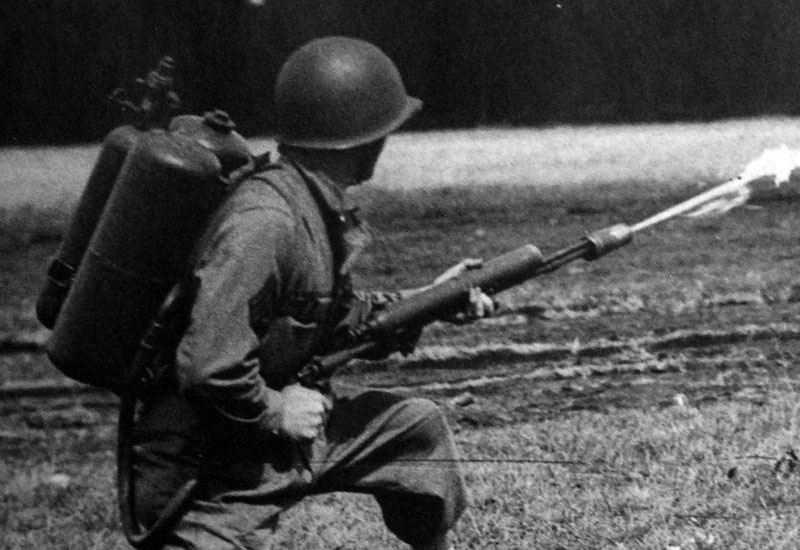 |
| The M1 / M1A1 series of flamethrowers saw widespread us by American forces in the Pacific Theater. |
Modern day "flamethrowers" were first unveiled by the German Army in World War 1. These cumbersome machines could require up to three soldiers to move the system about the battlefield and, while the psychological effect was there, it was hardly practical in the heat of an offensive. Nevertheless, the these weapons saw first use in the Argonne forest against the French Army as early as 1914 and saw much publicized use against the same enemy in the 1916 campaign at Verdun. Despite the global disgust towards these new weapons of war - perhaps no worse than the chemical agents being lobbed against trench adversaries throughout the conflict - the flamethrower was here to stay, generally accepted by all sides and soon developed (or outright copied) by other nations. World War 1 ultimately ended in November of 1918 and the flamethrower had more or less seen its day in the sun.
 |
| Within time, the rebuilding German Army under Adolph Hitler had begun replacing the large World War 1-era systems with man-portable components known under the family name of "Flammenwerfer" throughout the 1930s. |
The "flamethrower", as we know it today, had officially arrived. After their use in the opening salvos of World War 2 (seeing ever-improved forms), the British Army brought back into the fold their old World War 1-era flame-throwing developments. Likewise, the Australians put financing into a similar indigenous product all their own. The Japanese Army was also keen on the prospects of the flamethrower as a weapon through use of their Type 93 and Type 100 series. The Soviets had already been developing flamethrowers themselves by 1941. Before America had officially committed to the war effort, plans were already underway to design and develop an indigenous flamethrower system.
In 1940, the United States Army came down with a requirement for a new man-portable flame-throwing system. The department in charge for the design and development of the new weapon was the "Chemical Warfare Service". However, the department had little-to-no knowledge of how to proceed with the program and nothing of which to go by in beginning their endeavor. As such, they focused their efforts upon the flamethrowers utilized by the Wehrmacht (German Army). A prototype model - the "Flame-Thrower E1" was quickly developed and eventually evolved into the "E1R1" developmental model. Progress was deemed far enough along to send the E1R1 into trials. The E1R1 featured two large vertically-set tanks, each containing the needed fuel and a third, slimmer tank mounted atop and between the two fuel tanks contained the required propellant. The tanks were worn on the back of the operator as a backpack and fed to the "flame gun" dispenser (essentially a pipe) through a flexible tube line. The flame gun was held with two hands, one on the handle-grip type appendage and the other along the forend of the dispenser. A thin hydrogen tank was fitted laterally across the length of the flame gun and supplied the needed ignition. A battery pack was used to ignite the hydrogen by way of a spark, the hydrogen in turn igniting the outgoing fuel supply. A valve located at the aft end of the flame gun - the portion seeing the hose line connecting to the gun - was controlled by the operator.
Operation was such as that found on a rifle, though most often times fired from the hip as opposed to the shoulder. The firing action brought about a stream of "liquid fire" from the muzzle of the flame gun, the liquid fuel ignited at the nozzle end as it exited the gun. The pressurized tank allowed for a steady stream and the operator could "spray" an area in much the same way a person could spray a garden bed with a hose. Most trial images of the M1-in-training showcased the operator down on one knee, the M1 flame gun aimed upwards for arcing fire. In reality, this stance was not always possible.
The M1
The need for a flamethrower for the US Army was such that even some of these evaluation models were featured in operational assaults in Papau before the type was officially approved for active service. The operational evaluation did the project some good, though, for several key shortcomings were soon revealed in the American design. The E1R1 system was prone to breakdowns in the field and proved relatively unreliable in the harsh battlefield conditions. The controls were noted for their ill-placement and the machine was generally not a trusted weapon in the heat of battle. As such, the board took to refining the base design - attempting to produce a more robust and reliable system - and the new weapon was therefore accepted into service as the "Portable Flame-Thrower M1". American was fully committed to World War 2 after December 7th, 1941 following the surprise Japanese attack on Pearl Harbor, Hawaii and the M1 would soon be put to dastardly use.
The M1 differed only subtly from the E1R1 developmental model, retaining the same basic shape and configuration of the tanks. Production of the M1 began in March of 1942 and the weapon was soon to see action the following January in the Guadalcanal action. In theory, the M1 was a solid design effort with several key ingredients ironed out during its refinement process. However, once in practice, the M1 continued to fail its operators, sometimes at the worst possible times. One of the major drawbacks of the M1 became its ignition system which relied on electrical power supplied to the flame gun via batteries. In testing, this ignition method proved adequate but when pressed into the grimy, violent and unpredictable world of war, this solution was far from perfect. The construction material of each tank was also liable to develop small, unseen holes from general metal corrosion which ultimately allowed both pressure and liquids to unknowingly escape. As such, a special service was opened by the United States Army to specifically manage, repair and inspect all outgoing M1 throwers before their use in combat.
The M1A1
In June of 1943, American was engulfed in World War across two separate fronts - one to the East throughout North Africa/Europe against the forces of Italy/Germany and the other to the West in the Pacific against the Empire of Japan. Development for an improved M1 model was ongoing and deliveries of the new M1A1 soon began. Napalm was now being used as an additive in the tanks to produce a "thicker" fuel store thus increasing the flamethrower's operational range and damage effect. This thicker fuel differentiated the M1A1 from the M1 in that the M1 was categorized by it using "light" fuel. While range of the original M1 was roughly out to 30 yards, the M1A1 could now yield a flame burst out to 50 yards. The operational weight of the M1A1 was also reduced to a more "manageable" 65lbs. Despite the inadequacies of the ignition system inherent in the M1, it remained unchanged in the improved M1A1. By this time, however, American troops had learned to overcome its deficiencies and resorted to lighting their throwers by whatever means they had available - burning paper, matchsticks and even personal cigarette lighters were just some of the published methods. Some 14,000 M1A1s were ultimately produced and delivered to awaiting infantry platoons. Their operations took them across Italy and Germany though their use was severely limited throughout Europe following the end of the Normandy Campaign in 1944. Use of the M1/M1A1 continued throughout the Pacific however.
The M1/M1A1 in the Pacific
The M1/M1A1 were found to be highly relied upon in weeding out the fanatic Japanese defenders on through the required island campaigns of the Pacific Theater. The flamethrower served American Marines well in engaging dug-in foes in foxholes, tunnels and bunkers. Additionally, the flamethrower worked extremely well for clearing out dry cover brush as found throughout the islands. In some instances, the mere appearance of the flamethrower led some enemy soldiers to surrender - such was the psychological power of "liquid flame", even centuries after the Byzantines.
M1/M1A1 Limitations
If there were limits to the reach of the flame-throwing unit, it was in range, inherent danger and portability to the operator himself. The 30- to 50-yard range was an impressive range on the testing and training courses of America. But in the field of combat, this often involved the operator to expose most of his body when engaging suspected enemy positions. This led to the use needlessly putting himself in harm's way. The size of the tanks and general stance of the infantryman called to bear the M1/M1A1 system also made for a juicy target to the enemy in which one solid shot could force the compression tanks to explode, engulfing the operator and those near him in a ball of flame. To add insult to injury, the M1/M1A1 system could weigh in as much as 70lbs - the infantryman called to carry the weapon would have to do so under combat conditions, trudging himself, his gear and the weapon through mud, rocky terrain, woods and humid jungle settings.
Values Despite the Drawbacks
Despite the drawbacks, the flamethrower proved to still have some value. The sheer psychological effect was second to none for there were few enemy soldiers willing to die in a blast of hot liquid flame. There was little escaping fire too, for its crevice-finding ways were similar to that of water - if there was a will, there was a way. And if the flame itself did not reach the intended target, perhaps the heat would - and intense heat has a way of moving a man out from hiding.
The M2
By the middle of 1943, the Chemical Warfare Service had developed more of sense of what the infantryman needed out of his flamethrower, based on after-action reports and feedback. This ultimately led to the development of the much-improved M2 flamethrower series with its new rotary cartridge ignition system. The M1 series was soon-after replaced by the M2 and production surpassed that of both M1 and M1A1 models combined.
End of the Road
Ultimately, all portable flamethrowers were more or less given up in favor of tank-mounted flame guns. This offered better range and protection for the crew and made for a more imposing target to the enemy.
Wednesday, September 18, 2013
Korobov TKB-408
The TKB-408 assault rifle has been developed by designer German A. Korobov by 1946. This weapon has been designed in Tula, for 1946 Soviet Army trials for anew assault rifle. Usually claimed as a first military-type automatic rifle of bullpup configuration, this weapon, in fact, has been preceded by several designs that appeared during the WW2 in Great Britain and USSR (i.e. Korovin 7.62mm experimental assault rifle of 1945). This weapon was tested by Soviet Army commission in 1946-47, but was found unsatisfactory; eventually, trials were won by Kalashnikov AK rifle.

TKB-408 is gas operated, locked breech weapon that uses vertically tilting bolt to lock the barrel. Cocking handle is located at the left side of the weapon,above the wooden handguard; it does not reciprocate when gun is fired. Gun fired in full automatic mode and in single shots. Firing mode selector is located at the left side of receiver, above pistol grip. Separate safety switch is located within the trigger-guard, in front of the trigger. Ejection port is located at the right side of weapon, above the magazine, and has flip-down dust cover.There were no provisions for firing from the left shoulder. TKB-408 used proprietary magazines, made from sheet steel. each magazine held 30 rounds and had a forward projection that entered the magazine lock, located at the bottom of pistol grip. Weapon was mostly made of stamped steel, with wooden buttstock and handguard.
Caliber: 7.62x39mm M43
Action: Gas operated, tilting bolt
Overall length: 790 mm
Weight: 4.3 kg
Magazine capacity: 30 rounds
TKB-408 is gas operated, locked breech weapon that uses vertically tilting bolt to lock the barrel. Cocking handle is located at the left side of the weapon,above the wooden handguard; it does not reciprocate when gun is fired. Gun fired in full automatic mode and in single shots. Firing mode selector is located at the left side of receiver, above pistol grip. Separate safety switch is located within the trigger-guard, in front of the trigger. Ejection port is located at the right side of weapon, above the magazine, and has flip-down dust cover.There were no provisions for firing from the left shoulder. TKB-408 used proprietary magazines, made from sheet steel. each magazine held 30 rounds and had a forward projection that entered the magazine lock, located at the bottom of pistol grip. Weapon was mostly made of stamped steel, with wooden buttstock and handguard.
Caliber: 7.62x39mm M43
Action: Gas operated, tilting bolt
Overall length: 790 mm
Weight: 4.3 kg
Magazine capacity: 30 rounds
Subscribe to:
Posts (Atom)
LinkWithin
