Showing posts with label Anti-Aircraft Gun. Show all posts

Wednesday, May 13, 2015

WWII German 12.8cm Flak 40 Zwilling

The 12.8 cm Flak 40 was a German anti-aircraft gun used during World War II, most famously in the Flakturms around some of the major cities in Germany including of course Berlin.

Although this gun was intended to replace the 88 mm gun it was unsuccessful in it’s bid for major production numbers but remained one of the most effective anti-aircraft guns of the war. This twin mount cannon 12.8 cm FlaK 40 Zwilling Twin mounted anti-aircraft was capable of firing 20 rounds per minute. Production started in 1942 with 10 twin sets produced, then another eight in 1943 and in February 1945 a total of 34 were available for the German forces. 
 The barrel weighed 12 tons in firing position, making it difficult to deploy and move, so in 1938, new solutions were made. The solution had to simplify the platform fire based on the idea that this gun would be mounted only on a concrete slab. Nevertheless, the system carried the weight of the barrel to 26.5 tons, making it impossible to tow the field. In August 1944, 450 of the single mount guns had been built and it was intended to equip the 250 anti-aircraft towers around Berlin and the other mounted on rail-cars.

AA versions firing a shell 26 kg with an initial velocity of 880 m / s 10 675m, compared to 88; 128 used 4 times more powder to initiate the explosive charge. The AT versions firing a shell of 26.4 kilograms could penetrate 200 mm of armour at close range, 120 mm at 2,000 m.


Thursday, March 1, 2012

M1939 (61-K) 37 mm automatic air defense gun


37-mm automatic anti-aircraft gun 61-K in Saint Petersburg Artillery museum


37 mm automatic air defense gun M1939 (61-K) (Russian: 37-мм автоматическая зенитная пушка образца 1939 года (61-К)) was a Soviet 37 mm caliber anti-aircraft gun developed during the late 1930s and used during World War II. The land based version was replaced in Soviet service by the ZSU-57-2 during the 1950s. Guns of this type were successfully used throughout the Eastern Front against dive bombers and other low- and medium-altitude targets. It also had some usefulness against lightly armored ground targets. Crews of the 37 mm AD guns shot down 14,657 Axis planes. The mean quantity of 37 mm ammunition to shoot down one enemy plane was 905 rounds.

Soviet '''M1939''' 37 mm AA gun


The Soviet Navy purchased a number of Bofors 25 mm Model 1933 guns in 1935, trials of the weapon were successful and it was decided to develop a 45 mm version of the weapon designated the 49-K. The development under the guidance of leading Soviet designers M. N. Loginov, I. A. Lyamin and L. V. Lyuliev was successful, but the army thought that the 45 mm calibre was a little too large for an automatic field weapon. In January 1938 Artillery Factory Number 8 in Kaliningrad was ordered to develop a 37 mm weapon based on the same design. The task was fulfilled by the chief designer of the Factory Mikhail Loginov and his assistant Lev Loktev. Firing trials of the new 61-K were conducted in October 1938.

Competitive firing trials were conducted in 1940 between the 61-K and the Bofors 40 mm/56. They found that there were no substantial differences between them.

Land version

The weapon was initially installed as a single barrel weapon on a four wheeled ZU-7 carriage, and was soon ready for service. An initial order for 900 units was placed. The gun was operated by a crew of eight men. A total of 200 rounds of ammunition were carried which were fed into the gun in five round clips. Total Soviet production was around 20,000 units, ending in 1945. However, it has also been produced in Poland, China and North Korea.
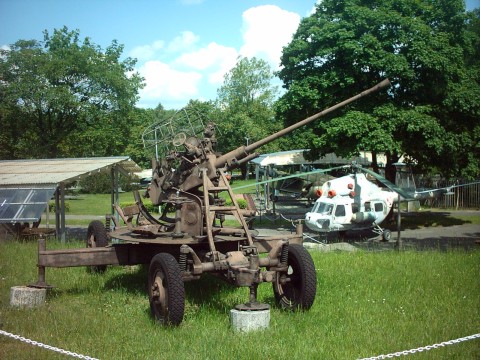
61-K in Poznan citadel, Poland.


Armour penetration of the armour-piercing (AP) rounds is reported as 37 millimeters of Rolled homogeneous armour (RHA) at 60°at 500 meters range and 28 millimeters of RHA at 90° at 1500 meters range.

Naval version

The naval mounting was produced as the 70K, and had entered service before the German invasion of the Soviet Union replacing the semi-automatic 45 mm/46 21-K on many ships. It was fitted in large numbers to Soviet ships during the Second World War, notably the T301 class minesweeper. The V70K was produced until 1955, with a total of 3,113 built.
V-11 as a memorial to the defenders of Seraya Loshad fort

V-11 as a memorial to the defenders of Seraya Loshad fort


One drawback was that the 70K required a barrel change after every 100 rounds fired. To improve on this, a twin barreled water cooled mount, the V-11 (called "W-11" in East Germany and Poland because of different Cyrillic trasliteration), entered service in 1946, and was in production until 1957. A total of 1,872 V-11 mounts were built.

After this an 85-caliber 100 mm (3.9 in) anti-aircraft mounts long version, the 45 mm/85, was developed and accepted into service in 1954, it was deployed in twin and quad turrets on a number of classes of vessels, including the Neustrashimy, Kildin and Kotlin class destroyers. However it was later replaced with the ZIF-31 twin 57 mm mounting.

The 37 mm twin mounting was exported to China where it was manufactured and used extensively, as the "Type 65". A turret based version was produced from the late 1980s called the "Type 76" or H/PJA 76.

ZSU-37

The ZSU-37 was developed late in the Second World War, it was a single 37 mm gun mounted in a large open turret on the chassis of the SU-76 self propelled gun.

Monday, February 27, 2012

M1939 (52-K) 85 mm air defense gun


The 85mm Model 1939 was nothing more than an enlarged version of the existing 76.2mm M1938 system.


Throughout the 1930s, aircraft development was evolving by leaps and bounds across the world. As such, air defense forces of the world needed a similar evolution to keep pace with many of the current ground-based offerings having become outmoded by faster and higher flying aircraft. The Soviet Union was one such military force that had a vast amount airspace to concern itself with should she ever be invaded. As opposed to developing an entirely new system from scratch for the Red Army, Soviet authorities elected to utilize the existing - and successful - 76.2mm (3-inch) Model 1938 air defense gun as the basis for a new, more potent and capable weapon.


Design and development work soon yielded the 85mm (3.346-inch) Model 1939 air defense gun. Similar in scope and operation to her predecessor, the Model 1939 was essentially nothing more than an enlarged and upgunned version of the original 76.2mm system. A key differentiating feature was a multi-baffled muzzle brake fitted to the business end of the barrel, a physical feature that the Model 1938 clearly lacked. An forward facing armored shield could be affixed to the gun mount as an option for added crew protection during the heat of battle but offered little true protection overall. Like the fabled "88" anti-aircraft guns of the German Army, the Red Army also saw double value in their M1939 and attention in design was also given to utilizing it as an anti-tank defense weapon should the need arise.

The 85mm gun mount sat on a four-wheeled traveling carriage for maximum portability. The carriage could be transported into position by any number of towing vehicles then in service with the Red Army, from trucks and jeeps to light tanks. The seven man crew could also pushed the gun into a precise position once at a target area. The gun system itself was fully positional apart from the carriage and could attain an upwards attack angle to target incoming enemy aircraft or a leveled attack angle to counter oncoming enemy vehicles or infantry. Elevation limits were stated at +82 and -2 degrees while traverse was a full 360-degrees. When in transport, the gun was leveled and locked into place with an inverted "vee" type bracket. The weapon weighed in at 9,303lbs when traveling and 6,739lbs when made ready to fire. Overall, the system measured in at over 23 feet when in transit while the barrel itself was over 15 feet long. Along with the standard flak in-air exploding shrapnel rounds, M1939 crews were also issued with a supply of anti-tank projectiles.

By the time the M1939 was entering production, the facilities at Kaliningrad outside of Moscow came under direct threat from the surprise German invasion of the Soviet Union in 1941. As such, the Soviets took to moving the manufacturing equipment out of the area and relocating them to the safety of the Ural mountains to the East. Within time, the facilities were set in place and production of the new M1939 soon got underway. When the delivery numbers dictated, the M1939 was officially recognized as the standard anti-aircraft defense gun of the Soviet Army.

The M1939 proved an excellent gun platform throughout the war. The system was delivered to the active fronts and utilized in defense of strategic positions. The weapon proved quite valuable in the war for both sides, so much so in fact, that even the Germans considered its capture as something of a war trophy. Enough M1939s and available 85mm ammunition were captured by the advancing German Army that many M1939s were reconstituted back into service for the Wehrmacht under the designation of 8.5cm Flak M.39(r) and used extensively alongside their excellent 88mm guns with powerful results. Additionally, other captured M1939s were delivered back to Germany, rebored to the standard German Army 88mm caliber and setup in defense of the homeland under the new designation of 8.8cm Flak M.39(r).

The M1939 was replaced in its role with the Soviet Army by the more powerful 85mm Model 1944 series (KS-18) before the end of the war. The Model 1944 was more or less the same gun system as the M1939 before it, however, its projectiles were issued with a propellant charge of increased power, making the M1944 a better alternative to the M1939. The 85mm gun was further modified for use in the SU-85 tank destroyer and many M1939/M1944 guns were still in use throughout the air war over Vietnam of the late 1960s and early 1970s. The M1939 can still be found in operational service with a few countries around the globe, mostly former Soviet satellite states and Cold War allies.
NANG THIS POST, NANG THIS POST, NANG THIS POST

LinkWithin

Related Posts with Thumbnails