
Showing posts with label Robot. Show all posts
Showing posts with label Robot. Show all posts
Wednesday, July 8, 2015
Thursday, February 6, 2014
Tuesday, December 13, 2011
Drones: A deeply unsettling future
SEE ALJAZEERA: http://www.aljazeera.com/indepth/opinion/2011/12/201112774824829807.html
San Francisco, California - On Sunday, Iran claimed to have taken down a US drone in Iranian airspace - not by shooting it out the sky, but with its cyber warfare team.
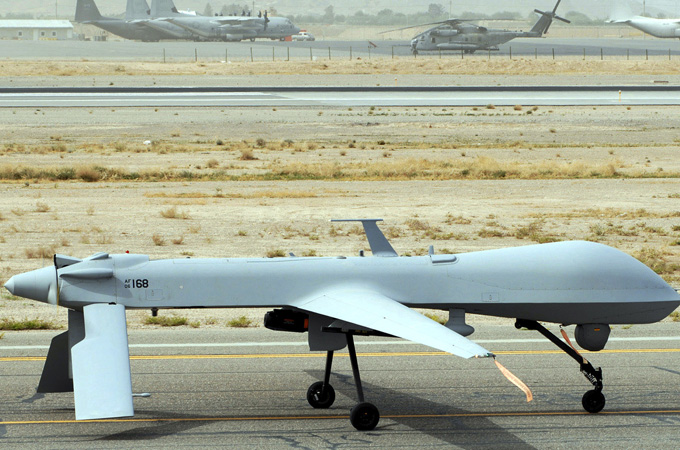
Two years ago the Wall Street Journal reported Iran-funded militants in Iraq were able to hack into drones' live-video feeds with "$26 off-the-shelf software". In another unnerving incident, Wired reported in October that a fleet of the Air Force's drones was infected with a computer virus that captured all of drones' key strokes. Technicians continually deleted the virus to no avail. How did the drones get infected? The military is "not quite sure". Worse, the Air Force's cyber security team didn't even know about the virus until they read about it in Wired.
Wired reported in a separate story that an upcoming Congressional report will detail how hackers broke into the US satellite system. With one satellite, hackers "achieved all steps required to command" it, "but never actually exercised control".
Last summer, a drone caused a scene in the nation's capital, when, as New York Times wrote, "fighter jets were almost scrambled after a rogue Fire Scout drone, the size of a small helicopter, wandered into Washington's restricted airspace". A similar incident took place in Afghanistan where military planes had to shoot down a "runaway drone" when pilots lost control.
The US, of course, leads the world in drone use for both surveillance and combat missions. Attacks are carried out in Pakistan every four days on average. Many times, the US isn't even sure exactly who they are killing. Despite the fact that the location of vast majority of drone bases are classified, journalist Nick Turse pieced together a startling picture of the massive US fleet. He determined that the US has at least 60 drone bases operated by either the US military or the CIA around the world, and "most of these facilities have remained unnoted, uncounted, and remarkably anonymous - until now".
But drone use is not just relegated to US military. Drone manufacturers already command a $94bn market, according to some estimates, and the drone arms race is in full swing. As the Washington Post reported, the constant buzz of drones and threats of attack now dominates the lives of civilians in Gaza. And Turkey plans to have Predator drones in operation by June 2012.
Meanwhile, Chinese contractors unveiled 25 types of unmanned aircraft last year. In all, at least 50 countries now have some sort of unmanned aerial vehicles, and the New York Times reports that "the number is rising every month". That number also includes Iran, which is seeking to upgrade its fleet. Even the Libyan rebels had their own surveillance drone - provided to them by Canadian defence contractors - before they were in full control of their own country.
The technology itself is also developing at an alarmingly rapid pace. The New York Times reports that researchers in the US are working on "shrinking unmanned drones, the kind that fire missiles into Pakistan and spy on insurgents in Afghanistan, to the size of insects", along with oversized drones that can capture video of an entire city. There are birdlike drones, underwater drones, drones within drones, facial recognition drones, and perhaps most terrifying, completely autonomous drones - currently being tested in Georgia - which will require no human control at all.
As Micah Zenko, Senior Fellow at the Council on Foreign Relations, told me last month, "It's a very impressive and responsive tool that should be used sparingly. Even if we’re responsible now, we might not be forever."
But in the US, drones will become yet another way authorities can compromise the privacy of ordinary citizens, as the FAA plans to propose new rules for their domestic flight. As Newsweek reported, police forces and border patrols in the US are buying the technology from defence contractors, and one has already been spotted flying over Houston. Police departments are already using GPS and cell phone tracking without warrants, this will another powerful surveillance weapon in their arsenal. As privacy advocates warn, "drones can easily be equipped with facial recognition cameras, infrared cameras, or open Wi-Fi sniffers". And while these drones will be used for many surveillance purposes (a scary thought in and of itself), contractors admit they are equipped to carry weapons, such as Tasers.
Whether they are being used for surveillance or all-out combat, drones will soon pose serious risks for all of the world's citizens. They can offer governments, police departments, or private citizens unprecedented capabilities for spying, and given their security vulnerabilities, the potential consequences could be endless.

Tuesday, June 14, 2011
Modern Robots at War
REMOTEC ANDROS F6A
 |
| The REMOTEC ANDROS RONS has proven most effective in IED disposal across the Iraqi Theater. |

The "ANDROS" (collectively a part of the RONS - "Remote Ordnance Neutralization System") is a class of remotely-controlled bomb disposal robot used by the American military as well as by SWAT and law enforcement groups. The basic kit includes the LCD monitor, the RONS robot itself, the communications cable supply and the applicable tools needed to keep the RONS functioning at peak performance. Operators are trained on an EOD Robot Training Simulator. The use of robots on the battlefields of today removes the direct risk that EOD personnel were often exposed to in their everyday actions. Most of us rarely have the threat of being blown up in our workplace - EOD personnel lived with that threat routinely until the increased use of battlefield robots made it possible for them to handle explosives from a distance away. In Iraq where the IED is a top killer of American and coalition troops, systems such as the RONS has become a godsend to service personnel and their families. The ANDROS family of robots is designed by the REMOTEC firm, operating as a subsidiary of defense giant Northrop Grumman. Northrop claims to have some 1,000 ANDROS robots in circulation worldwide. There are five major ANDROS variants currently in circulation with the base model being the "F6A".

The ANDROS F6A

The F6A weighs in at a respectable 485lbs, features an extending manipulator arm (25lb limit) and four cameras. She is marketed as a "heavy duty" robot with the speed and agility to handle most any task. There is a color camera with full light, zoom, pan and tilt functions. Another camera serves the operator with 216:1 zoom and image stabilization. There is an 80-watt adjustable halogen light and an optional IR lens. The extension arm maintains a third camera with 40:1 zoom capability. There is also a 24-inch camera extender. The two-way weatherproof communications system offers the ANDROS operator full listening capability by way of a microphone and speaker. The gripper arm is fully positional with seven degrees of freedom and can be fitted with optional sensor or weapon systems as needed. Pneumatic wheels can replace the base tracked system without the need for tools to be used in the conversion. The integrated track system allows for traverse across a variety of uneven surfaces including ditches (up to 21-inches), obstacles (up to 18-inches) and stairs (up to 45.75 degree slopes). Three data links make up the communications/control system on the ANDROS F6A. A fiber-optic cable is fed from a spool mounted to the rear of the main compartment. Top speed is approximately 3.5 miles per hour and the turning radius is essentially the length of the robot thanks to its track system. The switchbox can be removed to allow for direct connection to the robot itself. ANDROS accessories include the control station, audio/video attachments, various manipulator arm tools, optional sensors, spare battery kit and maintenance kits.

The operator views the ANDROS actions by way of a 15" LCD anti-glare monitor with picture-in-picture display to access all camera mounts at once. The screen displays current battery life of the console, camera settings and sensor information. The camera feeds can all be recorded and the operator had access to an optional headset display system. Control is by way of joystick.

Other ANDROS Models
The Mark VA1 is similar to the F6A model but is larger and weighs in at 790lbs. The "Mini ANDROS-II" is a smaller cousin to the base ANDROS and weighs just 225lbs. The "Wolverine" is the largest of the ANDROS family line and tops the scales at 810lbs. The "Wolverine V2" was a custom design solution weighing in at 1,200lbs to be used for traversing underground mines for the Mine Safety and Health Administration service. She sports a wheeled or tracked design as required by the operator. The HD1 is another wheeled or tracked design but the smallest in the ANDROS family line at just 200lbs.

ANDROS F6A Walk-Around

The basic body compartment of the RONS houses the battery and motor, controlling the extended RONS functions. One of the four available cameras is fitted to a telescoping "neck" and helps to provide the visual cues and references back to the operator, viewing what the RONS "sees" on his/her LCD monitor display. There are four accessible quick-action rubber-tired road wheels, two to a side. These can be replaced in use by the integrated tracked wheel system to allow for traverse across uneven terrain including staircases. The rear of the body compartment maintains the cable supply along a spool. The main arm attachment is a large, two-finger grappling system with a wide range of movement and plays a prominent role in the handling of explosive ordnance. The RONS provides adequate mobility and close-range manipulation capabilities at a relatively acceptable purchase and operating cost. Each system is directed via a remote human interface a distance away. Communications from operator to robot are held transceiver/received within a secure communications channel.

Current Use and Deployment

Based on a Naval Sea Systems Command report, all four services of the United States military have fielded some version of RONS with over 270 having been purchased in total. Continuous improvements have extended the life of each system and battlefield experience has brought about changes to doctrine. Over a five year span alone, some 35 improvement programs have been run on RONS and EOD teams have seen considerable activity with the systems across Iraq. The RONS program has also benefitted from EOD personnel returning from the Iraqi Theater of War and offering their experiences for future development of RONS systems. Iraqi military forces are also being trained by American personnel in use of the RONS and like systems in combating the IED threat.

URBOT

The URBOT can perform a series of tasks including examination and destruction of IED (Improvised Explosive Devices). It has seen use in bomb squads and in the battlefield (Operation Iraqi Freedom). The system is operated by remote control. Planned variants include a mobile remote controlled battlefield surgeon unit and an armed hunter-killer type system.
Subscribe to:
Posts (Atom)
LinkWithin
