Tuesday, January 10, 2012

HK33 and HK53


HK33A2

HK33 had been developed by the German company Heckler und Koch in mid-to late 1960s as a scaled-down version of their G3 battle rifle, and entered production in 1968. HK33 was developed for then-new cartridge, 5.56x45mm (.223 Remington), and while it had not been adopted by German military, it saw significant use by some West Germany police and security units, and also widely exported, and used by Malaysia, Chile and Thailand armed forces. Since 1999, HK33 also manufactured under license in Turkey. HK33 is still in production in Germany by HK, and also served as a platform for further developments, such as G-41 assault rifle and HK53 compact assault rifle (known by HK as a submachine gun).

HK53A2

HK53 is a ultra-compact version of HK33, which advertised by HK as a "submachine gun" and, by common sense, falls in the same category as soviet AKS-74U or Colt "Commando". All these guns can be classified as "compact (or short) assault rifles" by the fact that they used the intermediate rifle round. HK53 was developed in mid-1970s and is still in production and offered for export.

HK33 is a delayed blowback operated, selective fire rifle, that utilized two pieces bolt with two rollers that used to delay bolt blowback. The receiver is made from stamped steel, and HK33 is available with either a polymer fixed buttstock (HK33A2) or retractable metallic buttstock (HK33A3). Carbine version of the HK33 also available and featured shorter barrels and similar fixed or retractable stocks (HK33KA2 and HK33KA3, respectively).

All HK33 variants available with different trigger units, with or without 3-rounds burst mode. HK's proprietary claw-type mounts allow telescopic sights to be mounted on any version of HK33. Full-length HK33s can be equipped with bayonet or underbarrel 40mm grenade launchers, HK79A1, also made by Heckler & Koch. Full-length HK33 rifles also can launch rifle grenades from combined muzzle compensator/flash hider. All HK33 and HK53 guns are equipped with drum-type rear sights.

HK53A3 with retractable buttstock

HK53 is internally similar to the HK33 but cannot fire rifle grenades nor mount underbarrel 40mm grenade launcher. HK53 also cannot be equipped with bayonet, and featured long, four-prong flash hider.

Both HK33 and HK53 can use 25, 30 and 40 round box magazines, but latter are out of production by HK for some time.


HK33 HK33K HK53
Caliber 5.56x45mm (.223 Rem) 5.56x45mm (.223 Rem) 5.56x45mm (.223 Rem)
Length 919 mm
740 mm with retracted stock in A3 variant
865 mm
670 mm with retracted stock in A3 variant
780 mm
590 mm with retracted stock in A3 variant
Barrel length 390 mm 322 mm 211 mm
Weight empty 3.9 kg 3.65 kg 3.0 kg
Magazine capacity 25, 30, 40 rounds 25, 30, 40 rounds 25, 30, 40 rounds
Rate of fire 750 rds/min 750 rds/min 750 rds/min
 

Friday, January 6, 2012

Various anti-tank rocket launcher systems


Panzerfaust 3


The Panzerfaust 3 has been modernized to defeat the latest in tank armor.

The Panzerfaust 3 is a single-shot disposable anti-tank rocket launcher (only the sight and firing systems are reusable). It is designed to be a close range system to defeat heavy armor and to be used primarily in an urban warfare setting (where close range fighting is expected). No doubt the system itself stemmed from experience in fighting Soviet armored forces in the streets of Berlin during World War Two, with German and civilian forces being armed with the original Panzerfaust series of tank-busters.


Early design drawbacks included excessive weight for a single-man portable battlefield system (leading to the weapon being uncomfortably cumbersome) and jamming issues within the launcher's firing mechanism. In fact, one of the greatest design flaws was that the rocket itself was found not to penetrate the heaviest of armors as advertised, leading to a redesign of the entire system. The redesign also minimized the 'back blast' that occurred when the system was fired, making the system somewhat safer to be fired out from within close quarters.


A later model designated as the PzF 3-T was put into service with a few notable improvements on the original system including a dual hollow-charge warhead. This specialized warhead was developed exclusively to compete with the newer explosive reactive armor that made its appearance as optional add-ons to many tank systems.

The latest Panzerfaust 3 variant in service is designated the PzF 3-IT-600.

Specifications for the Dynamit-Nobel Panzerfaust 3
Operation:
Action: Spring Coil Mechanism Ignition
Cartridge: 90mm launcher
Feed System: 1 x 110mm rocket
Maximum / Effective Range: 1,640ft (500m; 547yds)

Dimensions:
Overall Length: 1200mm (47.24in)


AT4

The AT4 is the primary anti-armor weapon of the United States Army.

The M136 AT4 is billed as the United States Army's primary light anti-tank weapon system available to infantry squads and is based on the original AT4 anti-tank shoulder-launched munition system. The system can be used by a single operator against armored targets posing a threat to the lively hood of the infantry squads. Essentially, the M136 AT4 operates as a recoilless rifle (as opposed to a guided missile launcher), allowing for high penetration of armored targets and fires a cartridge round measuring over half the length of the launching tube. When fired, the projectile sports spring loaded fins during flight.


The M136's cartridge round is an 84mm High-Explosive Anti-Tank munition with a rocket-type cartridge, fin stabilization and can achieve free flight once it leaves the launcher (not a wire-guided munition). The launcher itself is a single-piece tube system wrapped in fiberglass and is disposable after one shot.


The United States Army has since stopped purchases of the base AT4 anti-tank system in favor of the newer AT4-CS (Confined Space) implement. The AT4-CS is designated as the M136E1 and holds the advantage of being able to fire from confined areas such as inside of buildings, improving its reach in urban settings. The weapon has a listed effective range of 300 meters and weighs in at only 7.5 kilograms. The recoilless qualities of the M136 family allow for just about any trained operator to fire one and its rugged capabilities mean that the system can receive a great deal of in-the-field abuse and not reflect that in its performance.


Specifications for the FFV / Alliant TechSystems M136 AT4 Light Anti-Armor Weapon
Operation:
Action: Single-Shot, Self-Contained Recoilless Rifle
Cartridge: 84mm
Feed System: 1
Muzzle Velocity: 950ft/sec (290m/sec)
Maximum / Effective Range: 985ft (300m; 328yds)
Sights: Range Indicator Rear Sight

Dimensions:
Overall Length: 1020mm (40.16in)
Barrel Length: 1,020.00 (40.16in)
Empty Weight: 1.80kg (3.97lbs)


B-300

The B-300 maintains an advantage of needing only a single user to operate the weapon.

The B-300 is an Israeli Military Industries product and is a man-portable anti-tank weapon system. It is designed to engage enemy tanks or fortified structures depending on the chosen warhead type (HEAT - High Explosive Anti-Tank round or HEFT - High Explosive Follow-Through). The Follow-Through round deals with fortifications in two stages, the first being the penetration phase. The second (i.e. the follow-through) phase, launches a secondary anti-personnel shaped charge into the structure. Design of the B-300 began in the 1970's with production running from 1980 through today.

The B-300 itself had origins in the French-produced STRIM anti-tank rocket launching system. This weapon replaced the American-made 3.5" Super Bazookas in service with the IDF. Review of Israeli Army experience in their 1973 conflict gave notice to the effectiveness of Soviet-produced RPG-7 systems in enemy hands. As such, a competing design by Israel was eventually ushered in, this becoming the B-300.

Physically, the B-300 follows conventional wisdom in design. A pistol grip is positioned slightly forward with the firing mechanism on a pistol grip and trigger assembly positioned near center of the firing tube. A folding bipod is positioned just aft of the pistol grip as is a retractable shoulder rest. Sights include integrated standard front and rear battle sights and a variable scope mounting. Scope types include the Starlight scope (via adapter) for night operations and Stadia Sighting Telescope with integrated Beta light for improved dawn/dusk efficiency.

The B-300 weighs in at 3.65 kilograms empty and at 8 kilograms loaded. The system is 1,440 millimeters in length and can fire 3 rounds per minute. Sights include the standard iron sights but this can be augmented with the use of telescopic sights and night vision scopes. Its ease of use allows various military components to utilize the weapon as needed - this includes airborne and mechanized infantrymen alike.

The B-300 won the US Marines competition trials to become the SMAW bunker buster weapon.

The B-300 has seen active combat use in the 1st and 2nd Intifadas as well as the 2006 Lebanon War.

Specifications for the IMI B-300
Operation:
Action: Not Applicable
Cartridge: 82mm
Feed System: 1
Cyclic Rate-of-Fire: 3rds/min
Maximum / Effective Range: 1,312ft (400m; 437yds)
Sights: Iron; Night Vision; Telescopic; Starlight; Sighting

Dimensions:
Overall Length: 1440mm (56.69in)
Barrel Length: 0.00 (0.00in)
Empty Weight: 3.65kg (8.05lbs)


M141

The M141 is commonly known as the SMAW-D and fills the role of bunker buster for the United States Army.

The M141 (SMAW-D) was developed for the United States Army to fill the role of "bunker buster", though the system itself has proven to be most multi-purpose in nature, particularly in urban the urban warfare setting. The system is used for the destruction of masonry, wood and earthen structures as well as a general light-armored vehicle-stopper. The system has proven useful in the demolition of network caves throughout the mountainous terrains of Afghanistan.


The launcher is of an extending tube type with built-in optics. The rocket features folding spring-loaded fins for in-flight stabilization. Target ranges are within a 15-to-500 meter range. The projectile warhead is high-explosive.


The US Army designates the system as M141 or SMAW-D while the US Marine Corps use the SMAW (Shoulder-launched Multi-purpose Assault Weapon). Warheads featured in the projectiles of the two weapon systems are the same.


Specifications for the IMI M141 Bunker Defeat Munition (BDM) / SMAW-D
Operation:
Action: Disposable Shoulder-Launched Assault Weapon
Cartridge: 83mm
Feed System: 1
Cyclic Rate-of-Fire: 1rds/min
Maximum / Effective Range: 1,640ft (500m; 547yds)
Sights: Iron; Telescopic; Night Vision

Dimensions:
Overall Length: 826mm (32.52in)
Barrel Length: 826.00 (32.52in)
Empty Weight: 7.12kg (15.70lbs)


LRAC 89-F1

The LRAC system was a reusable shoulder-fired rocket launcher developed for the French Army.

The LRAC 89-F1 was developed for the French Army to replace the aging M20A1 Super Bazooka rocket launcher. The M20A1 was an improved form of the World War 2-era American M1 Bazooka launcher and entered production in 1952. The LRAC 89-F1 was constructed out of plastic and fiberglass to promote a lighter carrying weight for those soldiers assigned to operate the system. A typical crew included two personnel, one to handle the launcher itself and the other to facilitate initial loading and subsequent reloading of the launch tube. The LRAC derived its designation from the name of "Lance-Roquettes AntiChar de 89mm modele F1" and was also known as the STRIM 89mm (based on the abbreviation of the name Societe Techique de Recherches Industrielles et Mechanique).

In the mid-1960s, the Societe Techique de Recherches Industrielles et Mechanique was contracted to find a suitable replacement for the outgoing M20A1 series and, in the early 1970s, delivered two viable candidates. The first was a recoilless rifle design known under the designation of ACL-APX with an 80mm projectile assisted in flight by rocket propulsion. The second became the LRAC 89-F1 of 89mm. After evaluation by the French Army, the more promising and cheaper-to-produce LRAC system came out ahead and was selected for procurement and serial production.

As its designation implies, the LRAC 89-F1 fired a rocket of 89mm caliber. Muzzle velocity was rated at 967 feet per second with an effective range within 500 meters and a maximum range out to 2,300 meters. Sighting was accomplished through use of an APX M290 scope and a passive night telescope sight were also available. The base penetration rocket was fin-stabilized (spring-loaded) while in flight and can pierce up to 400mm at a 0-degree angle and up to 110mm at 65-degrees. Broken down, the projectile featured an electric generator at its head followed by the cap and head with the fuse at the midway point. The projectile was then largely made up of the propulsion charge and finally ended with the exhaust nozzle. The launch tube contained the integrated sighting device, trigger mechanism and bipod. The rocket was not made active until the rear tube container was affixed to the launcher. Only then the rocket's propellant was not activated until after the rocket was fired. The rocket was then armed some 32 feet from the launch point.

Design of the base LRAC launcher was essentially a detailed tube. The tube was larger at the rear and tapered off to a consistent forward end. The main control components were held at the center of the tube and included a pistol grip type handle, a retractable forward hand grip and an adjustable ergonomically curved shoulder rest with twin feet (bipod). The sighting system was mounted near the pistol grip unit (or firing generator handle). A carrying handle was set to the right side of the tube body. The rear of the tube was capped by a removable plug and the front by a removable muzzle cover. A back sight notch was mounted atop the business end of the muzzle.

Beyond the base issue rocket, LRAC ammunition included an anti-personnel/anti-vehicle projectile (spraying out up to 1,600 high-speed, molded steel pellets), a pair of smoke projectile (35 second disbursement time in either liquid smoke/phosphorous head forms) and an illumination projectile that burned in air for up to 30 seconds at 300,000 candela power, settling to the ground by a small parachute.

The LRAC 89-F1 in French Army service has since been replaced by the AT4-CS (of Sweden) single-shot and the ERYX portable wire-guided anti-tank weapons. The LRAC does, however, continue service with other militaries around the world, thee being primarily former French colonies residing in Africa.

Specifications for the LRAC 89-F1 (Lance-Roquettes AntiChar de 89mm modele F1)
Operation:
Action: Propellant-Based, Shoulder-Fired
Cartridge: 89mm
Feed System: 1
Cyclic Rate-of-Fire: 3rds/min
Maximum / Effective Range: 1,969ft (600m; 656yds)
Sights: APX M290 / Passive Night Optics

Dimensions:
Overall Length: 1170mm (46.06in)
Barrel Length: 0.00 (0.00in)
Empty Weight: 5.50kg (12.13lbs)


M1

The American Bazooka was a successful - albeit simplistic - anti-armor developed as early as 1933, though not fielded until 1942. The system consisted of a basic tube, wiring and a pistol grip, fore grip and shoulder rest (all three usually of wood) with the rocket loaded from the open rear. While the primary weapons handler aimed and fired the system, a secondary member was charged with connecting the ignition wiring at rear.


The Bazooka series was first used in the desert campaign of North Africa against Axis tanks. The initial Bazooka system, the M1 and the equally similar M1A1, were designed to fire the penetrating M6A3 rocket round or the practice M7A3 rocket round for training. The M1A1 took over the M1's role shortly after the M1 entered service. Later improved Bazooka models would also fire incendiary and smoke rounds (the Bazooka M9). In some cases, a wire mesh was fitted to the firing end of the launch tube as often times not all of the propellant would be consumed during ignition, spraying the remaining propellant into the face of the firer.


Though often thought of for its anti-tank capabilities, the Bazooka was equally adept at taking out dug in enemy and their surrounding installations not to mention obstacles. Though the effective range of the system was listed at about 300 yards, usage of the Bazooka was usually kept around or under 100 yards to increase accuracy.


The lethality and effectiveness of such a cheap system to produce enlightened the Germans to use the M1 as the basis for their own Bazooka-type system, becoming the large caliber Raketenpanzerbusche. Despite this, the American Bazooka enjoyed more acclaim than any other shoulder-fired rocket system of the war, accounting for over 15 million rockets produced with some 475,000 Bazooka launcher systems in circulation.


The success of the M1 and the improved M1A1 led to the M9, basically a Bazooka launcher that could break down into a more portable two-piece system for easier carrying. The ultimate Bazooka evolution became the M18, seeing introduction at war's end. These later Bazooka systems saw almost exclusive use in the Pacific Theater.


Specifications for the M1 (Bazooka)
Operation:
Action: Electrically-Fired Single-Shot Launcher
Cartridge: 60mm
Feed System: 1
Muzzle Velocity: 270ft/sec (82m/sec)
Dimensions:
Overall Length: 1390mm (54.72in)
Barrel Length: 0.00 (0.00in)
Empty Weight: 6.01kg (13.25lbs)

Thursday, December 22, 2011

G41


Heckler und Koch G41


The G-41 assault rifle had been developed in early 1980s from HK-33E assault rifle as a companion to the G-11. While the caseless G11 had to be issued to the front line troops, the G-41 had to be issued to second line troops. When G-11 programme collapsed due to financial and political reasons in early 1990s, the G-41 had been offered for many customers but found no sales, being of high quality, but too expensive.

Basically, the G-41 is a further development of the early G-3 rifle, having the same roller delayed blowback action, but chambered for 5.56mm NATO ammunition. The G-41 also featured the 0-1-3-30 trigger group, STANAG compatible magazines and scope mountings, silent bolt closure device (similar to the "forward assist device" on the M16A1 and M16A2), integral dust cover on the ejection port, and integral side-folding carrying handle. The G-41 could be issued with fixed plastic butt or with telesopic (folding) butt.

Close-up view to the G41 receiver with dust cover, forward assist button and STANAG magazine veil

Caliber: 5.56x45 mm NATO
Action: Delayed blowback
Overall length: 997 mm (fixed butt) or 996/806 mm (folding butt)
Barrel length: 450 mm
Weigth: 4.1 kg
Magazine capacity: 20, 30 or 40 rds

Tuesday, December 20, 2011

De Havilland Daylight Bomber in WW1


The Airco DH.4 was a highly-produced day bomber for Allied forces in the First World War.

With production numbering over 6,000 total units, the Airco / de Havilland DH.4 was another one of Geoffrey de Havilland's successful aircraft designs of the First World War (his legacy would later be solidified with the development of the World War Two DH.98 Mosquito series). The system was fielded en masse and proved to be a very capable system, so much so in fact, that the DH.9 - the planned successor to the DH.4 - could not even unseat the original DH.4 system. As such, the Dh.4 would enjoy a lasting legacy, achieving success in war time as the principle daytime bomber and in peacetime, serving the roles of aerial surveyor and crop duster well into the 1920's.


The DH.4 was designed to meet a specialized War Office specification and classified as a light daytime bomber. Though listed in this entry with "Airco" as the manufacturer, the aircraft was in fact produced by a variety of sub-contractors in England and the United States - with the United States accounting for nearly 5,000 units of the overall production total. British-produced units were often fielded with the Rolls-Royce brand engine generating 250hp whilst American models would feature the more powerful Liberty 12 400hp engine for use by the United States Army Air Service.


Crew accommodations for the DH.4 amounted to seating for two - the pilot and an observer/rear gunner. Seating, it should be noted, placed the pilot and rear gunner in distanced cockpits and as such, communications would have suffered somewhat in the midst of a firefight. The DH.9 series would remedy this by placing the pilot and rear gunner back to back, cockpits placed closer together. The pilot had access to twin Lewis-type 7.62mm machine guns in a forward fixed firing position. Additionally, the rear cockpit was fitted with twin 7.62mm Lewis machine guns as well, though these were trainable. External bomb provisions were limited to 460 lbs of ordnance.


Specifications for the Airco DH.4


Dimensions:

Length: 30.68ft (9.35m)
Width: 42.39ft (12.92m)
Height: 10.99ft (3.35m)

Performance:

Max Speed: 143mph (230kmh; 124kts)
Max Range: 478miles (770km)
Rate-of-Climb: 1,000ft/min (305m/min)
Service Ceiling: 21,998ft (6,705m; 4.2miles)


Structure:
Accommodation: 2
Hardpoints: 2
Empty Weight: 2,392lbs (1,085kg)
Max. Weight: 3,479lbs (1,578kg)

Powerplant: Engine(s): 1 x Rolls-Royce Eagle VI inline engine generating 250hp.

Armament Suite:
STANDARD: 2 x 7.62mm Vickers machine guns (fixed, forward-firing); 2 x 7.62mm Vickers machine guns on trainable mount in rear cockpit.
OPTIONAL: Maximum External Bomb Loadout of 460 lbs.

Friday, December 16, 2011

Anti-tank rifles by Finnish and British designers in WW2


Lahti L-39 Anti-Tank Rifle

The Lahti L-39 was a large Finnish anti-tank rifle used in the World War 2 engagements against the Soviet Union, earning itself the nickname of Elephant Gun.


The Lahti L-39 was an indigenous Finnish 20mm anti-tank rifle design used during the "Winter War" of World War 2. The system was designed in 1939 and produced in some 1,900 examples by the end of her run, expanding to include the fully-automatic L-39/44 anti-aircraft variant. For a time, the weapon proved effective in combating Soviet armor head-on but as armor protection on new Soviet tanks soon increased, the Lahti L-39 was relegated to other - though still useful - battlefield roles as necessary.


Two schools of anti-tank thought had ultimately developed in Finland. On one side there were those believing in the effectiveness of the smaller 13mm cartridge tied to a fast-firing machine gun-type action, providing better penetration value via higher muzzle-velocity. On the other side there stood those believing in a larger-caliber 20mm rifle. Though slower-firing, the 20mm shell inherently held sufficient benefits in being able to penetrate the then known armor thicknesses of enemy tanks. Finnish patriot Aimo Johannes Lahti (1896-1970), the self-educated weapons designer, attempted to settle the debate - he himself favoring the larger 20mm projectile weapon. Lahti set forth to design both a 13.2mm anti-tank machine gun and a 20mm anti-tank rifle. Evaluation would soon enough reveal the 20mm cartridge to be the way of things.

By the time of the Winter War - the Soviet invasion of Finland - anti-tank weaponry for the Finns was in desperately short supply with only a few 20mm and some 13.2mm weapons in circulation. The 13.2mm breed was quickly found to be useless against even the base Soviet armor. Though these 13.2mm systems offered up their high rate-of-fire, the projectiles did little in the way of penetrating armor. Those 20mm systems that were in use, however, delivered much better results. As such, a priority on 20mm anti-tank weapons was put in motion and Amios Lahti ultimately produced his memorable L-39.

The L-39 maintained a most unique external appearance. The operator was braced by a curved padded shoulder piece. The pistol grip and trigger group were set aft of the receiver. The massive curved box magazine was fitted to the top of the receiver. To the forward portion of the weapon was supported by a decidedly Finnish bipod sporting ski-type implements - suitable for winter weather conflict. The barrel extruded out at length and sported noticeable cooling vents akin to a pepper shaker. The 20mm cartridge of choice became the 20x138mm "Solothum Long" to be fired from a 10-round detachable box magazine. Muzzle velocity was listed at 2,600 feet per second and the firing action was semi-automatic. The weapon weighed in at an astonishing 109lbs with an overall length of 88 inches, 51.2 inches of this made up by the barrel. The L-39 carried the appropriate nickname of "Norsupyssy" (meaning "Elephant Gun").

In practice, the Lahti L-39 proved quite effective at the outset. Perhaps moreso adding to its legacy was the fact that the L-39 was equally adept at engaging just about any type of Soviet target under the Finland sun - be they armored or unarmored. The L-39 was used against bunker emplacements, low-flying enemy aircraft and enemy troops including other enemy sniper teams. A fully-automatic variant - the L-39/44 - was introduced in 1944 in limited quantity to serve as a dedicated anti-aircraft weapon system - seeing service even after World War 2. At any rate, the long-range hitting power and penetration values were a godsend for the defense of the Finnish frontier.

L-39 gun teams also took to targeting certain vulnerable parts of tanks if their cartridge was not able to penetrate the armor directly. This proved the case with the arrival of the heavier T-34 and KV-1 tanks to come. Thick armor proved the Soviet modus operandi until the end of the war and such armor essentially dwindled the L-39's reach to an extent. Additionally, the large weapon system was cumbersome to deploy and relocate with any sense of efficiency and were often left to the enemy when positions were overrun.

Though never receiving much in the way of support from the Allies, the outnumbered Finns (3-to-1) utilized what they had - a special combination of weapons and winter tactics - against the ill-trained Soviet soldier. The result became several notable early victories against the mighty Red Army, sometimes resulting in the decimation of entire army groups and the capturing of Soviet armor, weapons and ammunition. Though Finland eventually capitulated on March 12th, 1940, with the signing of the Moscow Peace Treaty the damage was ultimately done - some 126,875 Soviet personnel were killed or went missing while a further 264,908 were wounded. In contrast, the Finns suffered 25,904 dead or missing and a further 43,557 wounded. Finland lost out on 11% of its pre-war territory and over a quarter of her economic power. Her resistance, however, kept the Soviet Union from claiming complete control over all of Finland - delivering an international black eye to the Communist powerhouse. In the "Continuation War" still to come, Finland would once again take up arms against the Soviet Union - this time with material support from Germany and Italy at a time when Germany and the Soviet Union were now fully at war with one another.

Specifications for the Lahti L-39
Operation:
Action: Semi-Automatic
Cartridge: 20x138B Long Solothum
Feed System: 10-round detachable box
Muzzle Velocity: 2,600ft/sec (792m/sec)
Cyclic Rate-of-Fire: 30rds/min
Sights: Iron Sights

Dimensions:
Overall Length: 2200mm (86.61in)
Barrel Length: 1,300.00 (51.18in)
Empty Weight: 49.50kg (109.13lbs)


Boys Anti-Tank Rifle (Stanchion) Anti-Tank Rifle

The Boys Anti-Tank rifle proved to be of some value, particularly against the early tank designs of the World War 2.

In 1934 the British Army issued a requirement for a light anti tank weapon. The designer of the heavy rifle was Captain Boys, a designer at the Royal Small Arms Factory, Enfield. For security reasons it was initially given a code-name 'Stanchion' but was later renamed after its designer.


Good progress was made and tests were encouraging with penetration of 1" (25mm) in armor plate. The Boys rifle was an oversized scale version of a service rifle that would be able to shoot a large round that an average soldier could be expected to hold and fire. This was made easier with a spring absorber using a muzzle brake and a front support monopod - later a bipod was added. Both models were bolt-action and used a detachable top-loading 5-round magazine. The first model had a double sight for 300 yards and 500 yards while the later models only had a fixed sight.


The weapon was introduced to the British infantry in 1937, however tank design had improved and with the outbreak of war it was clear the Boys was going to be limited in its use. In the early stages of World War 2, the Boys did prove effective against light armored German tanks and combat vehicles. The weapon was especially popular with Finnish Army troops in Finland in 1940 during the Winter War against the Soviet Union, as the rifle proved capable of knocking out the Soviet T-26 tanks encountered.

A shortened version was issued in 1942 for airborne forces and saw action in Tunisia, where it was proven ineffective due to the reduced velocity inherent with the shortened barrel. When used in roles against bunkers, machine gun nests, and light-skinned vehicles the Boys rifle truly found its success. In the Pacific Theater, the Boys was used effectively against light Japanese tanks and remained in the British inventory for use throughout that theater.

Most troops disliked the weapon due to the massive recoil along with the noise and a heavy muzzle blast causing bruised necks and shoulders. The weapon was not one of choice with numerous small screws in soft steel that made maintenance difficult in the field. Nevertheless, the weapon system saw continued use throughout the British Commonwealth along with a few samples falling into the hands of German and Japanese troops to be used against their owners.

Specifications for the Boys Anti-Tank Rifle (Stanchion)
Operation:
Action: Bolt-Action
Cartridge: 0.55 in
Feed System: 5-round detachable box magazine
Cyclic Rate-of-Fire: 10rds/min

Dimensions:
Overall Length: 1613mm (63.50in)
Barrel Length: 0.00 (0.00in)
Empty Weight: 16.00kg (35.27lbs)

Tuesday, December 13, 2011

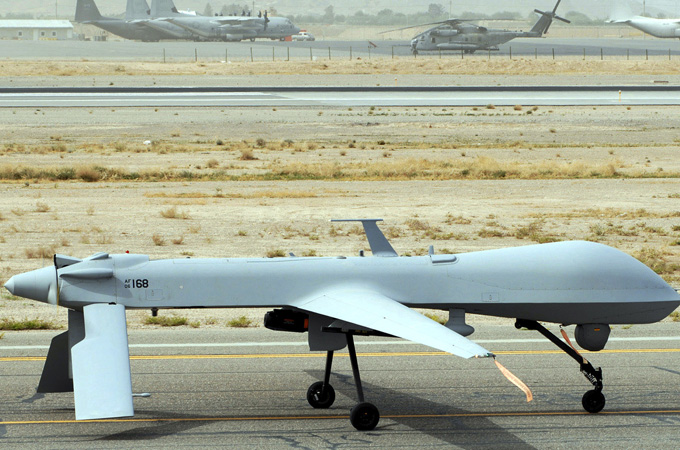
Drones: A deeply unsettling future


SEE ALJAZEERA: http://www.aljazeera.com/indepth/opinion/2011/12/201112774824829807.html

San Francisco, California - On Sunday, Iran claimed to have taken down a US drone in Iranian airspace - not by shooting it out the sky, but with its cyber warfare team.


Reports confirm that the US believes Iran is now in possession of "one of the more sensitive surveillance platforms in the CIA's fleet", but deny Iran's involvement. Of course, Iran’s claim of overtaking the drone with its cyber warfare team should be tempered with a serious dose of scepticism, as cyber security experts say the facts may not add up. But this is just the latest story in a series of incidents that raises worrying questions about security problems caused by drones. And given the coming proliferation of drone technology both domestically and abroad, this should be a concern to citizens all over the world.

Two years ago the Wall Street Journal reported Iran-funded militants in Iraq were able to hack into drones' live-video feeds with "$26 off-the-shelf software". In another unnerving incident, Wired reported in October that a fleet of the Air Force's drones was infected with a computer virus that captured all of drones' key strokes. Technicians continually deleted the virus to no avail. How did the drones get infected? The military is "not quite sure". Worse, the Air Force's cyber security team didn't even know about the virus until they read about it in Wired.

Wired reported in a separate story that an upcoming Congressional report will detail how hackers broke into the US satellite system. With one satellite, hackers "achieved all steps required to command" it, "but never actually exercised control".

Last summer, a drone caused a scene in the nation's capital, when, as New York Times wrote, "fighter jets were almost scrambled after a rogue Fire Scout drone, the size of a small helicopter, wandered into Washington's restricted airspace". A similar incident took place in Afghanistan where military planes had to shoot down a "runaway drone" when pilots lost control.

The US, of course, leads the world in drone use for both surveillance and combat missions. Attacks are carried out in Pakistan every four days on average. Many times, the US isn't even sure exactly who they are killing. Despite the fact that the location of vast majority of drone bases are classified, journalist Nick Turse pieced together a startling picture of the massive US fleet. He determined that the US has at least 60 drone bases operated by either the US military or the CIA around the world, and "most of these facilities have remained unnoted, uncounted, and remarkably anonymous - until now".

But drone use is not just relegated to US military. Drone manufacturers already command a $94bn market, according to some estimates, and the drone arms race is in full swing. As the Washington Post reported, the constant buzz of drones and threats of attack now dominates the lives of civilians in Gaza. And Turkey plans to have Predator drones in operation by June 2012.

Meanwhile, Chinese contractors unveiled 25 types of unmanned aircraft last year. In all, at least 50 countries now have some sort of unmanned aerial vehicles, and the New York Times reports that "the number is rising every month". That number also includes Iran, which is seeking to upgrade its fleet. Even the Libyan rebels had their own surveillance drone - provided to them by Canadian defence contractors - before they were in full control of their own country.

The technology itself is also developing at an alarmingly rapid pace. The New York Times reports that researchers in the US are working on "shrinking unmanned drones, the kind that fire missiles into Pakistan and spy on insurgents in Afghanistan, to the size of insects", along with oversized drones that can capture video of an entire city. There are birdlike drones, underwater drones, drones within drones, facial recognition drones, and perhaps most terrifying, completely autonomous drones - currently being tested in Georgia - which will require no human control at all.

As Micah Zenko, Senior Fellow at the Council on Foreign Relations, told me last month, "It's a very impressive and responsive tool that should be used sparingly. Even if we’re responsible now, we might not be forever."

But in the US, drones will become yet another way authorities can compromise the privacy of ordinary citizens, as the FAA plans to propose new rules for their domestic flight. As Newsweek reported, police forces and border patrols in the US are buying the technology from defence contractors, and one has already been spotted flying over Houston. Police departments are already using GPS and cell phone tracking without warrants, this will another powerful surveillance weapon in their arsenal. As privacy advocates warn, "drones can easily be equipped with facial recognition cameras, infrared cameras, or open Wi-Fi sniffers". And while these drones will be used for many surveillance purposes (a scary thought in and of itself), contractors admit they are equipped to carry weapons, such as Tasers.

Whether they are being used for surveillance or all-out combat, drones will soon pose serious risks for all of the world's citizens. They can offer governments, police departments, or private citizens unprecedented capabilities for spying, and given their security vulnerabilities, the potential consequences could be endless.

Thursday, December 8, 2011

Schmeisser MP 43


Hitler’s Germany was the leading country in the development of the assault rifle. Even the term "assault rifle", is no more than a translation of the German term Sturmgewehr,devised for propaganda reasons by no less than Hitler himself (or at least so the legend goes).

Germany began to develop intermediate cartridges during the mid-1930s. There were some developments in 7 mm and 7.75 mm calibre, but Heereswaffenamt (HWaA, or Department of Armaments), decided to retain the existing rifle calibre of 7.92 mm, to save money on new machinery that would otherwise be required to produce bullets and barrels of a non-standard calibre. The new 7.92 mm "short infantry cartridge" (Infanterie patrone Kurz), developed by the Polte Werke in 1938, was officially designated the 7.92 mm PP Kurz. It had metric dimensions of 7.92 x 33, considerably shorter and less powerful than the standard 7.92 x 57 rifle / MG cartridge, and propelled a 8.1 g (125 grain) bullet to roughly 680 meters per second.

MP 43 assault rifle, the first production variant of the Sturmgewehr, left side

In 1939 HWaA issued a contract for the development of a "Maschinenkarabiner", or machine carbine (MKb for short), chambered for the new Kurz cartridge, to the company C.G.Haenel Waffen und Fahrradfabrik. Initial development took place under the designation of MKb.42 - Maschinenkarabiner, 1942. The new weapon was intended as a replacement for submachine guns, bolt action rifles and, partly, light machineguns for front troops and was intended to have an effective range of 600 meters or so.

The famous designer Hugo Schmeisser led the Haenel development team, which produced the first working prototypes of new weapon by 1942, known as MKb.42(H). After extensive combat tests of the MKb.42(H), HWaA asked Haenel for several significant improvements over their initial design. Most notable was the request to replace the submachine-gun like open-bolt firing system with more convenient closed-bolt system, to improve single-shot accuracy. Schmeisserre designed the weapon accordingly, and by 1943 submitted the improved version to the HWaA. But by this time Hitler had ordered that only existing types should be developed and manufactured, and the Maschinenkarabiner was not on this list. To avoid this nuisance, the Germans decided simply to rename the MKb to the MP, or Machinen pistole (submachine gun), which was on the “approved” list. So, the new and improved weapon received the designation MP-43, and went into limited production and field trials at the front. During the following year, the MP-43 experienced several minor modifications, leading to MP-43/1 and MP-43/2 designations, but these differed only in details such as front sight bases and grenade launcher interfaces.

 MP 43 assault rifle, the first production variant of the Sturmgewehr, right side

In April 1944 the designation of all MP-43s was changed to MP-44, with no actual changes made to the design. At this time there were plenty of glowing reports from the German troops fighting with MP-43s and MP-44s at the Eastern front. Seeing these reports, Hitler finally approved the mass production and issue of the new “wunderwaffe”, and in December 1944 officially christened it the Sturmgewehr, or Assault Rifle, 1944 (StG.44) This was a pure act of propaganda, but the name stuck not only to that gun, but also to the whole new class of automatic weapons designed to fire intermediate cartridges.

The total number of MP-43s, MP-44s and StG.44s produced was about 450,000,and these guns proved very effective, but not without some flaws. After the end of the war the direct development of the Stg.44 was stopped, but the East German police used some remaining guns. Another major post-war user of Stg.44 was Yugoslavia; their paratroopers used it under the designation "Automat, padobranski, 7.9 mm M44, nemacki" until the early 1980s, when the Kalashnikov-type M64 and M70 rifles finally replaced it. Yugoslavia also produced 7.92 x 33 Kurz ammunition until the late 1970s.

Stg.44 assault rifle with the Krummlauf Vorsatz J (curved barrel) attachment, which was designed to be fired "around the corner" or from inside the armored vehicle

The StG.44 (like its earlier versions MP.43 and MP.44) is a gas operated, selective fire weapon. The receiver and trigger housing with pistol grip are made from steel stampings, with machined steel inserts. The trigger housing with pistol grip is hinged to the receiver and folds down for disassembly. The gas drive utilizes a long-stroke piston, and the bolt is tipped down to lock into the receiver. The gun is fired from a closed bolt. The MP-43 and subsequent versions all were hammer-fired, while the MKb.42(H) was striker-fired. The safety lever is located at the left side of the pistol grip unit, and a separate cross-bolt type of fire mode selector allows for single-shot and full auto fire. The charging handle is attached to the gas piston rod, and the ejection port has a dust cover. The recoil spring is located inside the wooden butt. At the top of the butt there is container for a cleaning kit, closed by the spring-loaded steel cover. The Stg.44 was provided with open, leaf-type sights, and could be fitted with telescope sights or a specially developed active infrared sighting unit, called “Vampir” (vampire).

The muzzle of the Stg.44 was threaded to accept a cup-like grenade launcher; a special muzzle nut usually covered the threads. The Stg.44 also could be fitted with a special curved barrel attachment (“Krummlauf”), which allowed the gun to be fired “around the corner” or from inside a tank, without exposing the shooter to the enemy fire. Several types of these attachments were developed, but only one type, the 30-degree “KrummlaufVorsatz J”, was apparently manufactured in any significant numbers. This device had a special mirror sighting adapter and reduced the bullet velocity down to mere 300 meters per second due to the high friction in the curved barrel extension. This apparently did not bother the German Army, since these curved barrel adapters were intended for short-range encounters only.

 MP 43 assault rifle partially disassembled

Caliber:7.92x33 mm (7.92mm Kurz)
Action: Gas operated, tilting bolt
Overalllength: 940 mm
Barrel length: 419 mm
Weigth: 5.22 kg
Rate of fire: 500 rounds per minute
Magazine capacity: 30 rounds
NANG THIS POST, NANG THIS POST, NANG THIS POST

LinkWithin

Related Posts with Thumbnails