Friday, March 22, 2013

Aeromarine 39 Trainer


The Aeromarine 39 was a two-seat plane for land-based or seaplane training ordered by the US Navy in 1917. The versatile aircraft was built by the Aeromarine Plane and Motor Company of Keyport, New Jersey. The design was a standard biplane configuration and construction. The aircraft was fabricated so the pontoons could be hastily detached and replaced with the supplied wheeled undercarriage for land or carrier operations. As time went on, fifty of the originally built designs were reassigned under the designation of 39A. The 39A models featured twin floats and the plane was powered by a Hall-Scott A-7 engine. The Hall-Scott A-7 was an early aircraft engine with a straight 4 configuration and could produce a maximum of 100 horsepower (75 kW). These engines suffered from consistency problems and many were prone to catch fire while in operation forcing the manufacturer to start using the Curtiss OXX powerplant. Other redesigns increased the wingspan for more lift needed for those water take-offs. This became known as the 39B. Additional changes included a single pontoon with outrigger floats, plus an enlarged vertical tail surface.

The Aeromarine 39 became the first American aircraft to land on a moving carrier in 1922.

On October 26, 1922 Lt.Cdr. G. deC.Chevalier, piloting an Aeromarine 39, circled the USS Langley as the ship was underway at 10 knots. Chevalier successfully landed his plane on the moving deck of the Langley. The first such landing on an American carrier.


Specifications for the Aeromarine 39A

Length: 30.35ft (9.25m)
Width: 46.98ft (14.32m)
Height: 14.76ft (4.50m)
Maximum Speed: 73mph (117kmh; 63kts)
Maximum Range: 273miles (439km)
Rate-of-Climb: 0ft/min (0m/min)
Service Ceiling: 8,202ft (2,500m; 1.6miles)

Empty Weight:1,940lbs (880kg)
Maximum Take-Off Weight:2,504lbs (1,136kg)
Engine(s): 1 x Hall Scott A-7 piston engine generating 100 horsepower.

Wednesday, March 13, 2013

Heavy Tank M103

The M103 was a mammoth tank design delivering armor protection and firepower at the expense of sheer size and speed. Stemming from the T43 trial version, the system evolved into the T43E1 which became the standardized M103. Main armament consisted of the heavy caliber rifled 120mm main gun mounted alongside a conventional 7.62mm coaxial mount in the turret. The commander was afforded a heavy caliber 12.7mm machine gun at his cupola, but this was externally mounted and classified as an air defense weapon. Ammunition supply for all guns was ample and five crew were required for optimal operation. Along with the driver and commander, there was the standard gunner along with two loaders.

With the Cold War in full bloom, design of heavy tanks for the United States Army increased in an effort to mimic the success of the World War Two / Korean War-era M26 Pershing Heavy Tank.

 
Despite the formidable array of arms, the system was dogged by reliability problems, a short road range and its sheer size. In the temperate and hilly terrain of Europe, the M103 faired below expectations. It's size alone made the system very difficult to conceal along the Cold War fronts throughout Europe. A new engine, bringing the road range from the measly 80 miles to over 300 miles was implemented in what would become the M103A2 but it was not meant to be. The M103 was dissolved from service with the United States Army in a few short years, bringing an end to the new generation of M103 Heavy Tank.


Thursday, February 28, 2013

Avtomat

Captain V. Fedorov of the Russian Imperial Army (later - a general of Soviet Army) started development of the self-loading rifle in 1906. His first rifle was chambered for standard Russian 7,62x54R ammunition, held 5 rounds in fixed magazine and fired only semi-automatically. In this job Fedorov was supported by his apprentice V.Degtyarov (who latter became one of most important Soviet small arms designers of pre-WW2 generation). Fedorov rifle entered trials in 1911. In 1912 the Rifle Commission of Russian Army decided to order 150 more Fedorov rifles for further trials, and in 1913 Fedorov submitted a prototype automatic rifle, chambered for his own experimental rimless cartridge of 6,5mm caliber. This new ammunition was more compact that Russian 7,62x54R, better suited for automatic weapons (because of rimless cartridge) and has less recoil. This experimental cartridge fired pointed jacketed bullet weighting 8,5 gram at initial velocity of 860 m/s(muzzle energy 3140 Joules as opposed to 3600 - 4000 Joules muzzle energy of 7,62x54R ammunition). 6,5mm Fedorov rifles were tested late in 1913 with good results; these rifles still had fixed magazines loaded from stripper clips.Further trials and development were stopped by the start of World War One. In 1915, however, the need for lightweight automatic arms forced Russian Army to order manufacture of Fedorov automatic rifles with detachable magazines of bigger capacity. Since production of the new cartridge was out of question, it was decided to convert 6,5mm Fedorov rifles to Japanese 6,5x50SR Arisaka ammunition which was in abundance, being purchased through Great Britain along with Arisaka rifles. The change of ammunition involved only minimal changes to the rifle, including chamber insert and new range scale for rear sights. In 1916 Weapons Committee of Russian Army decided that it is necessary to order at least 25 000 of Fedorov automatic rifles. In early 1918 orders for Fedorov rifle were limited to 9000 guns, but as result of turmoil of the revolution and following Civil war only 3 200 Fedorov rifles were manufactured in the city of Kovrov between 1920 and 1924, when production was finally stopped.

Fedorov "Avtomat" - the first practical assault rifle ever adopted

It is interesting that at the time of initial orders Russian Army considered Fedorov automatic rifles as substitute light machine guns; although in actual use Fedorov rifles were used as individual armament for infantry soldiers,exactly in the tactical niche of modern assault rifles. Fedorov automatic rifles served with Russian and later with Red (soviet) Army through WW1, Civil war and until late twenties, when it was decided to retire all rifles and machine guns that used non-standard (other than 7,62x54R) ammunition, and Fedorov rifles were put into reserve storage. The last conflict that saw action of Fedorov rifles was Winter war with Finland in 1940, when some Fedorov rifles were withdrawn from storage and issued to elite units of Red Army.

One important note must be made about the name of Fedorov rifle, which is universally known as "Avtomat" (automatic). This name was apparently devised by Russian small arms expert Blagonravov during mid- or late twenties. At the time, this term was used to designate any shoulder-fired automatic weapon, be that rifle or submachine gun. Up until now "avtomat" is unofficial Russian term for automatic weapon. Today this term is most often used for weapons, generally known as "assault rifles", and therefore Fedorov's "Avtomat" can be considered as one of the world's first practical assault rifles. At the time of its peak usage (1918-1924) there was only one practical automatic rifle made in the world which fell into same tactical class - the Browning's BAR M1918. Initially Bar was intended to be used as assault rifle, with individual soldiers firing itfrom the shoulder or hip during assaults on enemy trenches; however, Browning's rifle was almost twice as powerful (comparing muzzle energy of US .30-06ammunition used in BAR and 6,5x50SR used in Avtomat) and exactly twice as heavy compared to Fedorov's rifle. Therefore BAR soon evolved into light machine gun,while Avtomat set the pattern for the whole new class of infantry weapons, which rose to its heights during late stages of WW2 and especially afterwards.

Fedorov "Avtomat" action, removed from the wooden stock. Note that barrel is in full recoil position and locking plates are lowered and bolt isunlocked (right locking plate is visible in front of the round cocking handleknob).

Finally, we shall note that Fedorov's Avtomat was not without flaws. Its recoil-operated action was sensitive to fouling; early production guns suffered from non-interchangeability of parts, including magazines; disassembly and especially re-assembly was somewhat complicated. Despite these flaws, it was a formidable and historically important weapon, and, ironically, its ballistic properties are very close to modern idea of "ideal" assault rifle and its ammunition.

Diagram showing the locking action of Fedorov avtomat. Top - bolt is locked tothe barrel, bottom - barrel is in full recoil, bolt unlocked and partiallyopened
Parts are numbered as follows: 1 - barrel; 2 - bolt; 3 - locking lug (one of two);4 - fixed lug in receiver.

Fedorov's "Avtomat" is short recoil operated, locked breech weapon which fires from closed bolt. The bolt locking is achieved by two locking plates, located at either side of the breech. Those plates are allowed to tilt slightly down and up, locking and unlocking the bolt with special lugs.The barrel is fluted to save the weight and improve cooling. Trigger unit uses a pivoting hammer to fire, and separate manual safety and fire selector levers are installed within the trigger guard. The stock is made from wood, with semi-pistol grip and additional vertical fore grip in the front of the magazine.The curved box magazine held 25 rounds in two rows, and was detachable. A special bayonet was attached to the front of the steel heat-shield below the barrel. Standard open sights with tangent rear were installed on the barrel.

Caliber: 6,5x50SR Arisaka
Action: short recoil operated
Overall length: 1045 mm
Barrel length: 520 mm
Weight: 4,4 kg empty
Rate of fire: 600 rounds per minute
Magazine capacity: 25 rounds

Wednesday, February 13, 2013

Antonov An-2 multi-role light utility biplane

The Antonov An-2 is a multi-role light utility biplane initially produced under the Soviet flag. Despite its 1940's pedigree, the system has continued service and operations throughout the world and production itself has totaled over 18,000 examples as of this writing. The An-2 goes under the NATO codename of "Colt" and is designated in US DoD nomenclature as the "Type 22". The Soviet Union/Russia, Poland and China have all lent a hand in production of local base and specialized variants. Operators are numerous and range from those with military service to those with civilian-minded needs.


The Antonov An-2 Colt biplane was developed to replace the Polikarpov Po-2 in the utility and agricultural roles.

The engine - powering a four-bladed propeller - is held in the extreme forward of the fuselage to which the cockpit is situated directly aft. The cockpit is heavily glazed and observation port windows can be seen along the fuselage sides. The wing arrangement on this aircraft is of a sesquiplane (uneven span) biplane assembly with the top wing noticeably wider than the lower element. Each wing is connected via a single large vertical strut making up a single wing bay and each wing system showcases dihedral (upward angle). The fuselage tapers slightly into the empennage to which is affixed a single large, smooth-edge vertical tail fin and its applicable stabilizers mounted to either tail fin side. Like other aircraft of this classification, the An-2 sports a pair of fixed landing gear legs complimented by a smaller tail wheel. The main landing gear legs feature wheel bogies decidedly angled inwards with each leg braced at two points along the underside of the fuselage. Power is supplied from a single Shvetsov ASh-62IR 9-cylinder, supercharged radial piston engine of 1,000 horsepower. Maximum speed is a reported 160 miles per hour with a listed range of 525 miles and a service ceiling equal to 14,750 feet.
Externally, the An-2 shares many similarities with other light aircraft of this class.


Accommodations are generally made for a crew of one pilot but an observer/co-pilot is preferred. Cabin seating can hold an additional 12 passengers.


Beyond the typical prototype and evaluation models, the Soviet Union/Russia has produced the majority of the existing An-2 variants while Poland contributed as well.


Produced types ranged from basic observation and reconnaissance aircraft to specialized floatplanes, artillery observation, mail carrier, cargo transport, VTOL-minded projects, survey and photographic platforms, fire bombers and firefighters, research and VIP transports. Agricultural versions have seen extended use in for both Poland and China.


China has produced many versions of the An-2 beginning with the Fong Shou-2 ("Harvester-2").


This was the first An-2 built to agricultural specifications. The Nanchang Y-5 is a transport version since taken over in production by Harbin with 727 examples delivered. Nanchang Y-5II was an agricultural form seeing production number 229. Shijiazhuang Y-5A was a light passenger model based on the An-2T and produced in 114 examples. The agricultural derivative became the Shijiazhuang Y-5B based on the An-2 SKh. The PLAAF makes use of the Shijiazhuang Y-5B(T) para-drop model. The Nanchang Y-5C is an amphibious version of the Y-5A while the Nanchang Y-5D is a bomber crew trainer. The Nanchang Y-5K became a VIP passenger transport seating five.


Notable operators of the An-2 include (or have included) Afghanistan, China, Cuba, East Germany (and Germany proper), Egypt, Georgia, Hungary, Iraq, Laos, Lithuania, Macedonia, North Yemen, North Korea, Poland, South Korea, Romania, Russia, Serbia, Somalia, Sudan, Syria, Turkey, Ukraine, Vietnam, Yemen and Yugoslavia.


Despite its fragile appearance, the Antonov An-2 has seen its fair share of combat action.


It was debuted in such a manner during the Korean War (1950-1953) and later in the Vietnam War - the latter by the North Vietnamese. Some An-2's were converted from their traditional crop dusting roles to become make-shift bombers in the Croatian War of Independence (1991).


Specifications for the Antonov An-2 (Colt)
Dimensions:
Length: 40.68ft (12.40m)
Width: 59.71ft (18.20m)
Height: 13.45ft (4.10m)
Performance:
Max Speed: 160mph (258kmh; 139kts)
Max Range: 525miles (845km)
Rate-of-Climb: 700ft/min (213m/min)
Service Ceiling: 14,764ft (4,500m; 2.8miles)

Structure:
Accommodation: 2 + 12
Hardpoints: 0
Empty Weight: 7,275lbs (3,300kg)
MTOW: 12,125lbs (5,500kg)
Powerplant:
Engine(s): 1 x Shvetsov ASh-62IR 9-cylinder supercharged radial piston engine delivering up to 1,000 horsepower.
Armament Suite:
Usually none.

Some may be fitted with defensive machine guns. Crews may carry individual weapons while other An-2s modified for dropping bombs as needed.


Wednesday, February 6, 2013

D 20

The M1955 was developed in the 1950s to late to be deployed in the Great Patriotic War 1939-1945. However this howitzer has shown reliability and power in numerous wars deployed by scores of nations. The Soviet Union design bureau awarded the contract to Petrov Artillery and the M1955 was built in Yekaterinburg a city in central Russia used in WW II to relocate many heavy factories and many stayed after the war.

The D-20 can be towed by a variety of tracked and wheeled vehicles.

The D 20 was placed on an existing carriage used by the D 74 and was a common practice used by the Soviets. The gun proved to be well designed and rugged enough during field trails. An 8 man crew was needed to man the howitzer an AT-S medium tractor was used for towing along with the URAL-375 6x6 heavy truck. The Russian government still uses the M1955/D20 and still field about 1,000 guns in their arsenal. An initiative development was a semiautomatic vertical sliding wedge breech block.

The major copy was from The Peoples Republic of China that produced the Type 66. This variant has been shipped all around the globe. Type 66 was made with few changes making most Soviet parts interchangeable along with using all types of 152 mm ammunition. The barrel was 5.195 m (17ft 0.5 in) long using a double baffle muzzle to reduce the recoil. A shield was mounted to protect the breach and recoil mechanism. The crew also was protected to some degree. A firing pedestal was lowered to the grown before firing and the split tail carriage was also rested on the pedestal, this allowed a full 360 degrees traverse.

The main projectile used by the howitzer was the HE-FRAG that weighted 95.92 lbs which led to the sustained rate of fire to 1 rpm. Special types included an AP shell 107.54 kg that would penetrate 124 mm (4.88 in) of armor at 1,000 m (1,095 yards). Smoke and illuminating projectiles are available along with a shell contained flechettes for use against infantry and another that spread anti personnel mines in flight.

A rate of 5 to 6 rounds-per-minute can be achieved with 1 round-per-minute in the sustained firing role. Range for an HE-FRAG projectile is reported at 19,040 yards while a rocket-assisted projectile can land within 26,245 yards. Elevation of the barrel is -5 degrees to +65 degrees with a traverse of 58 degrees.

Specifications for the D-20 (M1955)


Overall Length: 26.57ft (8.10m)
Width: 7.71ft (2.35m)
Height: 8.27ft (2.52m)
Weight: 6.3 US Short Tons (5,700kg; 12,566lbs)

Armament Suite: 1 x 152mm Main Gun

Ammunition: Varies. Typical 152mm ammunition type is Frag-HE, OF32.

Wednesday, January 9, 2013

Kalashnikov AK-101, AK-102, AK-103, AK-104, AK-105, AK-107 and AK-108 assault rifles

AK-101

Kalashnikov AK-101 assault rifle with 40mm GP-30 under barrel grenade launcher


The AK-101 assault rifle is an export version of the 5.45mm Kalashnikov AK-74M assault rifle. The main difference between AK-101 and AK-74M is in ammunition used - the AK-101 is chambered for 5.56x45mm NATO ammunition. Otherwise it is basically the same as the AK-74M, which is current standard issue rifle of the Russian army.

Caliber: 5.56x45 mm NATO
Action: Gas operated, rotating bolt with 2 lugs
Length, mm: overall: 943; w/folded stock: 700;
Barrel length: 415 mm
Weight: 3.4 kg empty
Rate of fire: 600 rounds per minute
Magazine capacity: 30 rounds


AK-103


The Kalashnikov AK-103 assault rifle is a modification of the current Russian standard issue AK-74M rifle for older 7.62x39mm ammunition. It is primary intended for export, although it is believed that few AK-103 are in use by various Russian special Law Enforcement groups, which prefer 7.62mm over 5.45mmfor its better stopping power. So far the biggest buyer for AK-103 assault rifles was the Venezuela, which in 2006 bought 100,000 AK-103 rifles and intent to purchase the manufacturing license and necessary equipment for domestic production of this weapon.

The AK-103 is technically similar to AK-74M except for caliber and magazines used; any 7.62mm AK / AKM type magazine can be used in AK-103, but rifles now are issued with new production 30-round magazines made of black polymer.

Caliber: 7.62x39 M43
Action: Gas operated, rotating bolt with 2 lugs
Length, mm: overall: 943; w/folded butt 700;
Barrel Length, mm: 415
Weight: 3.4 kg empty
Magazine capacity, 30 rounds
Rate of fire: 600 rounds per minute


AK-107 and AK-108

Modified AK-107 assault rifle, as displayed in 2011. Note new top cover with integral Picatinny rail. Night sight is installed


During 1960s and 1970s Soviet gun designers tried several approaches to improve hit probability of the standard infantry rifle, when firing in bursts / full automatic mode (which is primary mode of fire for ordinary infantry troops as per Soviet and Russian field manuals and practice). One of such approaches is known as a “balanced action”. First developed during late 1960s by designers Alexandrov and Paranin in Izhevsk, and by Tkachev in Klimovsk, this system used a counter-mass to compensate the recoil impulse, generated by massive bolt group, slamming against the receiver in its rearmost and forward most position during the reloading cycle. The counter-mass is linked with second gas piston and moves in opposite direction to bolt group. Synchronization is achieved using a simple rack and pinion system. In this system, only the impulse of the fired cartridge is transferred to the receiver, and through the buttstock to the shoulder of the shooter. The impulses of the heavy and fast-moving bolt group are compensated by the counter-mass, and do not affect the shooting, unlike the AK where the moving bolt group produces a lot of additional recoil and vibration. The “balanced system” was employed in the AKB rifle, developed by V.M. Kalashnikov (son of the famous Mikhail Kalashnikov) in Izhevsk, and in the AEK-971 rifle, developed in Kovrov, both unsuccessfully tested during "Abakan" trials of late 1980s.

AK-107 assault rifle

Despite the failure of both designs in the army trials, development was continued, with intention to produce weapons superior (in full automatic fire mode) to standard AK-74 for domestic police use and export. The Izhevsk entry, initially known as AKB, evolved into the AK-107 and AK-108 rifles, which differed only by the ammunition used - AK-107 was intended for domestic use and thus chambered for 5.45x39 ammunition, while AK-108 was intended for export and thus chambered for 5.56x45 NATO ammunition. Both weapons were widely advertised through late 1990s and early 2000s, although it appears that no significant orders were ever received by the IzhMash factory.

Illustration of the balanced action, with dual, counter-moving gas pistons above the barrel

AK-107 assault rifle, disassembled

The AK-107 assault rifle is gas operated weapon with balanced action. It employs fairy conventional rotary bolt with dual locking lugs which is operated by long-stroke gas piston located above the barrel. To provide balancing action, second gas piston is fitted in the front of the first one. When gun is fired, main gas piston moves rearwards, operating the bolt group, while balancing piston moves in opposite direction, being synchronised to the main one via simple rack and pinion system. In all other respects the AK-107 is quite similar to the standard AK-74M assault rifle, except that AK-107 / 108 were also offered with optional 3-round burst firing capability.

Close-up view on the receiver and controls of the modified AK-107 rifle. Note four-position safety / selector lever

In 2011 IZHMASh has displayed an improved version of the AK-107, with apparent intent to offer it as a replacement for AK-74M assault rifles. Major improvements include new top cover with integral Picatinny rail and new rear sight, which is now of aperture (diopter) type.

New diopter-type rear sight of the improved AK-107 rifle

Caliber: 5.45x39mm (5,56x45NATO for AK108)
Action: Gas operated, rotating bolt with 2 lugs, balanced bolt-carrier/bolt group to reduce recoil jumping
Length: 943 / 700 mm
Barrel lenght: 415 mm
Sighting range,m: 1000
Weigth: 3.8 kg empty
Magazine capacity: 30 rounds
Rate of fire: 850 (900 for AK108) rounds per minute


AK-102, AK-104 and AK-105

5.56mm Kalashnikov AK-102 assault rifle (AK-105 looks exactly the same)

The AK-102, AK-104 and AK-105 rifles are essentially similar to one another, being different only in the caliber and type of magazine used. All three are 'compact' versions of the 5.56mm AK-101, 7.62mm AK-103 and 5.45mm AK-74M, respectively. The main visible differences between those 'Hundredth series compact assault rifles' and earlier 5.45mm AKS-74U compact assault rifle are that 'Hundred series' rifles use somewhat longer barrels and full length gas pistons, as opposed to shorter AKS-74U, and solid, side-folding polymer stocks. In fact, other than shorter barrels with special muzzle devices (flash / blast reducers) those compact rifles are similar in details to their respective full-size variants.
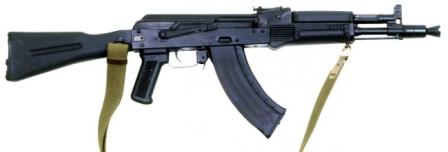
7.62mm Kalashnikov AK-104 assault rifle

Caliber: AK-102 5.56x45 mm NATO; AK-104 7.62x39 M43; AK-105 5.45x39 M74
Action: Gas operated, rotating bolt with 2 lugs
Length, mm: overall: 824; w/folded butt 586
Barrel Length, mm: 314
Weight, 3.0 kg empty
Magazine capacity: 30 rounds
Rate of fire: 600 rounds per minute


Friday, January 4, 2013

Aichi E13A

Based on number alone, the Aichi production E13A series of floatplanes (dubbed "Jake" by the Allies) was the most important such aircraft type for the Japanese Navy during the Second World War. The system was fielded in quantity in the early 1940's and were charged with reconnoitering the American Navy based at Pearl Harbor, Hawaii, prior to the infamous December 7th attack. A tremendous design with durability and endurance to boot, the E13A would serve through the end of the war, notoriously in Kamikaze attacks on advancing American naval convoys.

The Aichi E13A Jake became the most important floatplane for the Japanese Navy in World War Two.

The E13A was a three-crew low-monoplane aircraft with pontoons fitted in place of traditional landing gear systems. The initial need for the floatplane stemmed from a Japanese naval requirement for a new floatplane to replace the aging Kawanishi E7K2 series. As such, offers to the Aichi, Kawanishi and Nakajima aircraft firms were made to promote a competitive trial. At the end, only a Aichi and Kawanishi design remained, with the Aichi design getting the go ahead. A prototype was then produced and ordered into production after 1940.

Though limited in number at first, the E13A series made some initial carrier-based land-strikes and reconnaissance missions that promoted the use of this aircraft type. As such, the floatplane would be fielded regularly with future cruiser groups and mounted to catapults on Japanese battleships. Standard armament would consist of 1 x 20mm downward-firing cannon and a single 7.7mm machine gun in the rear cockpit. External stores were limited to a single 551lb bomb or depth charge as needed.

Aichi "Jakes" were utilized more importantly for their reconnaissance initiative than their strike capability (limited as they were in that respect). Reconnoiter missions would include the scouting of Pearl Harbor and the famous miscommunication reconnoiter mission for American battle groups in the early rounds of the Battle of Midway, leaving many carrier-based attack aircraft ready for action on the Japanese carrier decks, but waiting for the reconnaissance reports to come in.

The Aichi E13A would serve through to the end of the war, though limited with each passing month by the power of the new generation of American carrier-based fighters and the ever-advancing American forces. "Jakes", as other aircraft of this type, would later be relegated to Kamikaze attacks on American ships in the hopes of damaging psyche and disrupting supplies and combat capabilities. In the end, the masterful aircraft would be highly regarded as the best floatplane that Japan could field and the 1,418 such production models would attest to that.

Specifications for the Aichi E13A1a (Jake)
Dimensions:
Length: 37.07ft (11.3m)
Width: 47.57ft (14.50m)
Height: 15.42ft (4.70m)


Performance:
Maximum Speed: 234mph (377kmh; 204kts)
Maximum Range: 1,298miles (2,089km)
Rate-of-Climb: 0ft/min (0m/min)
Service Ceiling: 28,642ft (8,730m; 5.4miles)


Armament Suite:
1 x 20mm cannon (in downward-firing ventral position)
1 x 7.7mm machine gun (in rear cockpit position)

Maximum external bomb loadout (bombs or depth charges) of 551 lbs.
Structure:
Accommodation: 3
Hardpoints: 1
Empty Weight:5,825lbs (2,642kg)
Maximum Take-Off Weight:8,818lbs (4,000kg)


Powerplant:
Engine(s): 1 x Mitsubishi Kinsei 43 14-cylinder radial piston engine generating 1,080hp.


NANG THIS POST, NANG THIS POST, NANG THIS POST

LinkWithin

Related Posts with Thumbnails